HUG ME MOMMY I FEAR THE MOTH MAN ATE MY FRENULUM

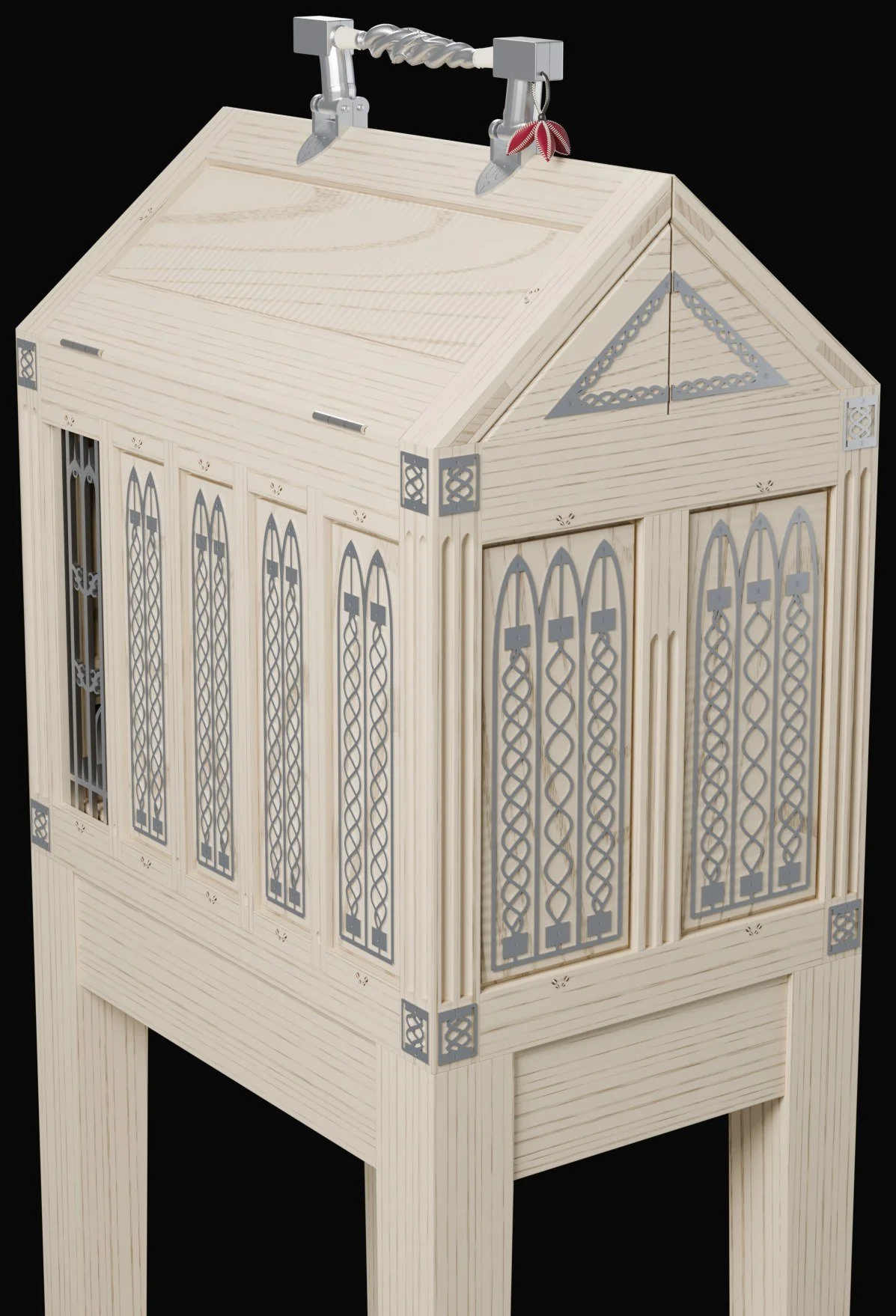
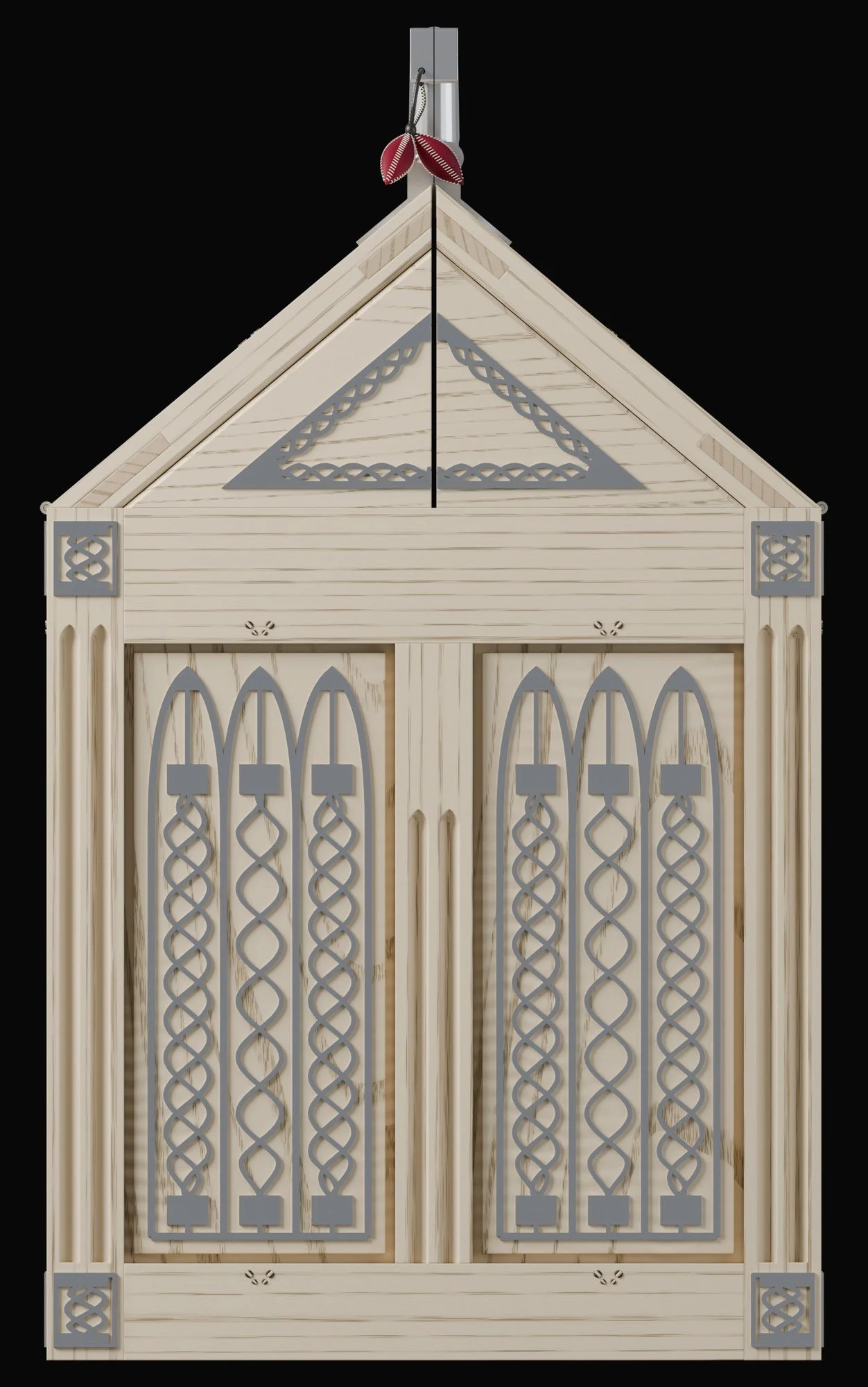
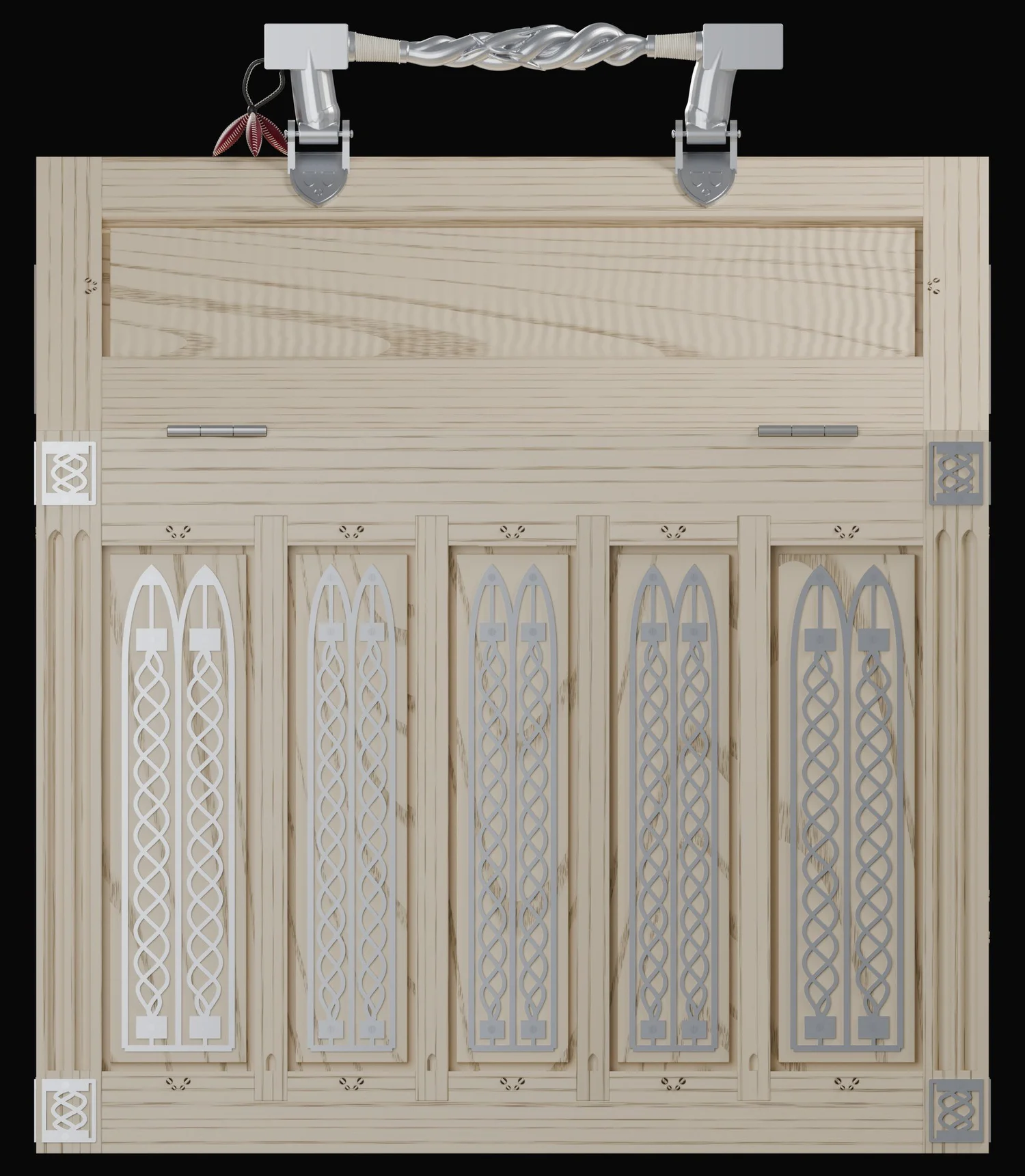
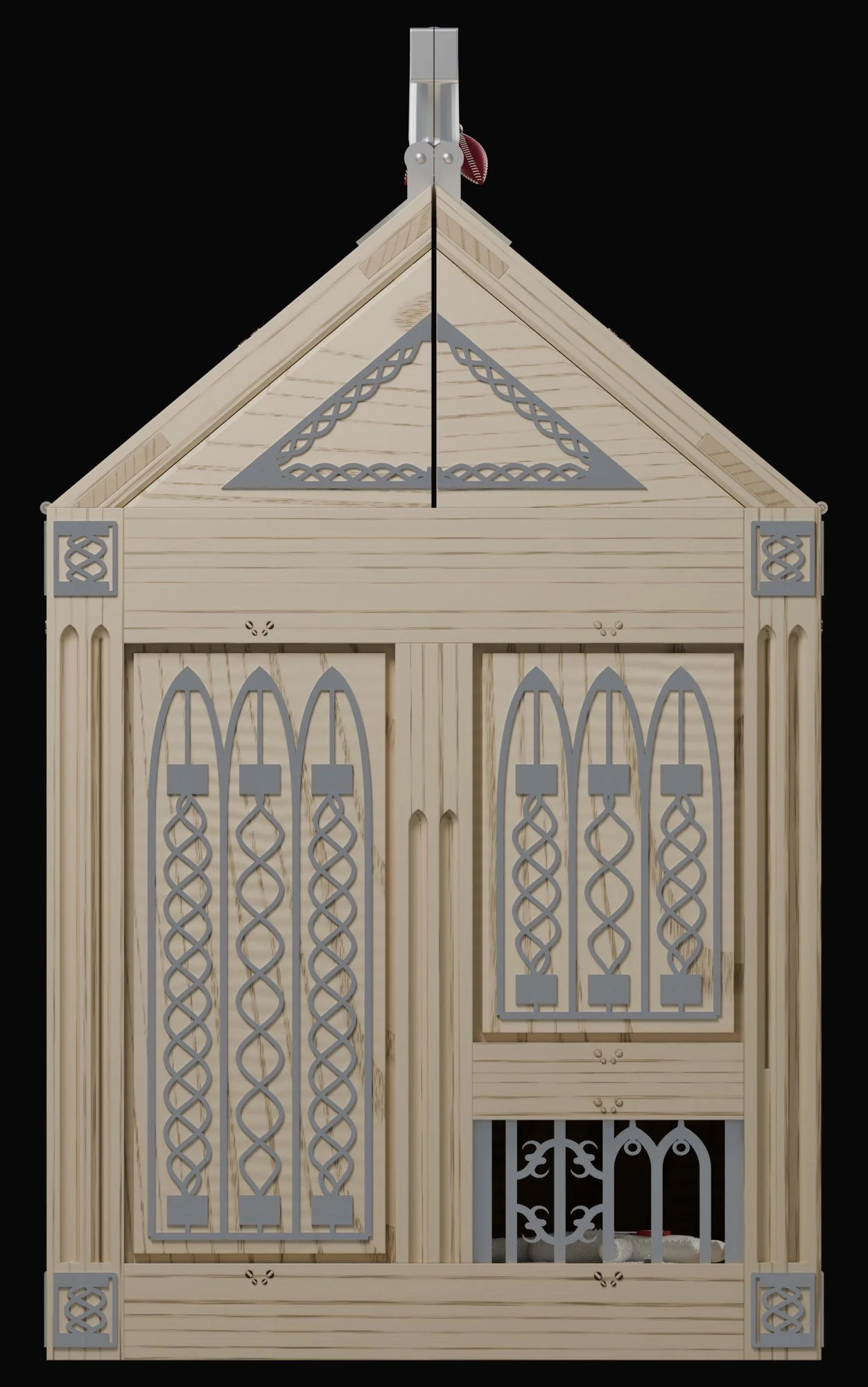
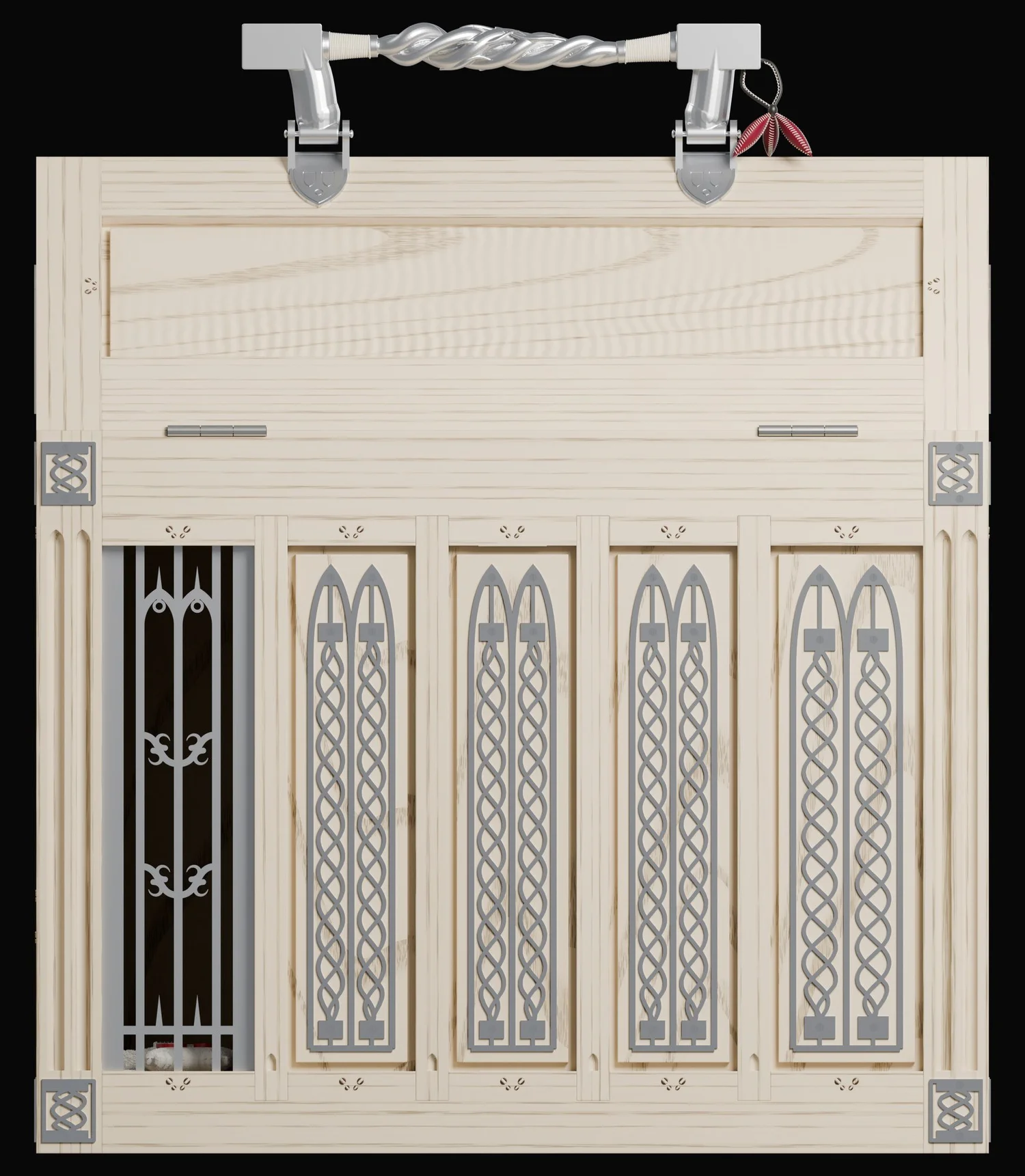
A gable-roofed toolbox case in raw white ash, built to hold ten caskets of instruments for the Moth Doctor. The roof splits on the ridge and opens on stainless eave hinges. Walnut pins set out as a moth’s four eyespots hold every panel, and in one back corner a jail of laser-cut stainless bars keeps a small white monster on the case floor.
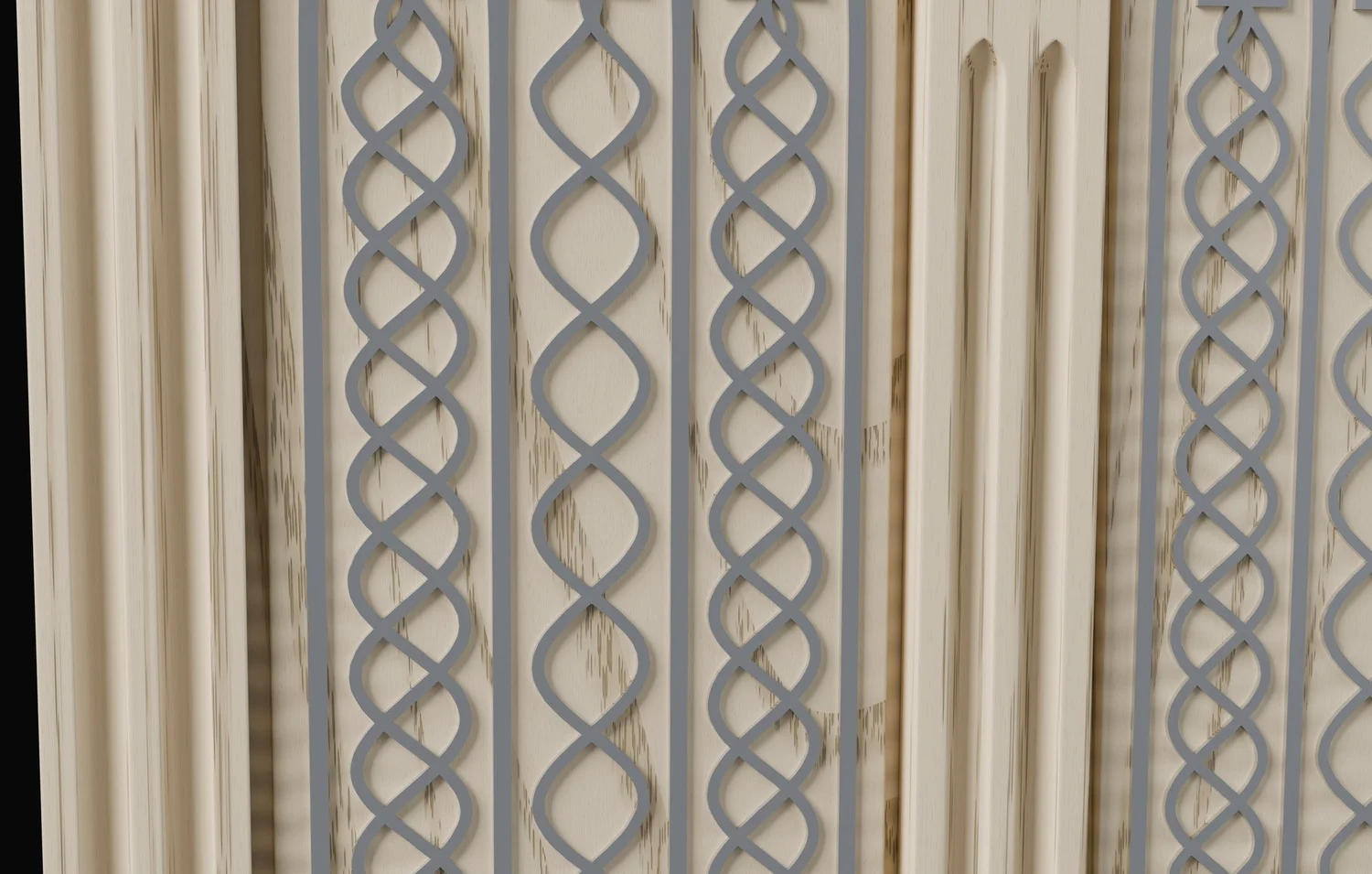
The case stands on a tall ash stand with a hidden tray beneath it, 59 1/2 in to the ridge. Laser-cut stainless is inlaid flush into every panel and both gables, screwed down with slotted flat heads.

Thirty instruments from the ten caskets, and the monster from the jail
The stand
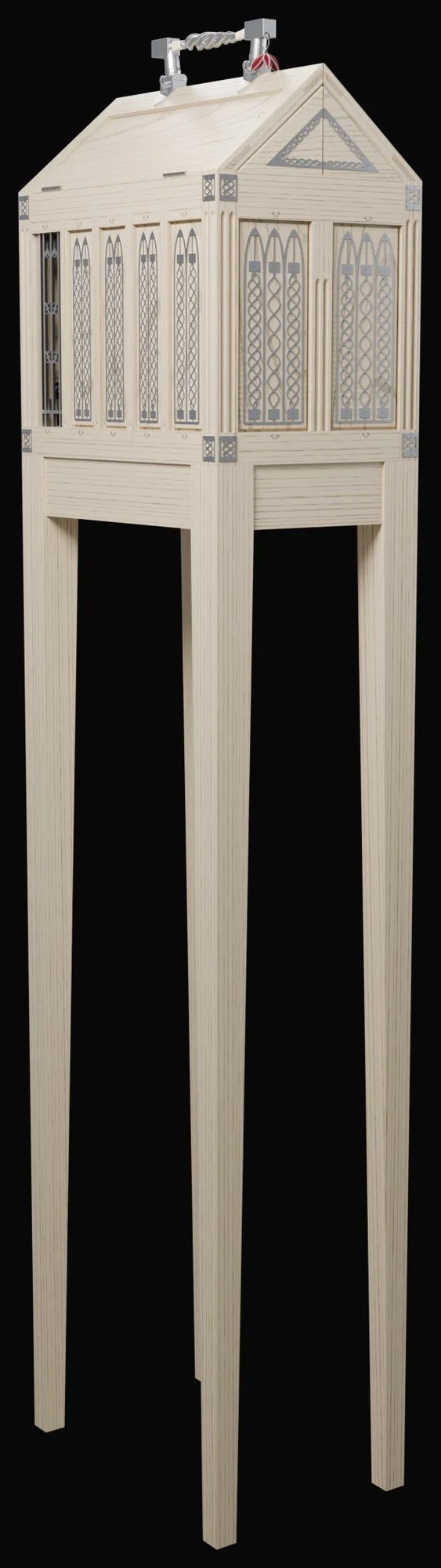
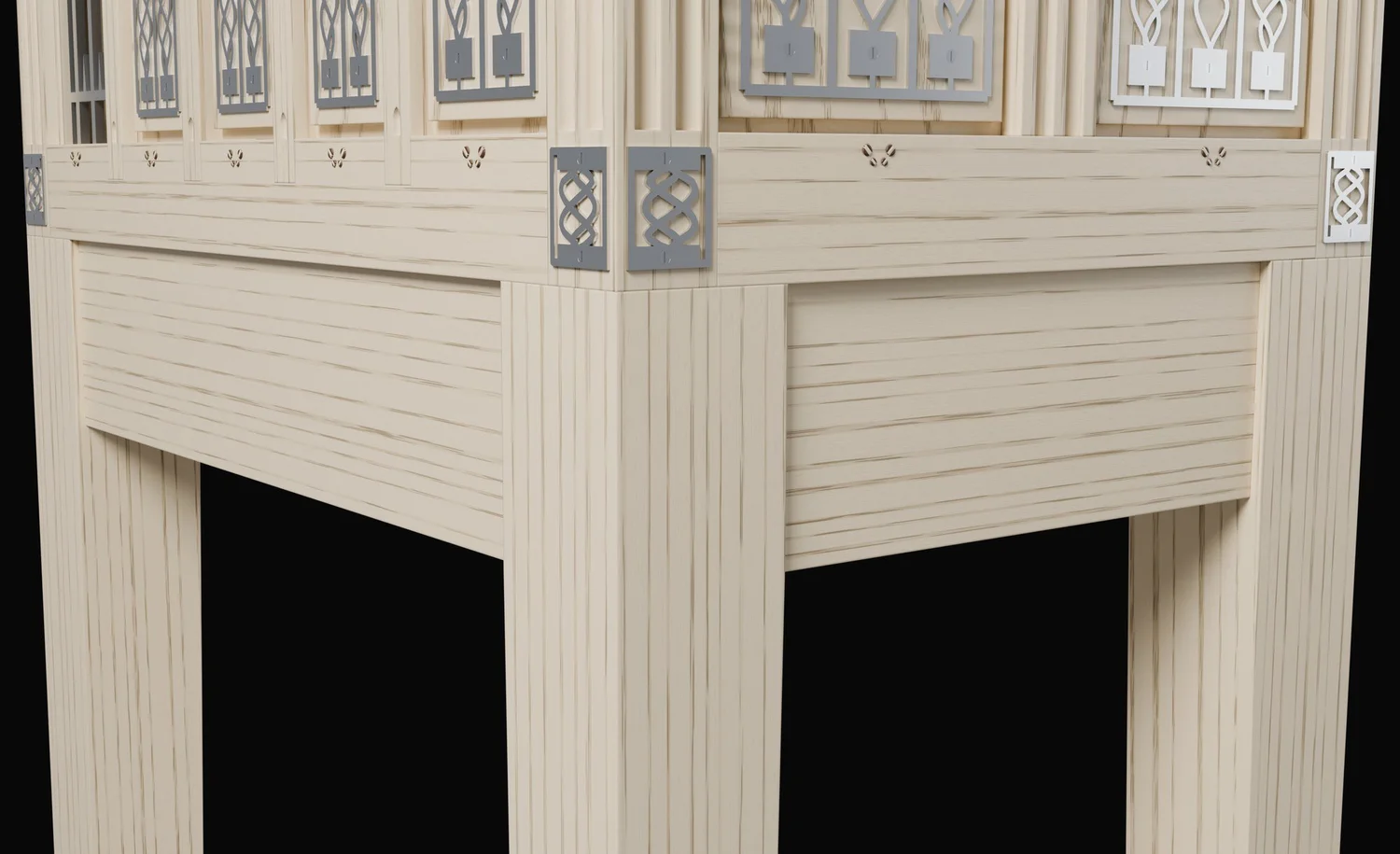
The case rides on a tall ash stand, just under 59 1/2 in to the ridge, two and a half times the height of the case. The stand is a tray: its lid is the floor the case sits on, and under it is a hidden well. Two ash T-keys lock the case down.
- To the ridge
- 59 7/16 in
- To the handle
- 61 5/16 in
- Stand, floor to tray lid
- 44 1/4 in
- Case body, tray lid to eave
- 11 in
- Roof rise
- 4 3/16 in at 40°
- Footprint
- 10 × 14 1/2 in
- Legs
- 1 3/4 in square, tapering to 1 in
- Aprons
- 3/4 × 2 1/2 in, set back 1/8 in
- Tray bottom
- 3/8 in ash, in a 3/8 in rabbet
The Body
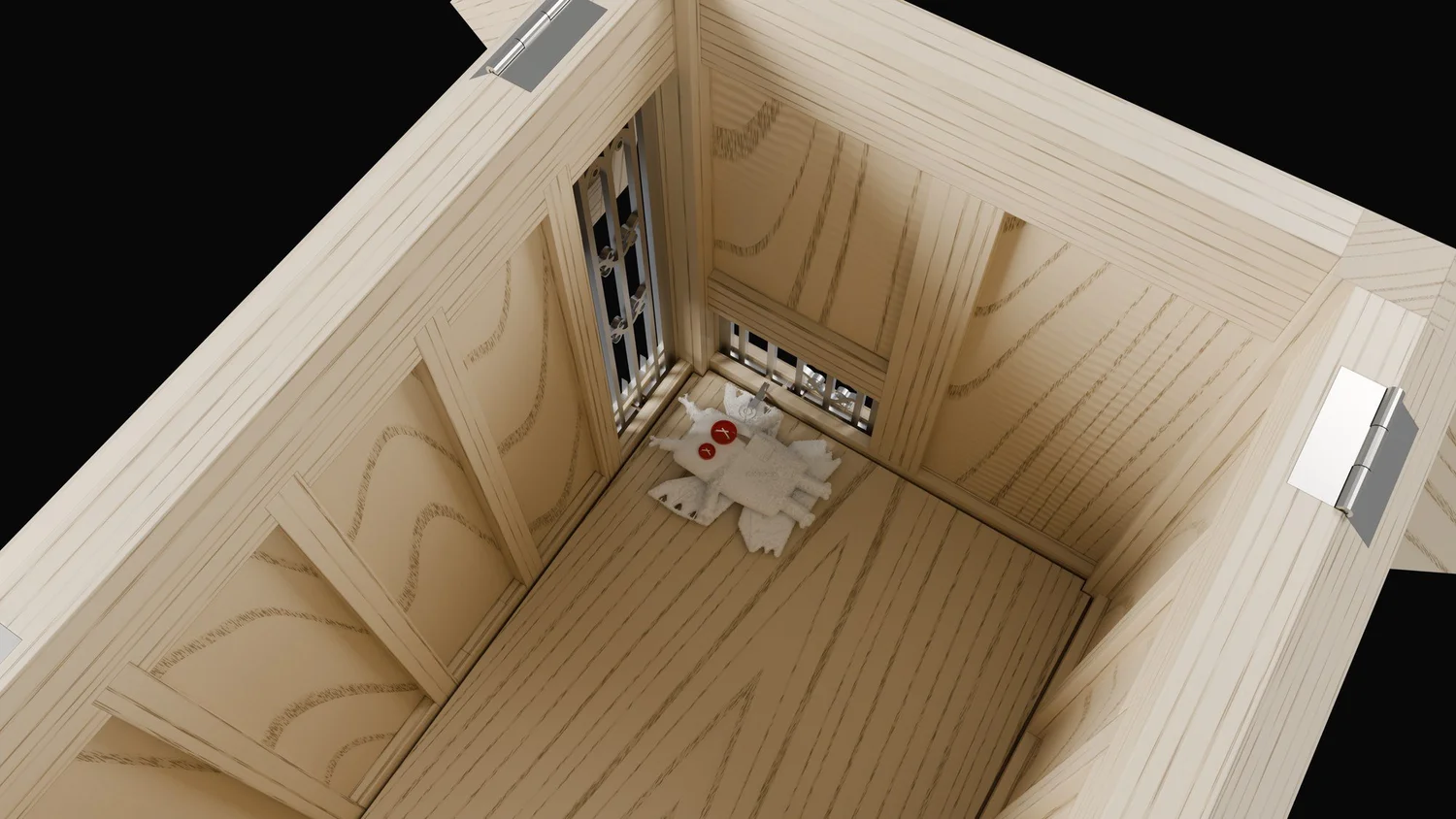
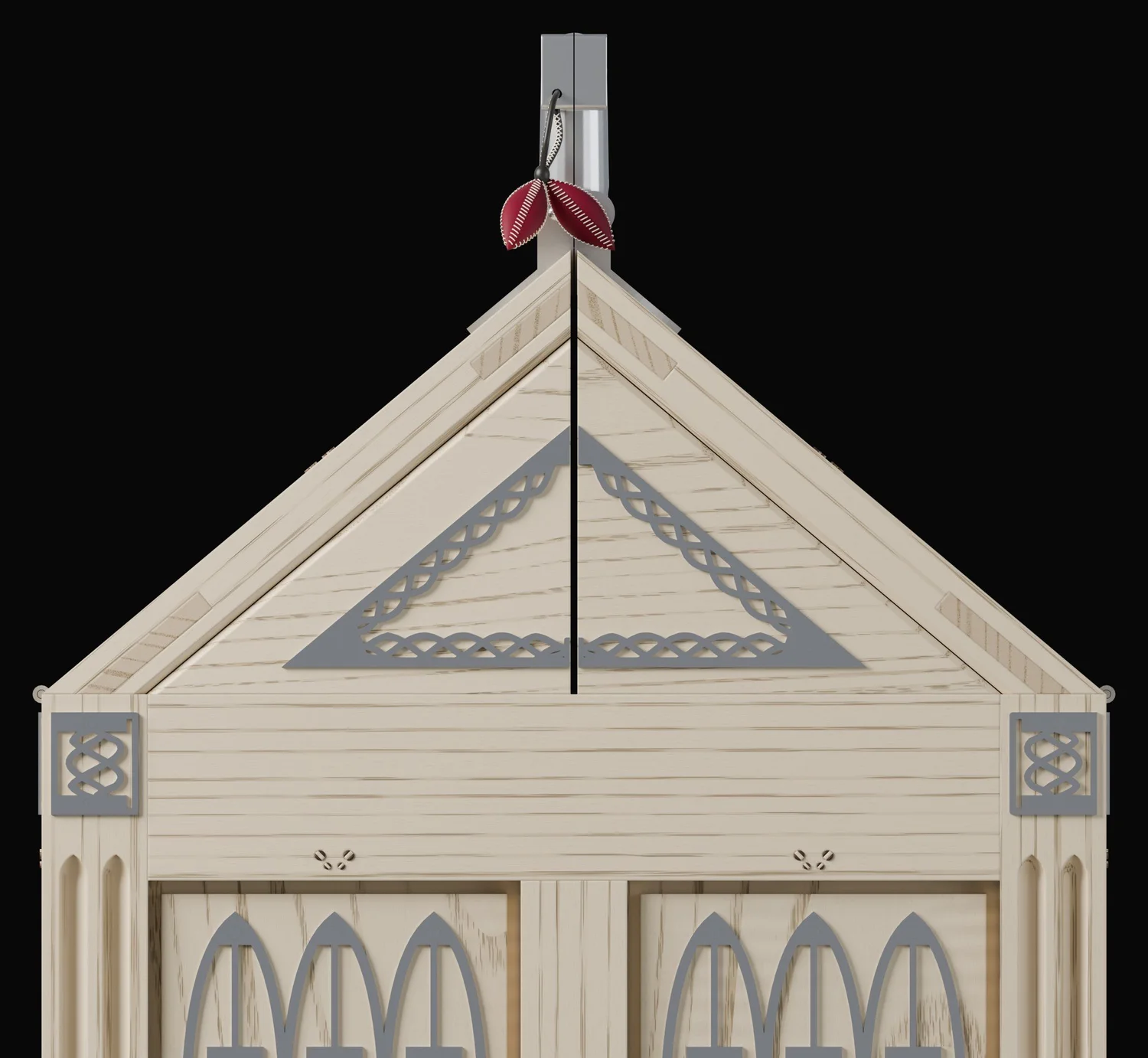
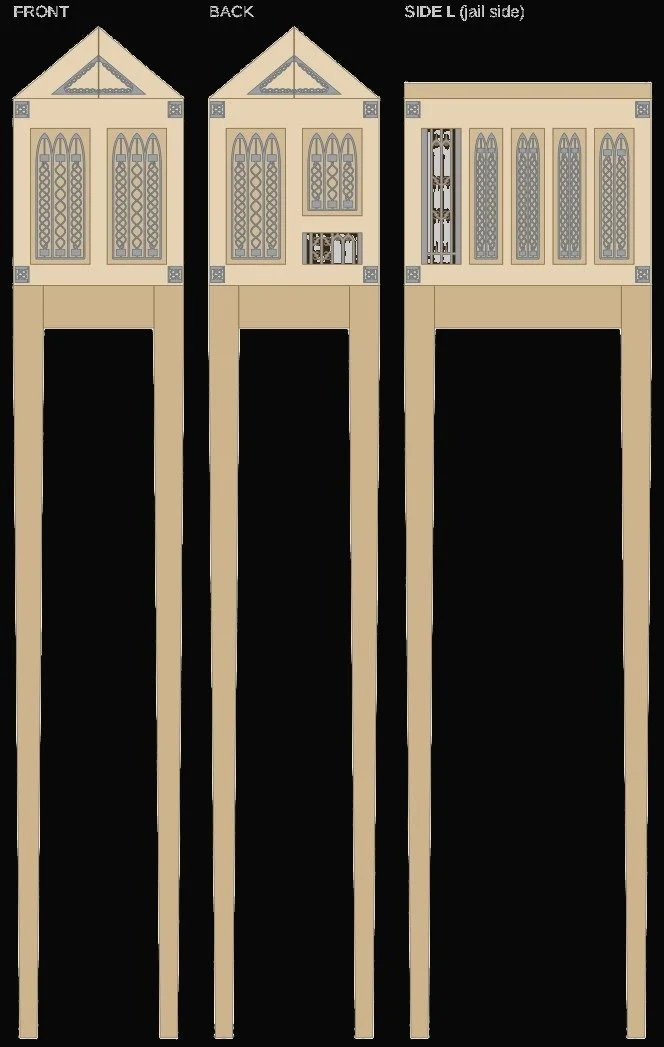
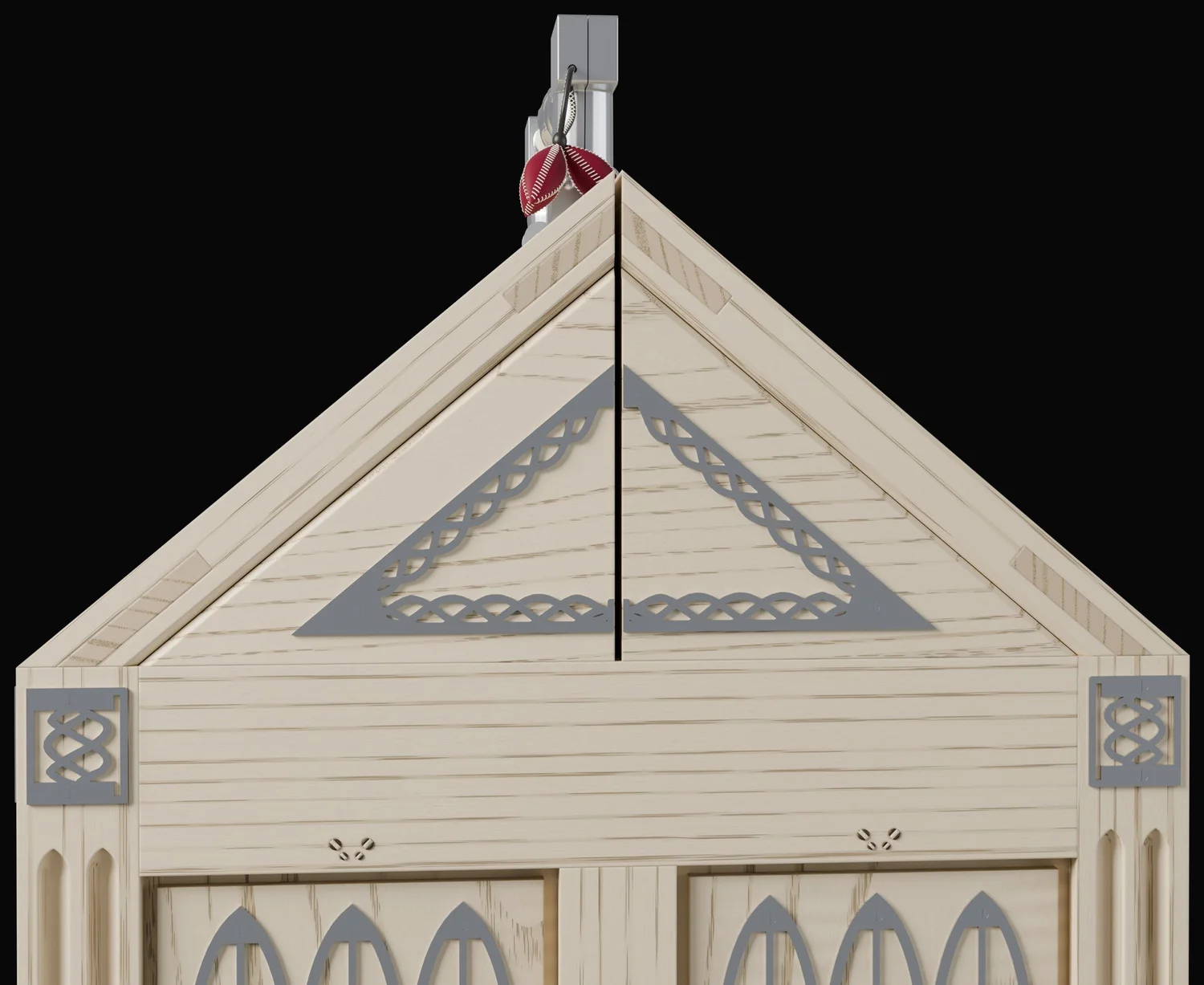
The case itself is a gable-roofed box in raw white ash. The roof splits on the ridge and both halves swing back on stainless eave hinges, so the whole top folds open onto the ten caskets inside. Laser-cut stainless sits flush in every panel and both gables, walnut pins mark a moth’s four eyespots on each side, and the back corner holds the jail.
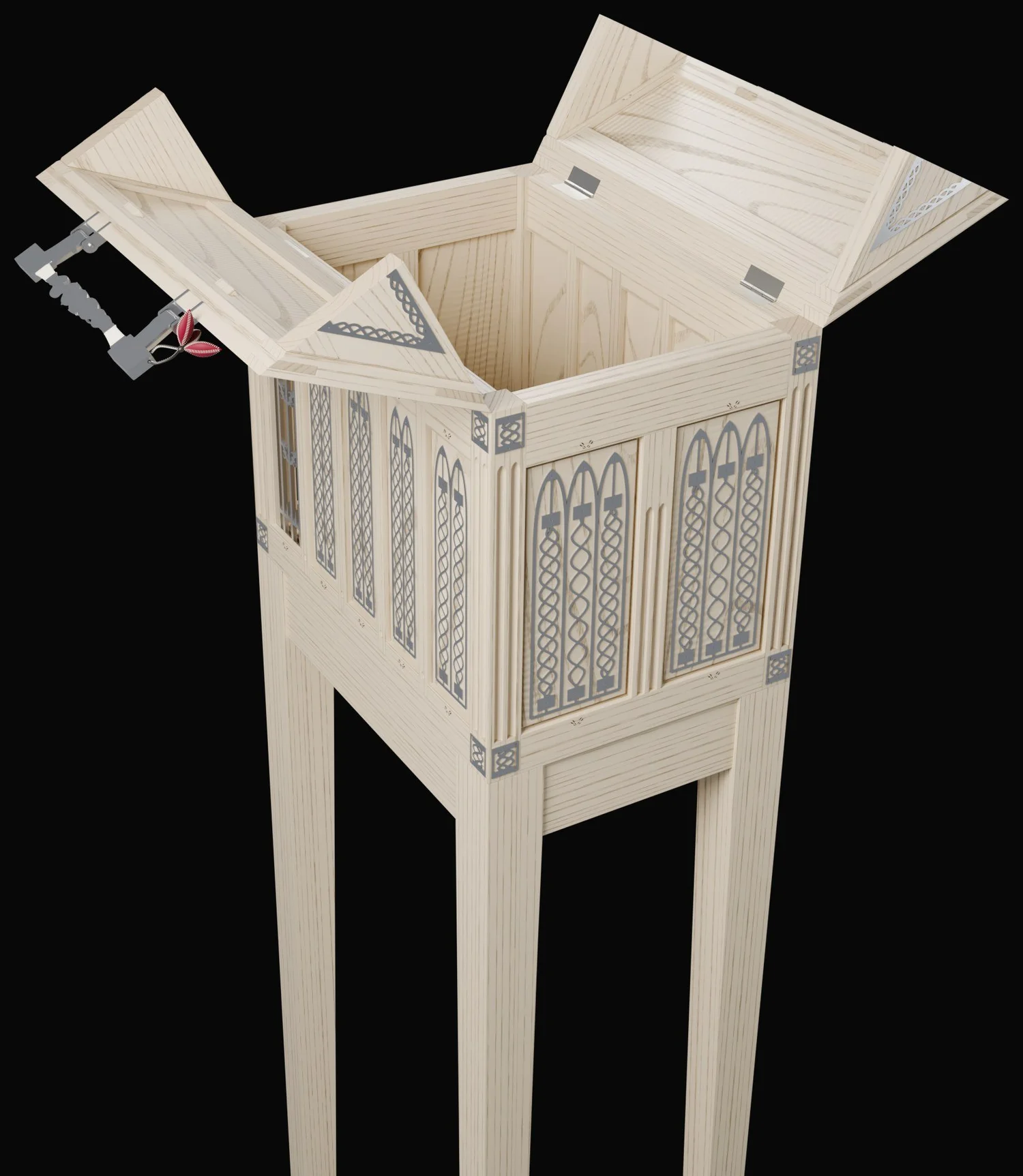
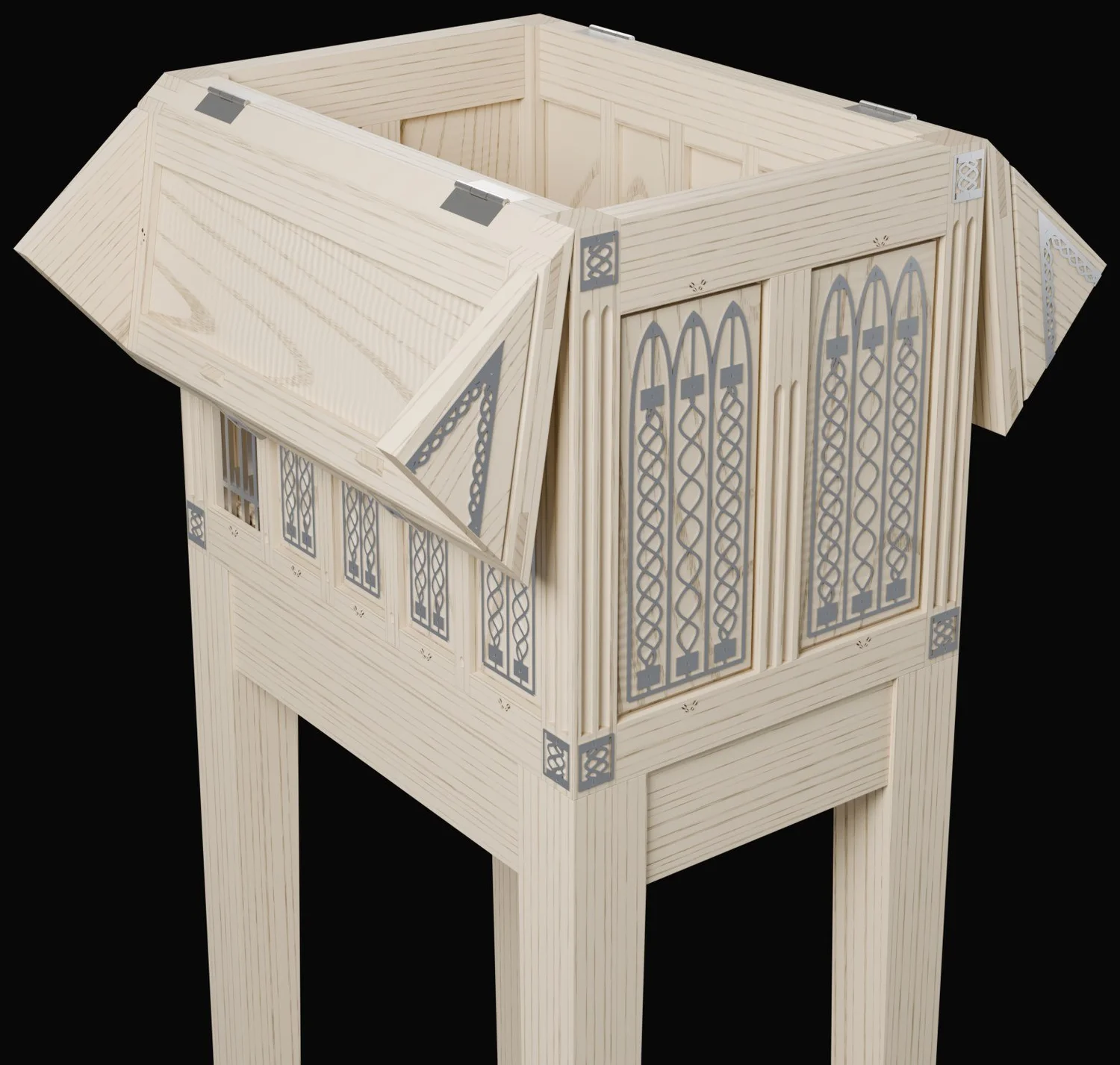
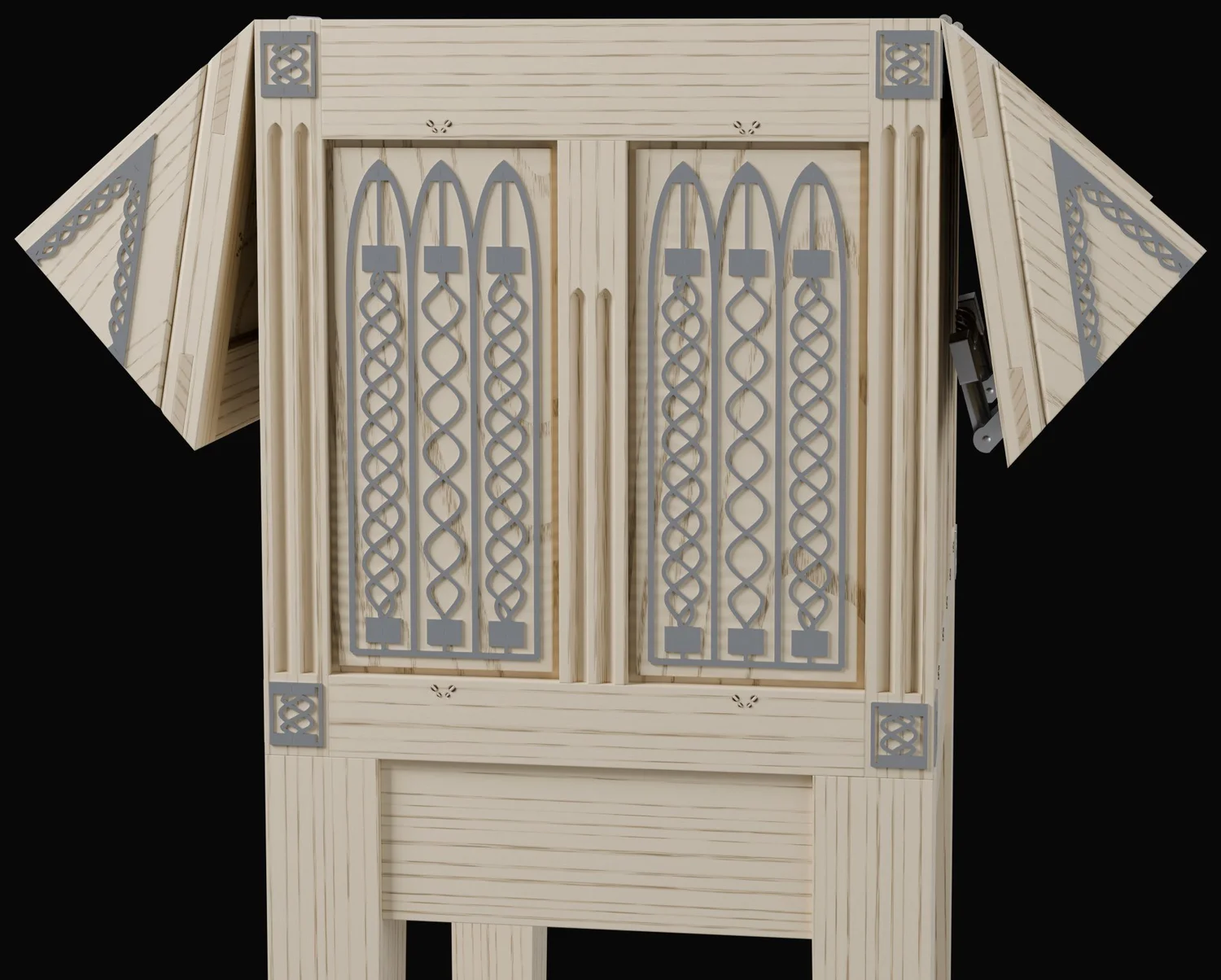
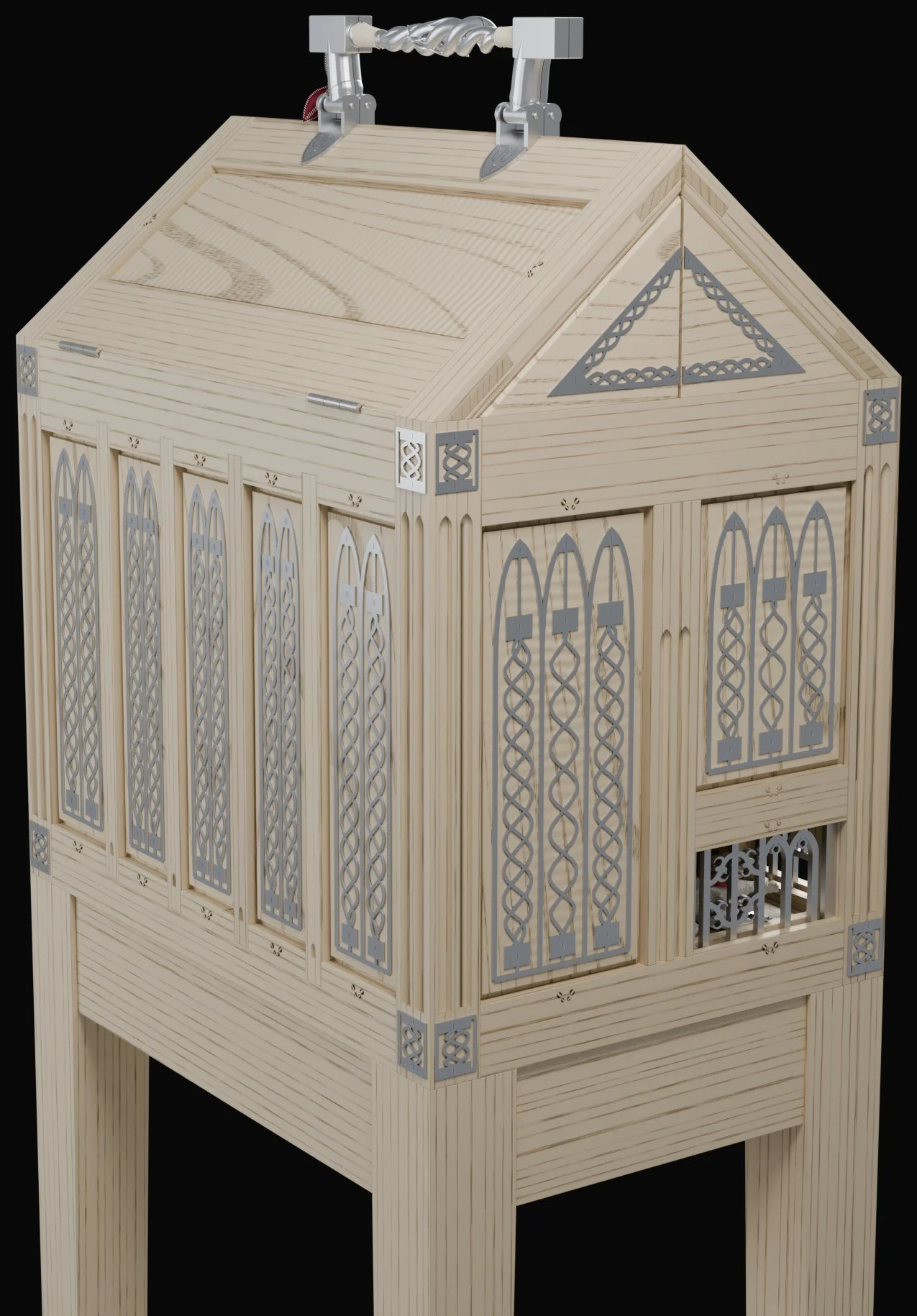
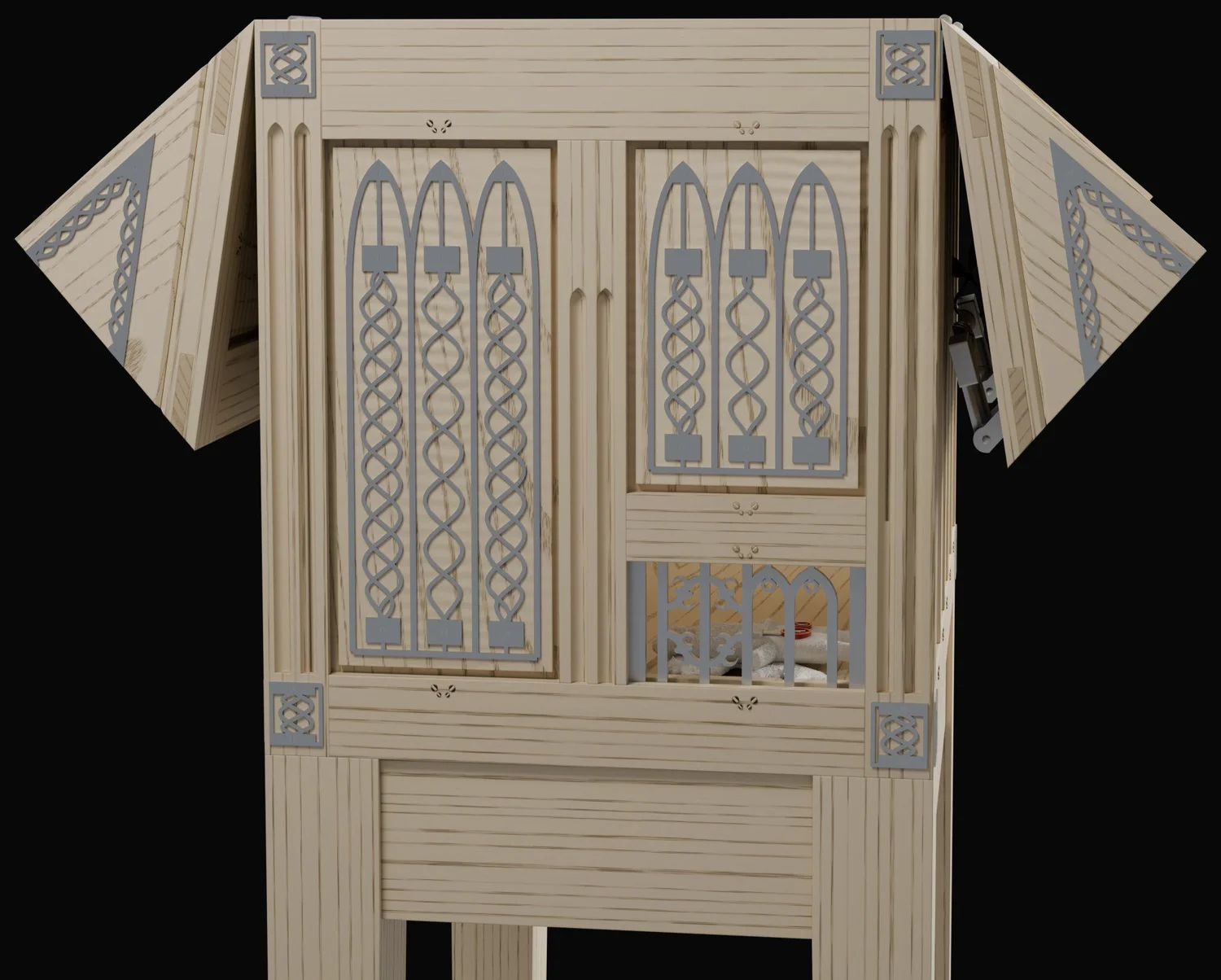
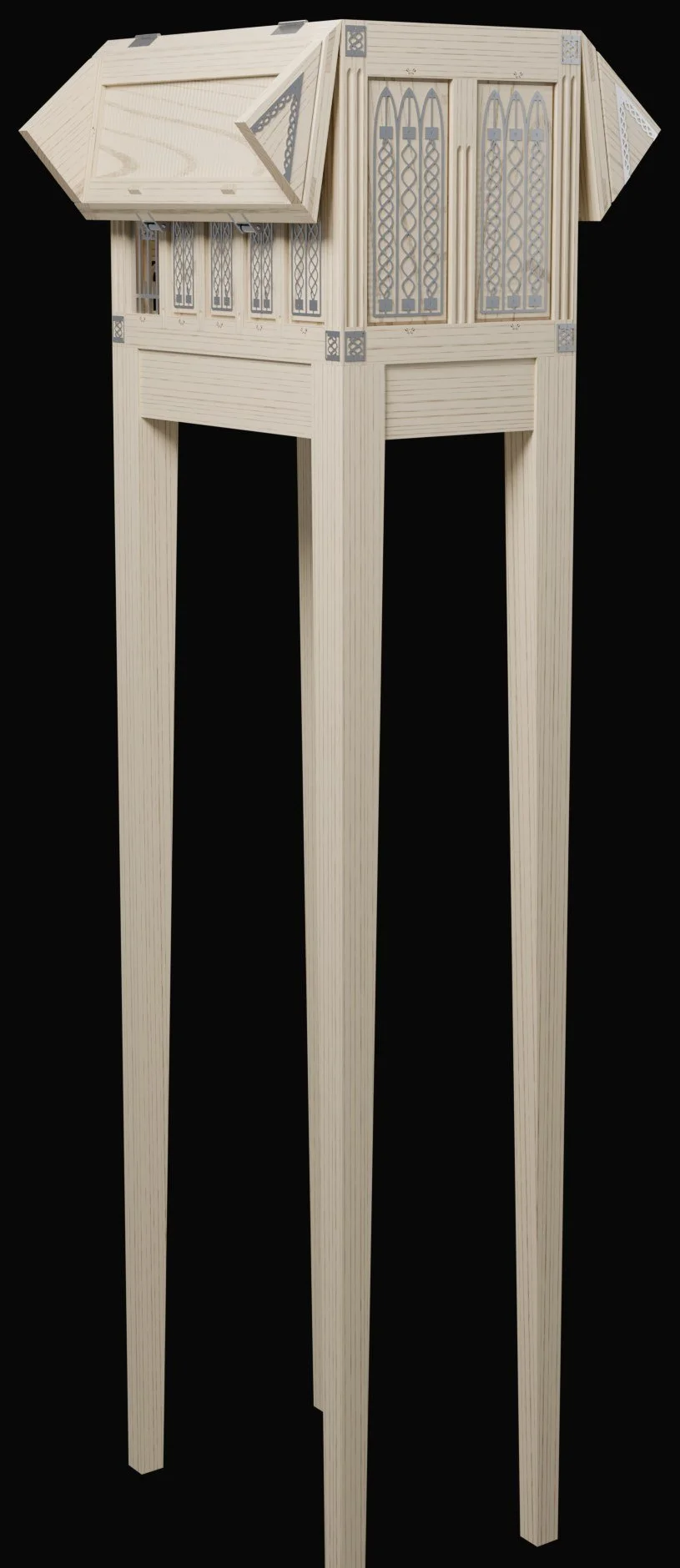
Before the inlay
The case in bare ash, before the stainless goes on
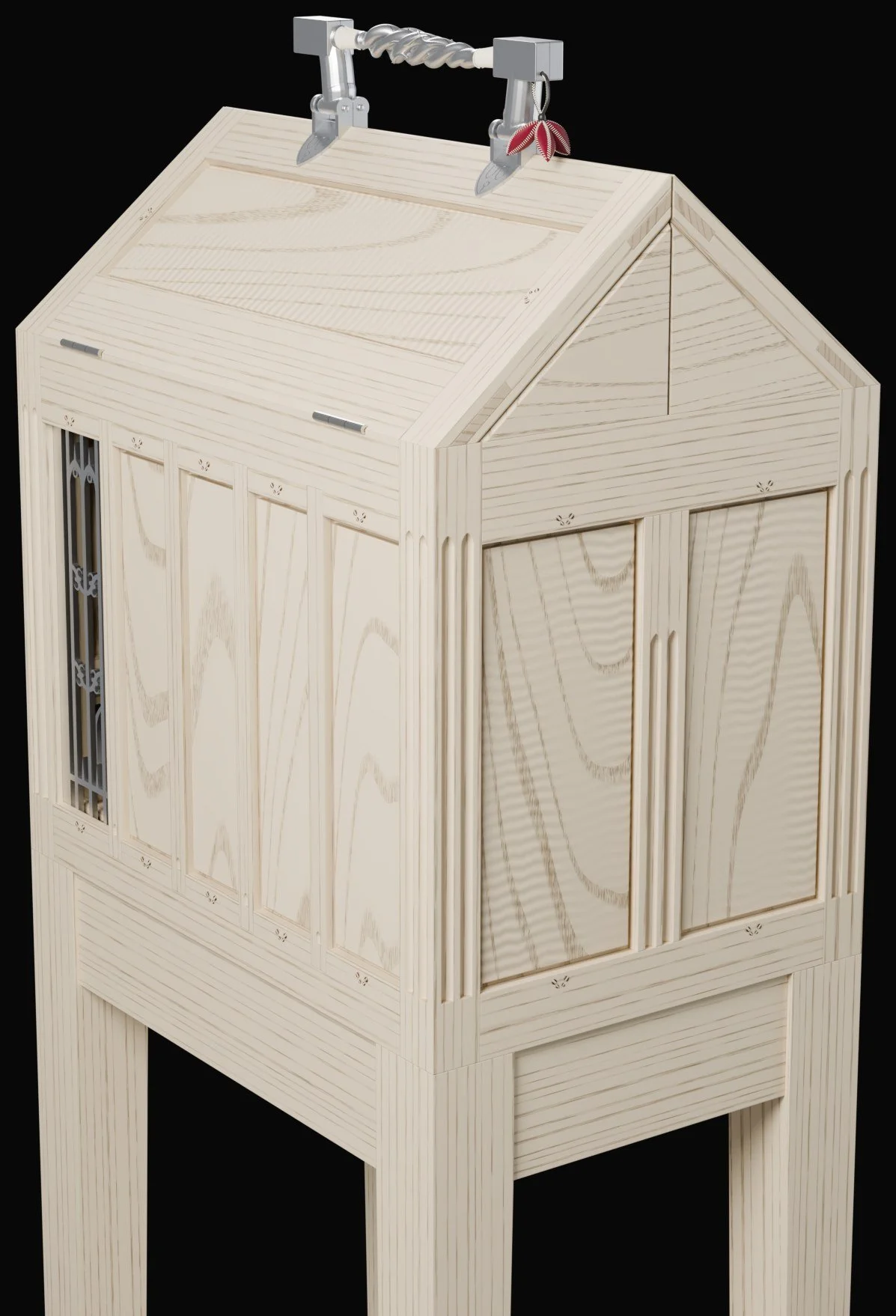
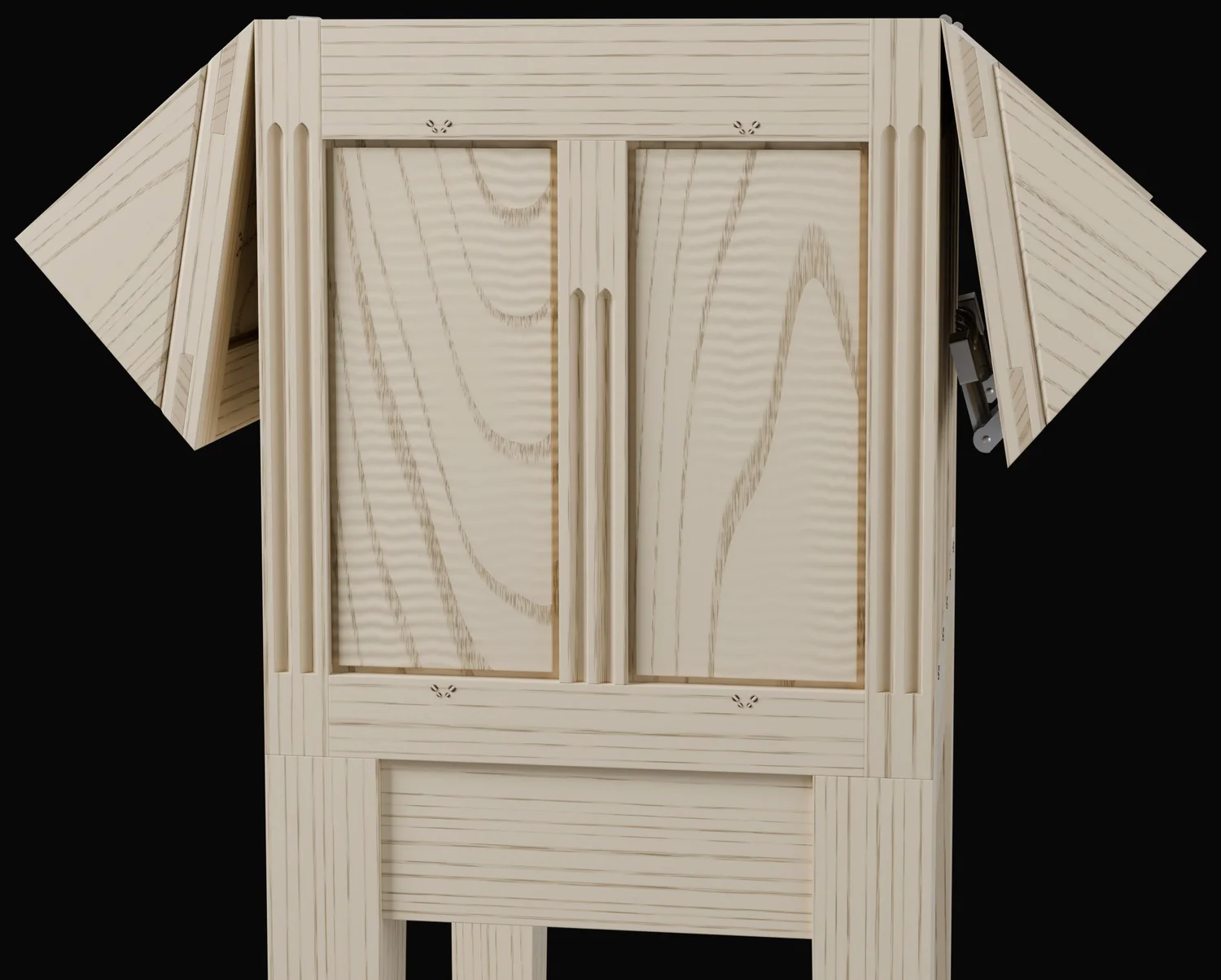
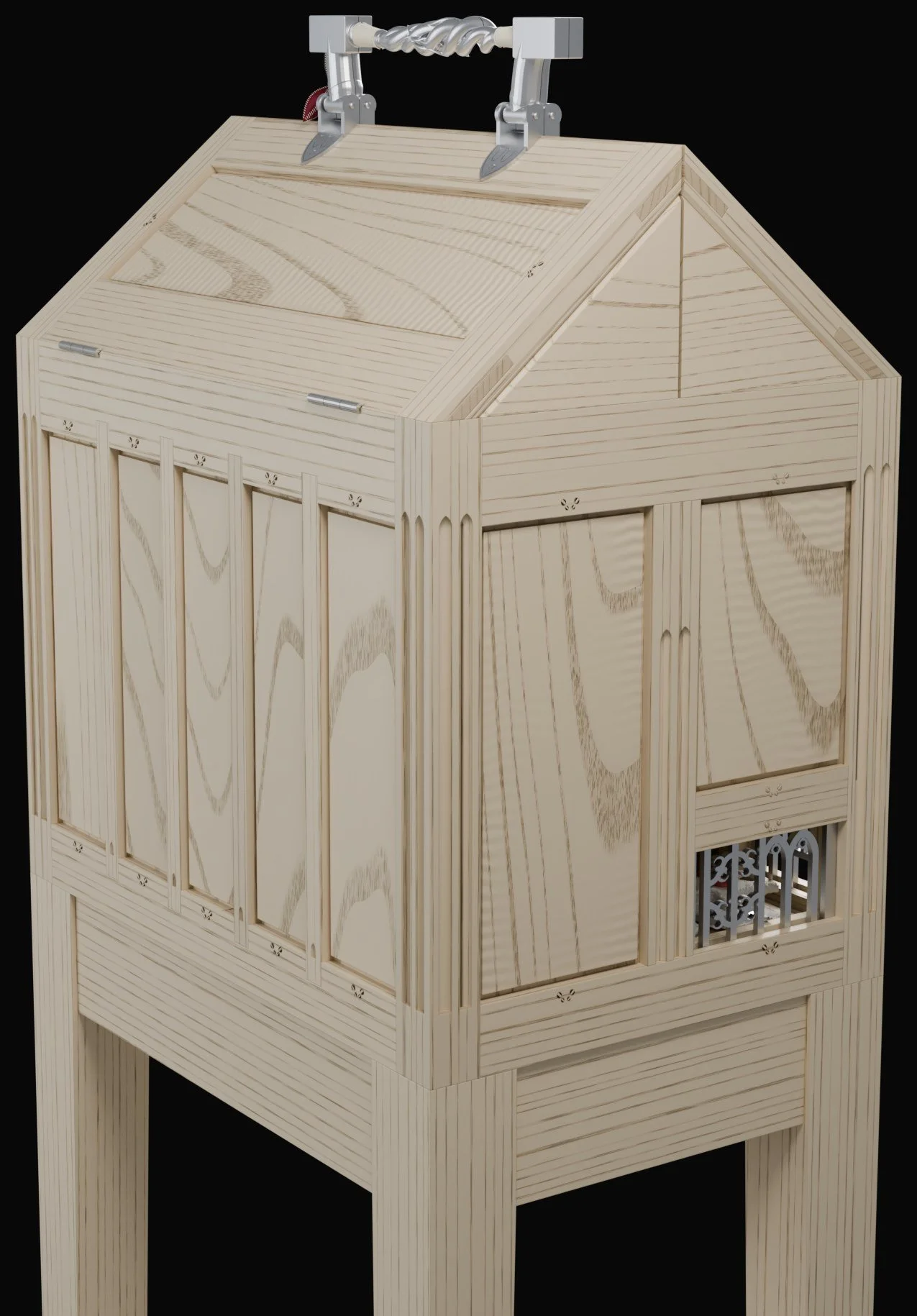
How it goes together
Exploded / raw white ash, stainless inlay, walnut pins
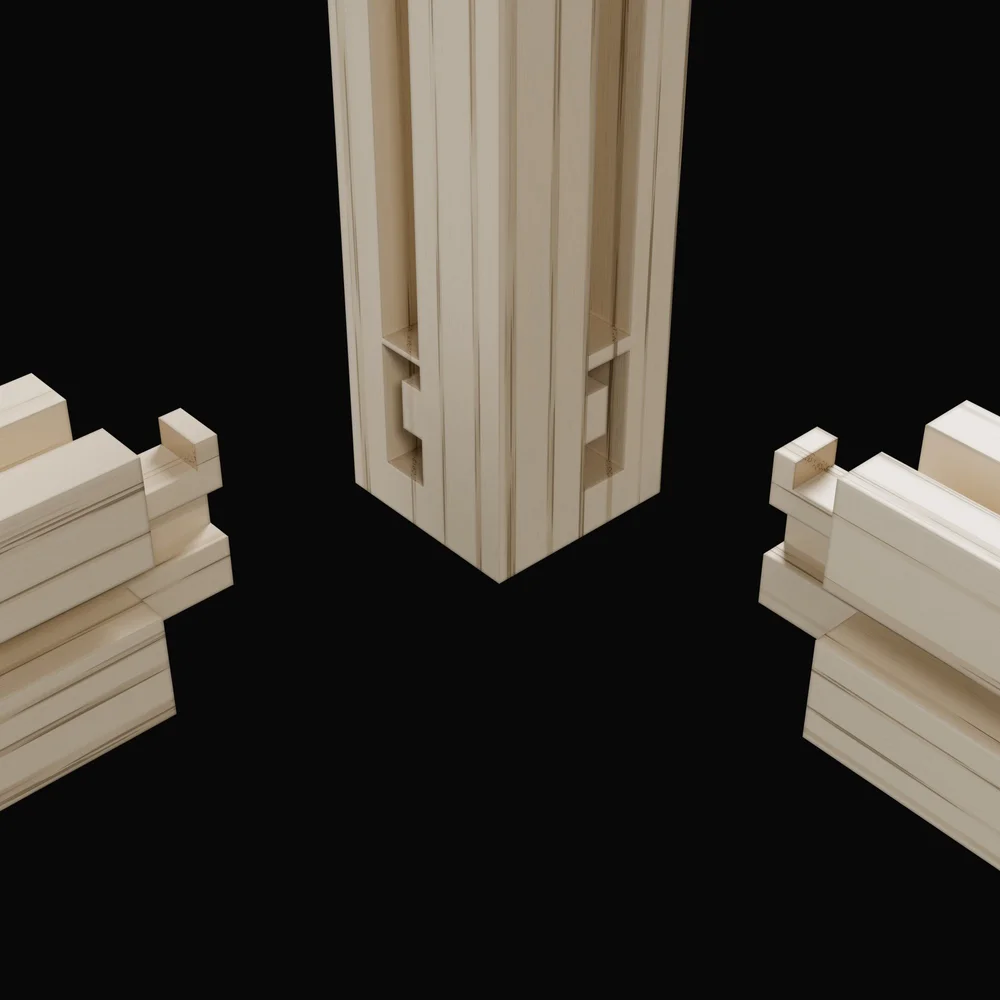
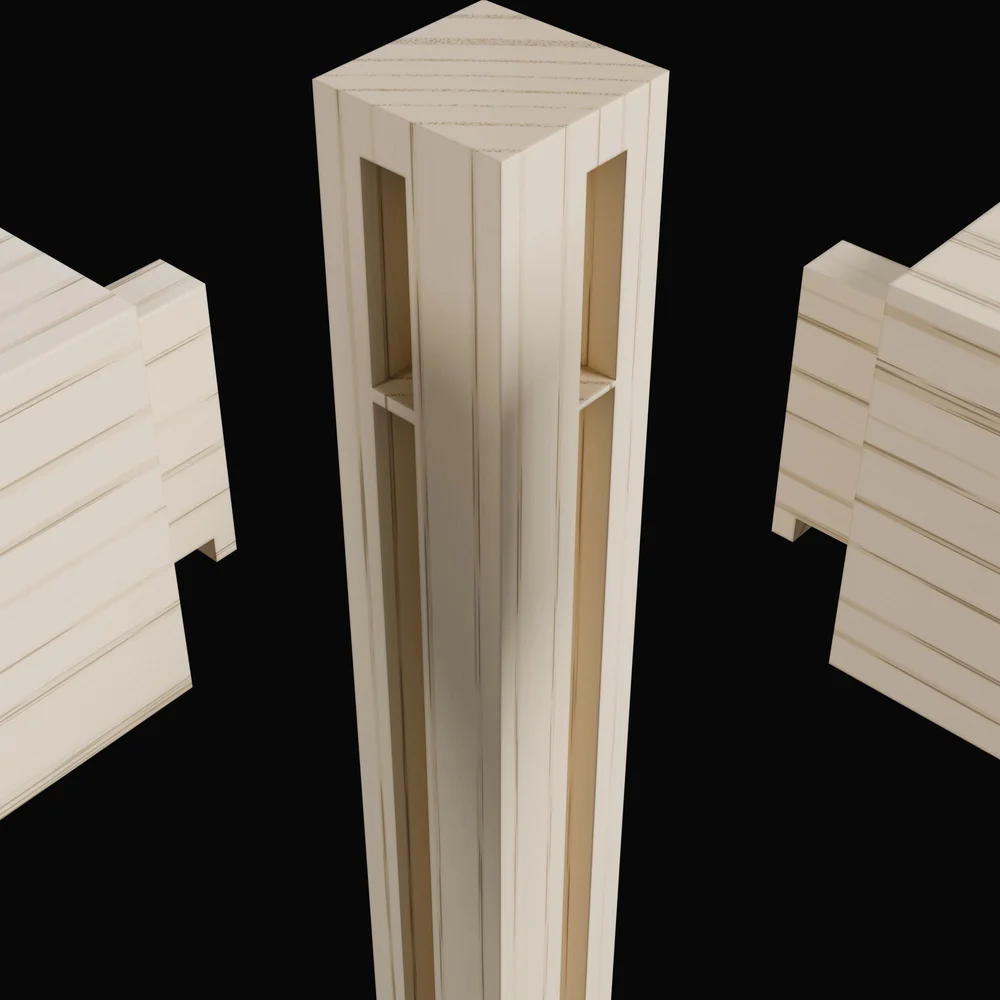
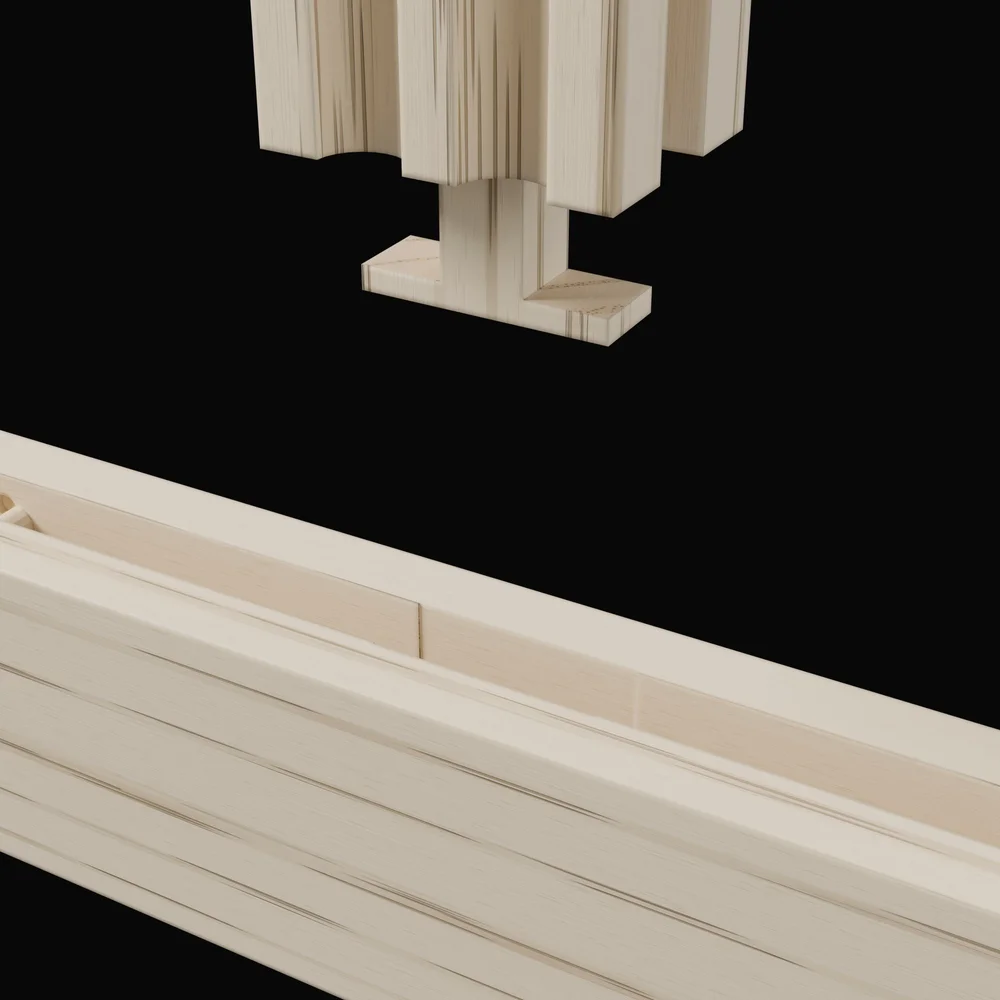
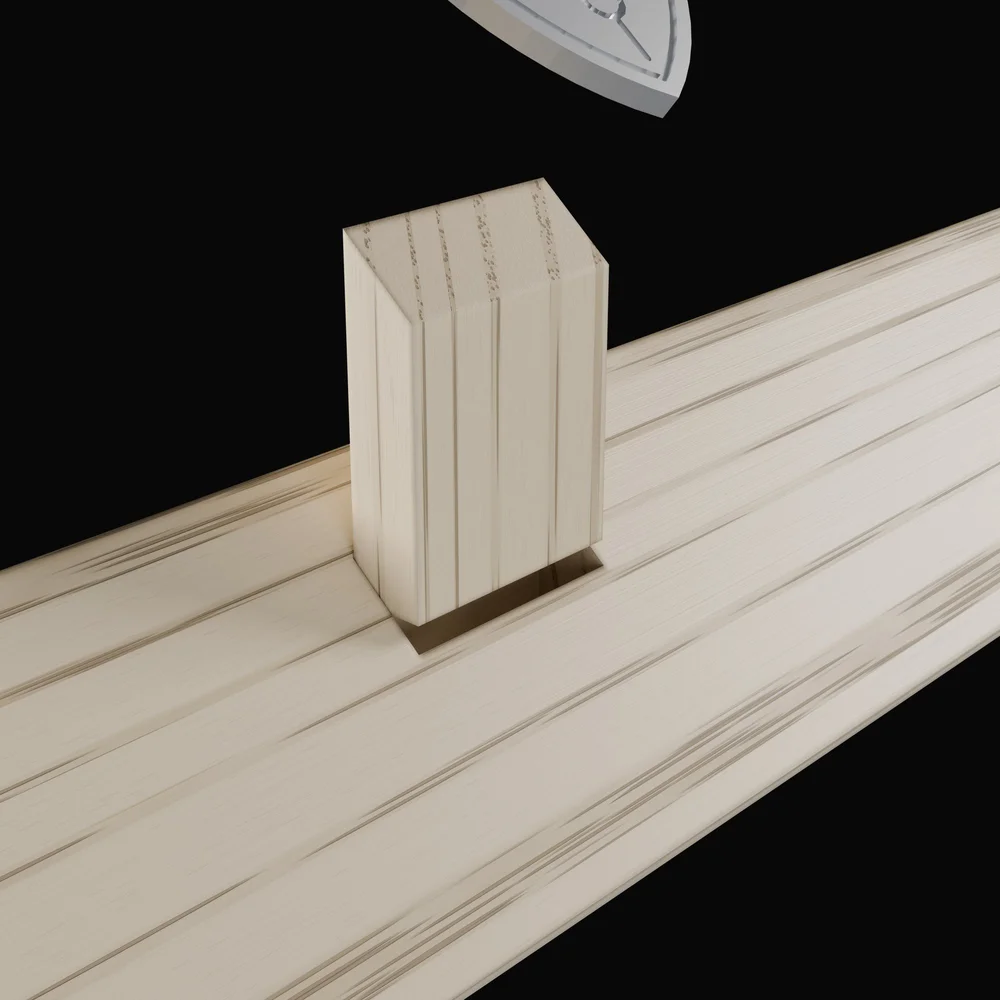
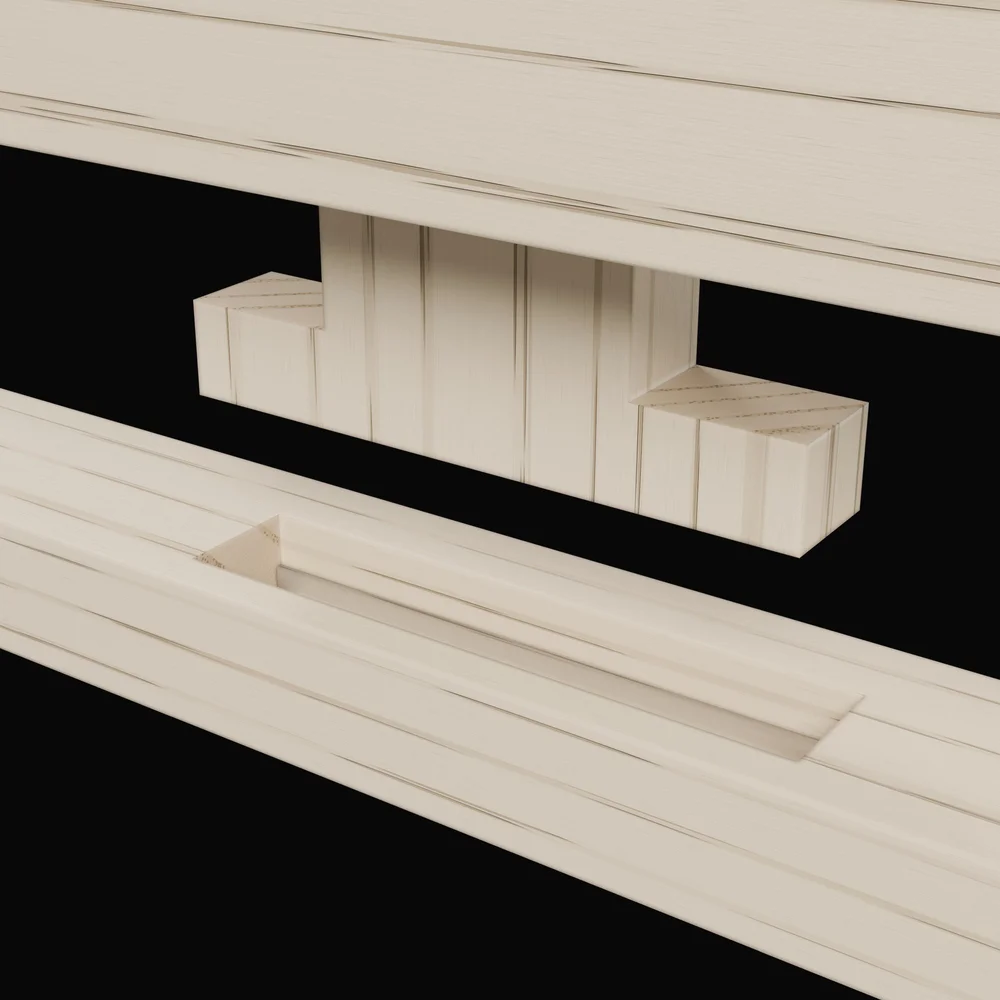
01Corner posts: twin flutes
Twin 1/4 in round-nose flutes run down each outer face, square at the foot, lancet tips at the top. Plain blocks otherwise, so the posts read as one piece with the rails.
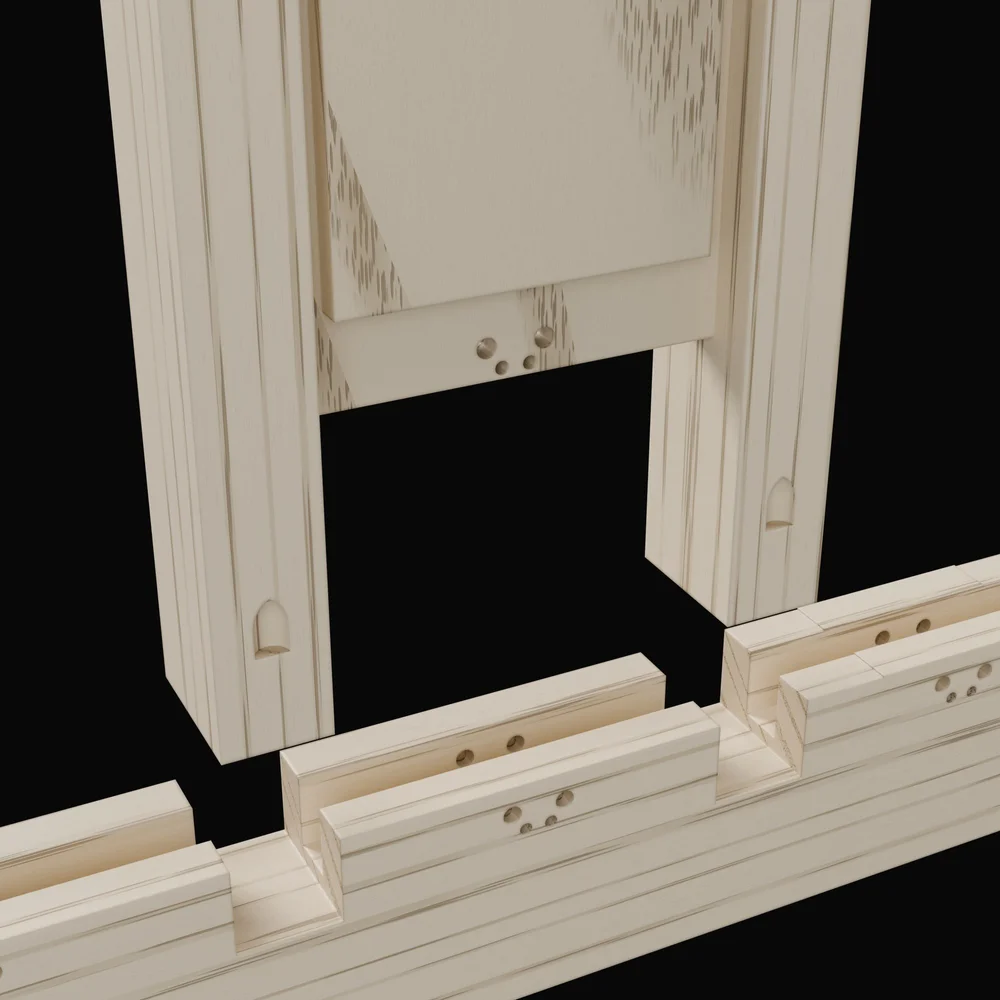
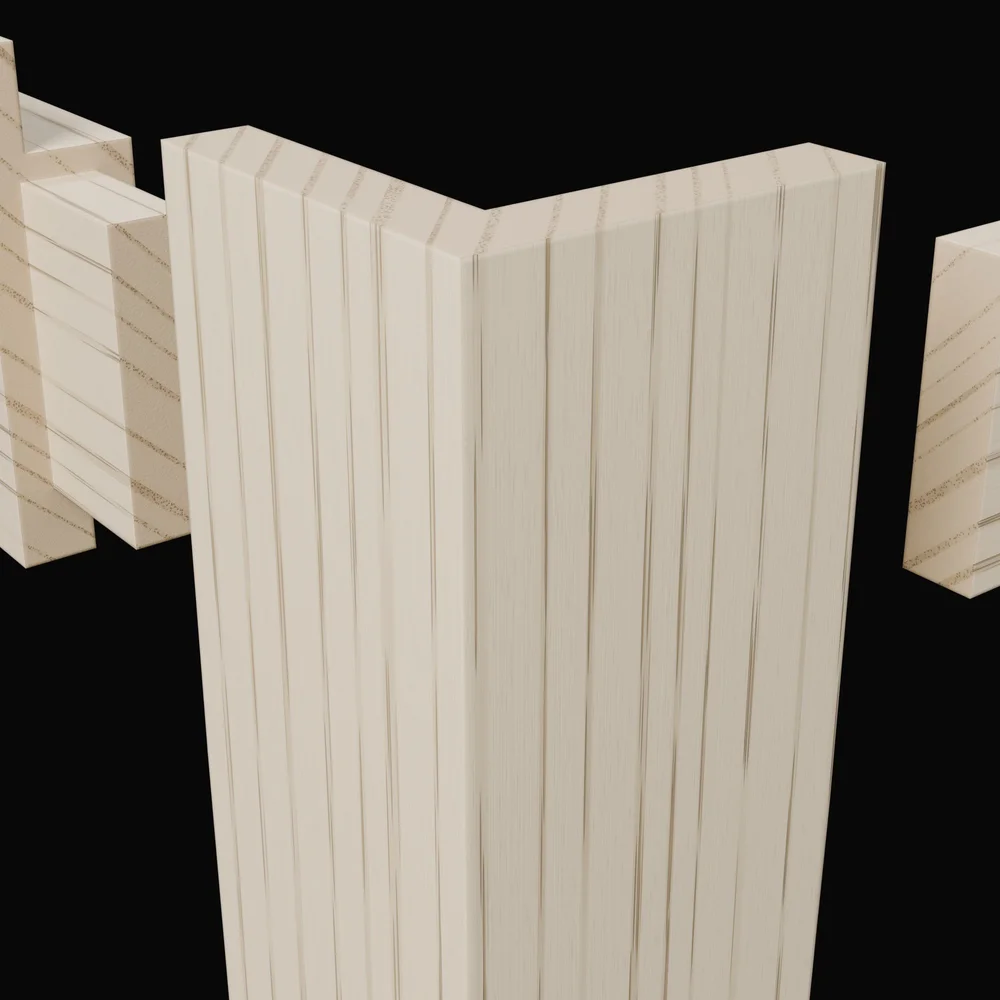
02Rails: haunched mortise and tenon
Rails tenon into the posts, the haunch filling the panel groove. At the foot of each muntin a short round-nose flute in the rail carries the motif round the case.
03Raised panels, 1/8 in shadow groove
Every panel is raised: a 1/4 in tongue floats in the groove, the field stands 1/8 in shy of the frame, with a 1/8 in shadow groove all round. The same on the flanks, the back and the roof.
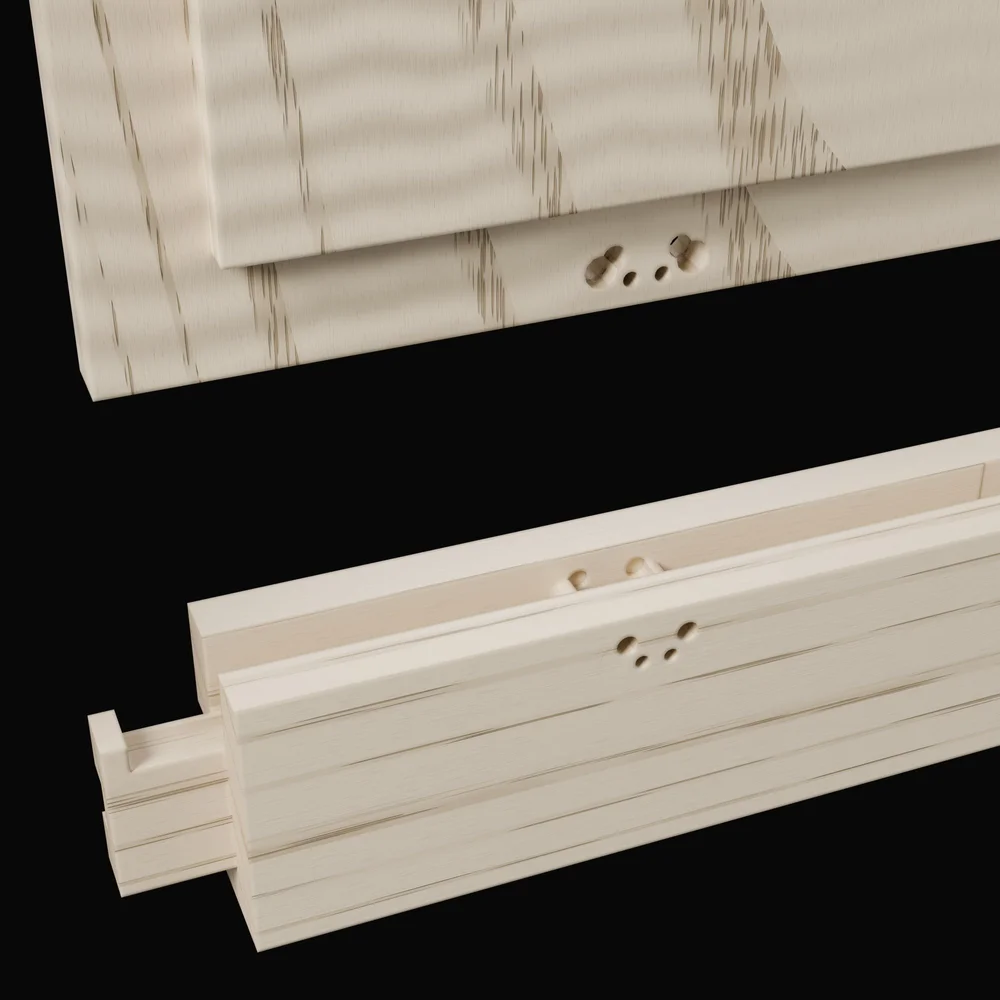
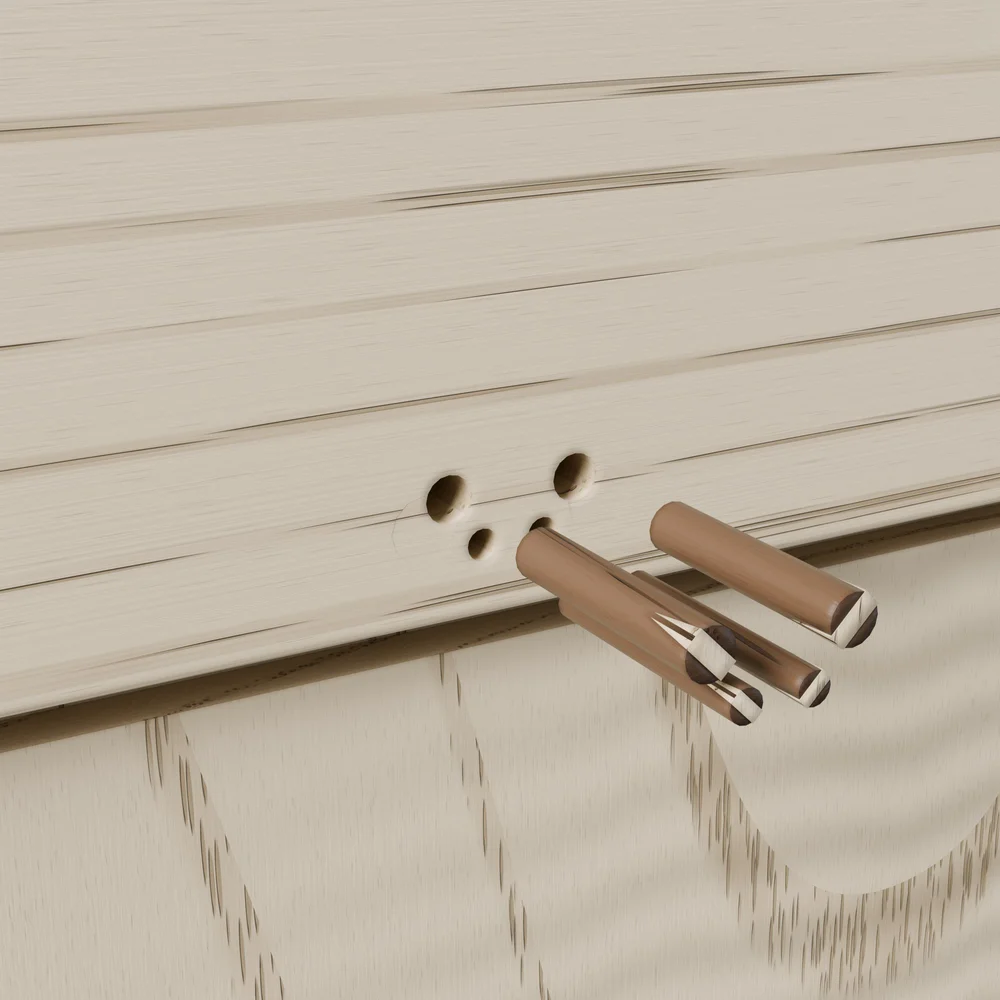
04Walnut pins set out as a moth
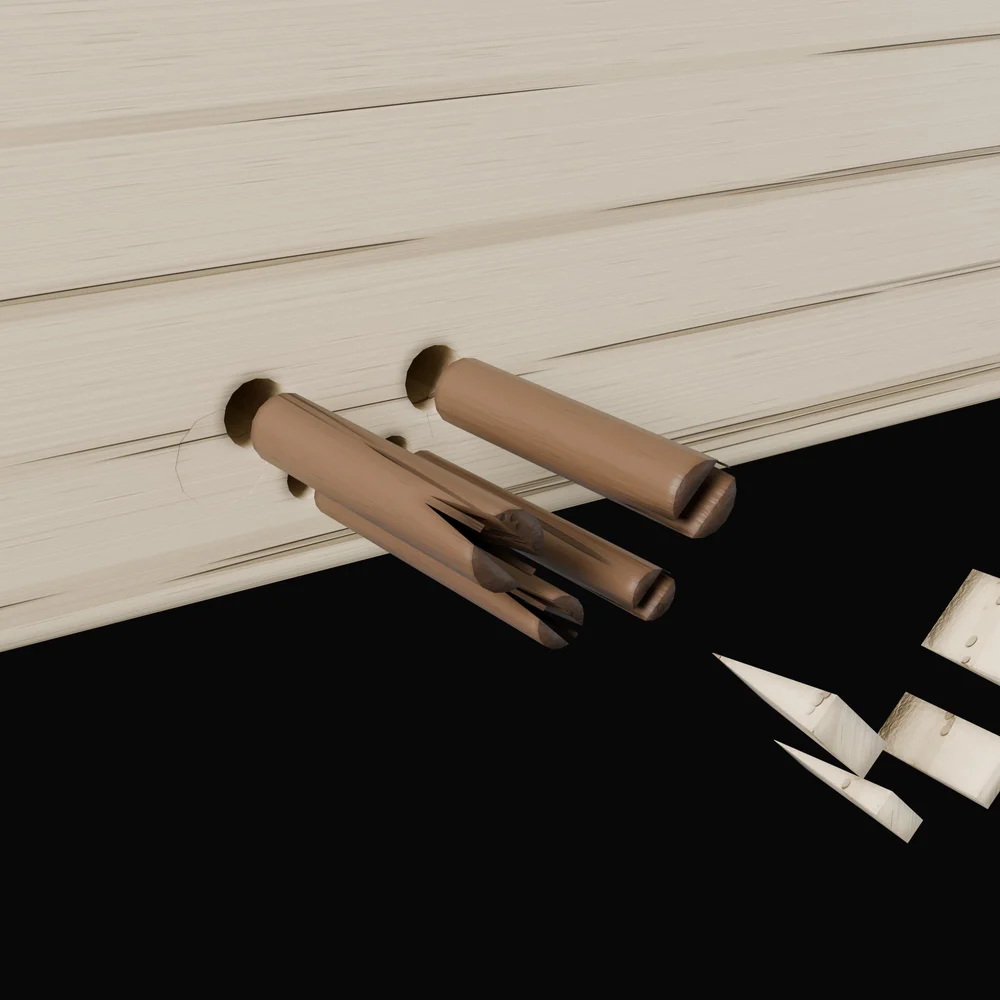
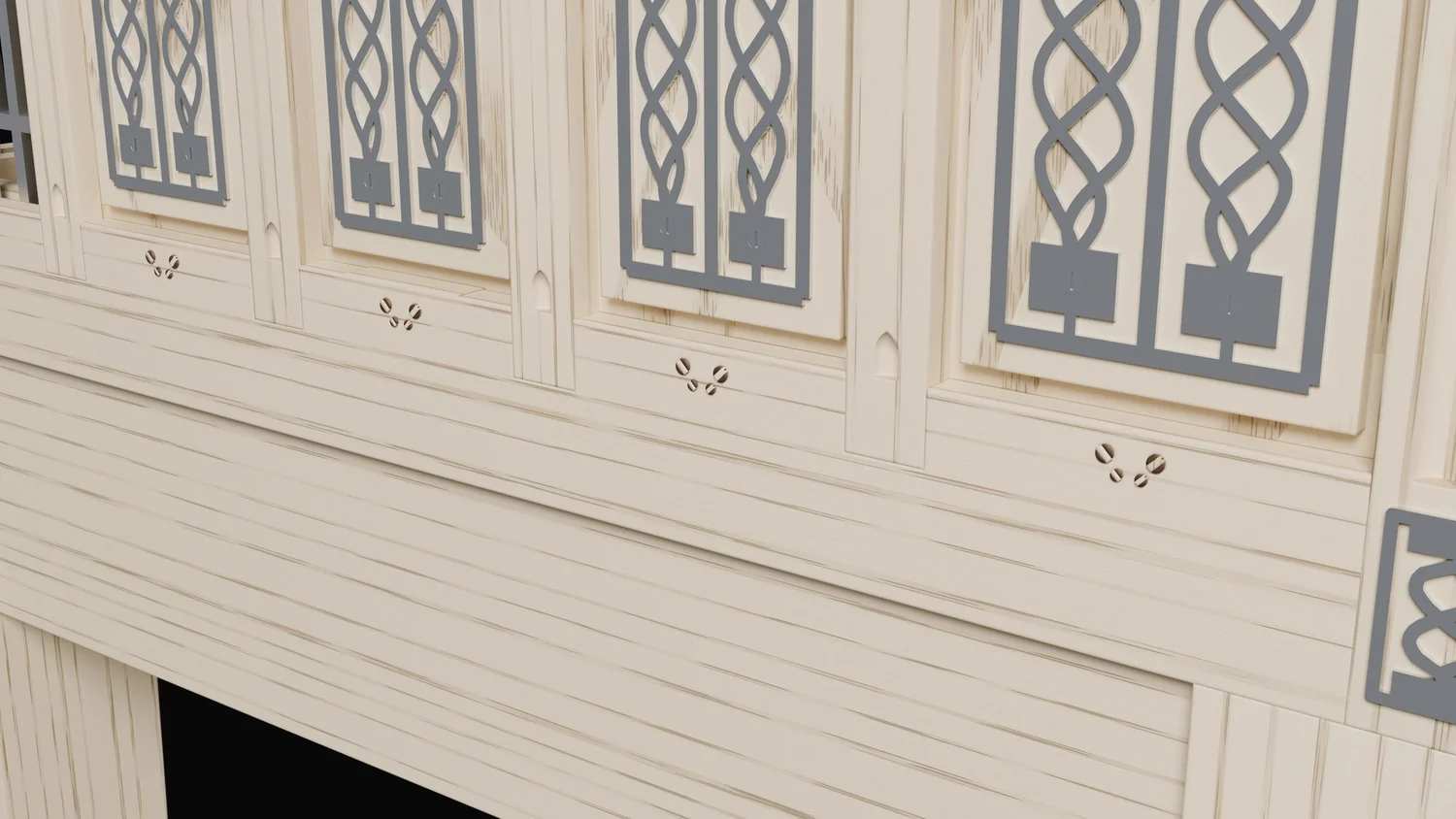
Walnut pins through the rail into the panel tongue: 3/32 in forewings, 1/16 in hindwings, a walnut wedge in a kerf across each end.
05Muntin: the same flutes
1 in wide, tenoned into the rails. Twin 1/4 in round-nose flutes, 1/8 in deep, square at the foot, lancet tips at the top.
06Flanks: five bays, four muntins
Four floating raised panels between 1/2 in muntins tenoned into the rails. The fifth bay, by the back-left post, holds the stainless jail plate instead of a panel.
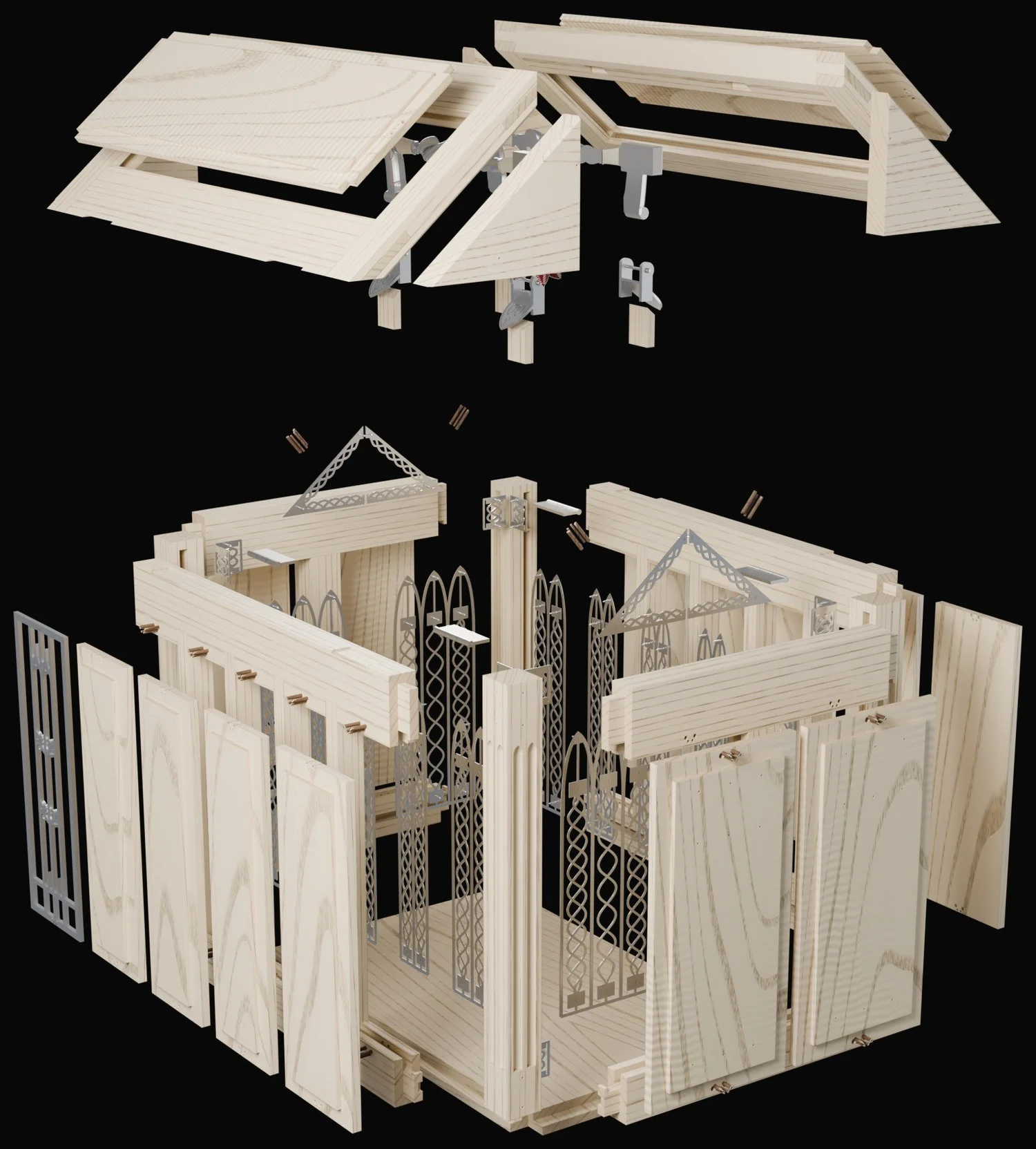 123456789101112
07Moth pins on the flank rails
The same four-pin moth in walnut, through the rail into each panel tongue.
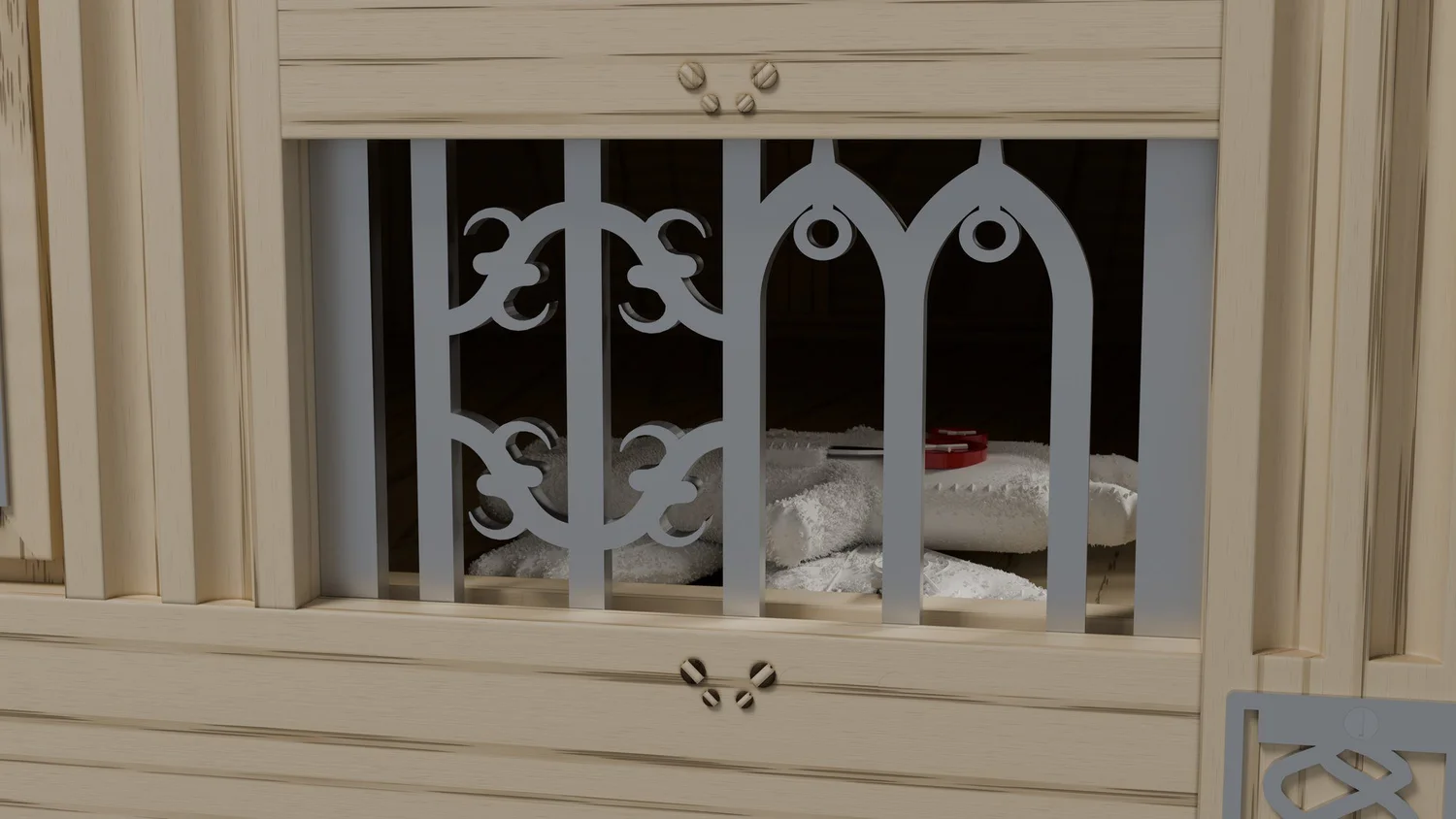
08The jail: two bar plates on a corner
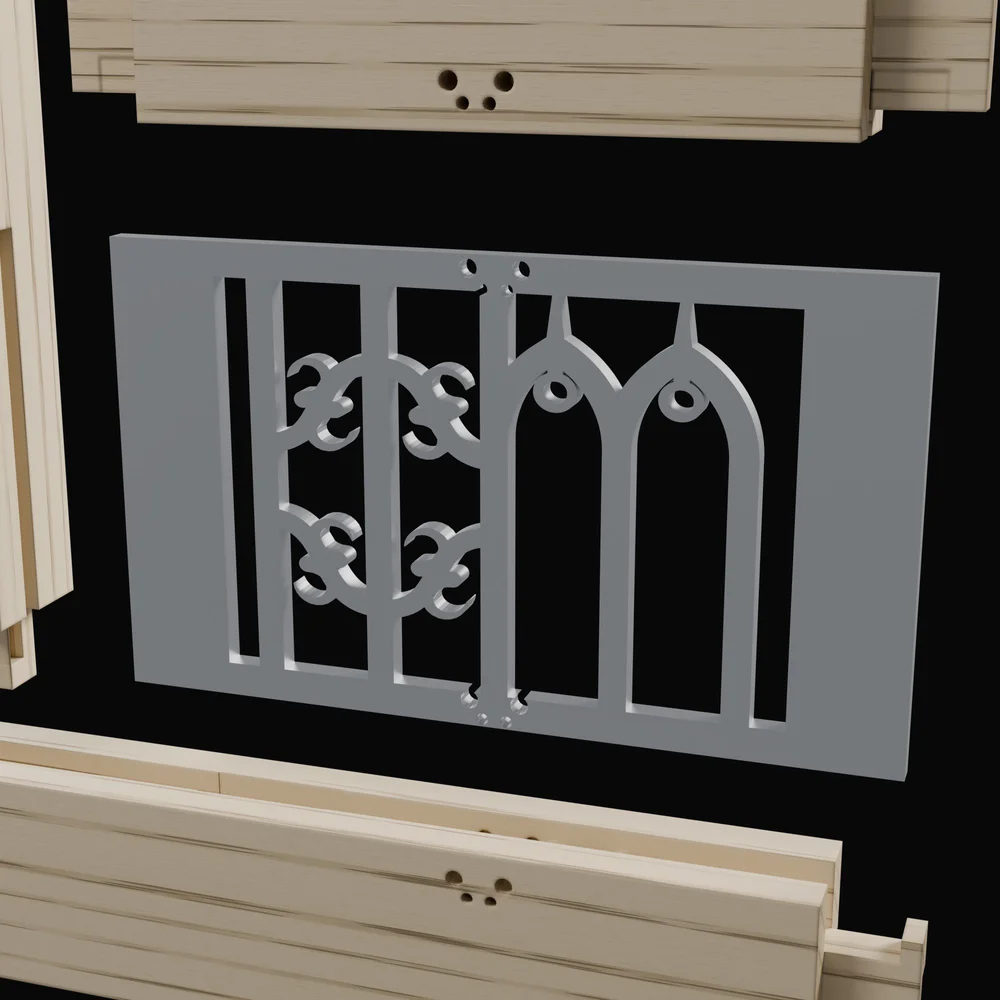
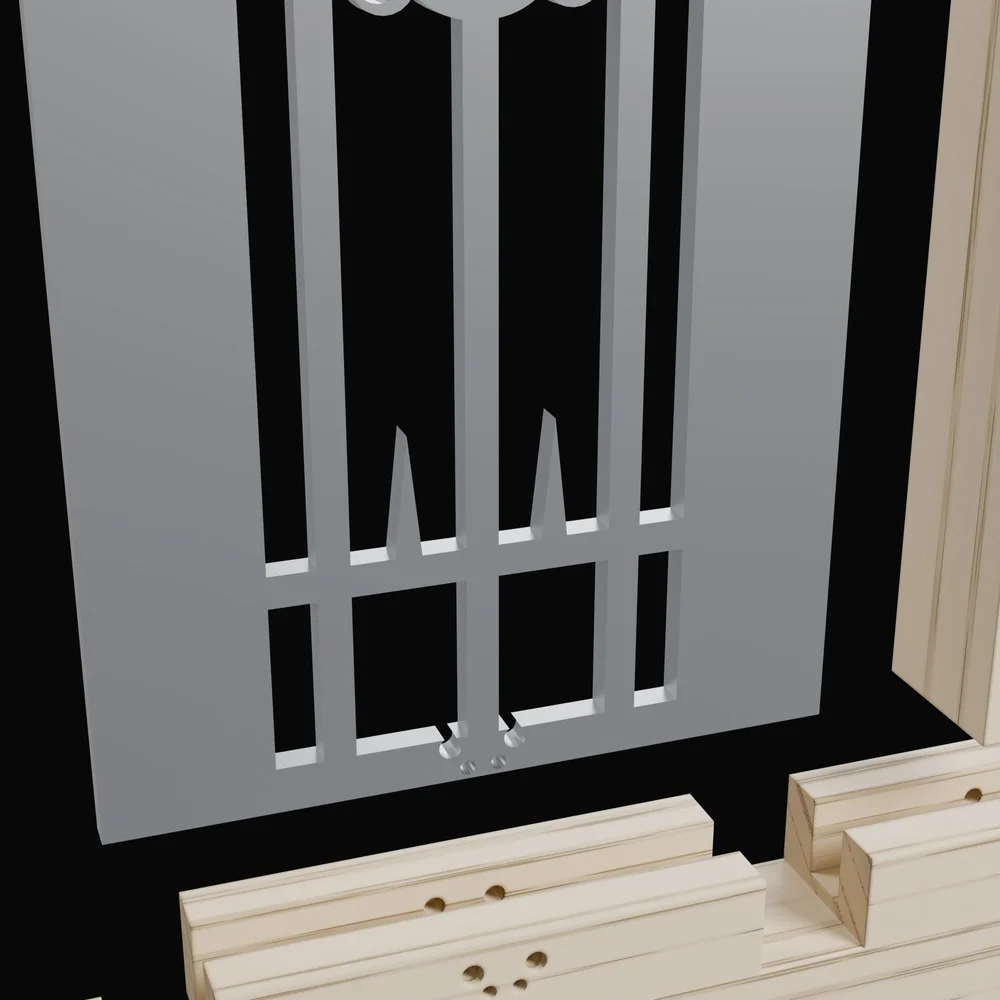
1/8 in stainless, laser cut, held in the panel grooves and pinned through the rails. One in the flank, one in the back, meeting at the corner.
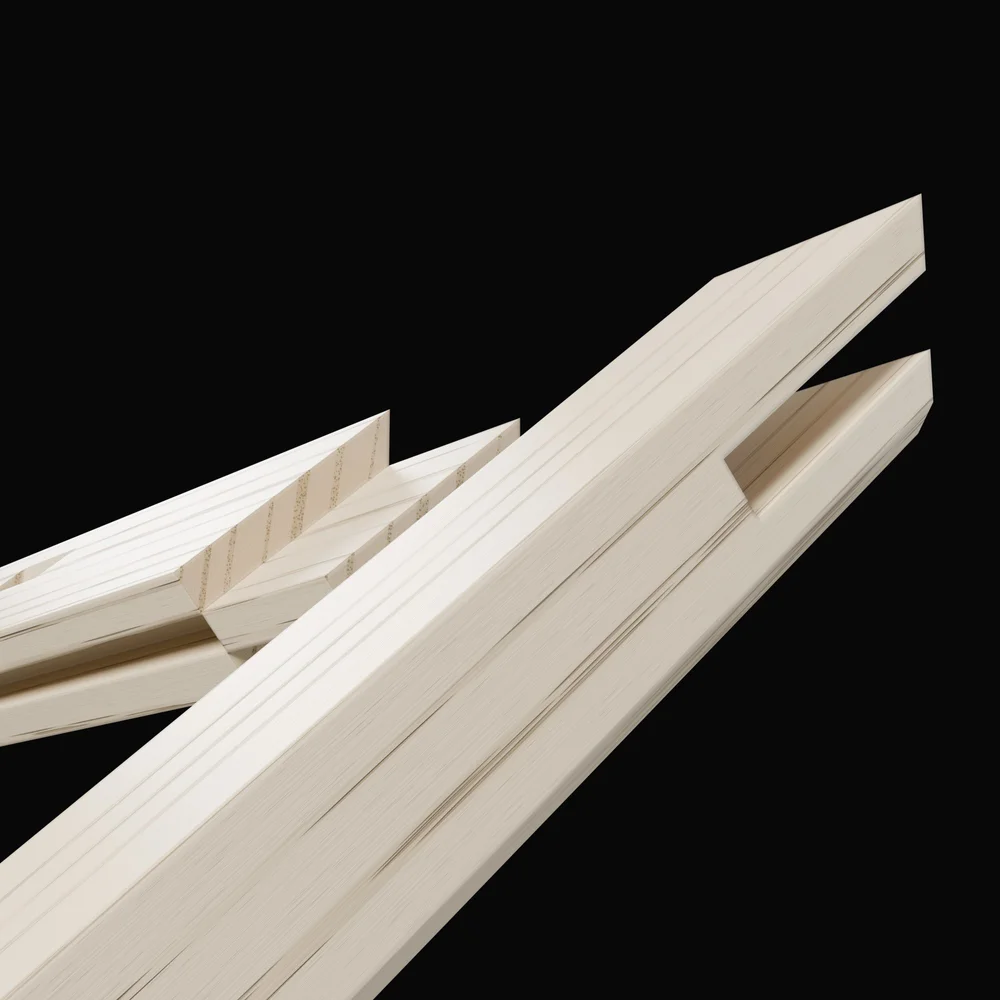
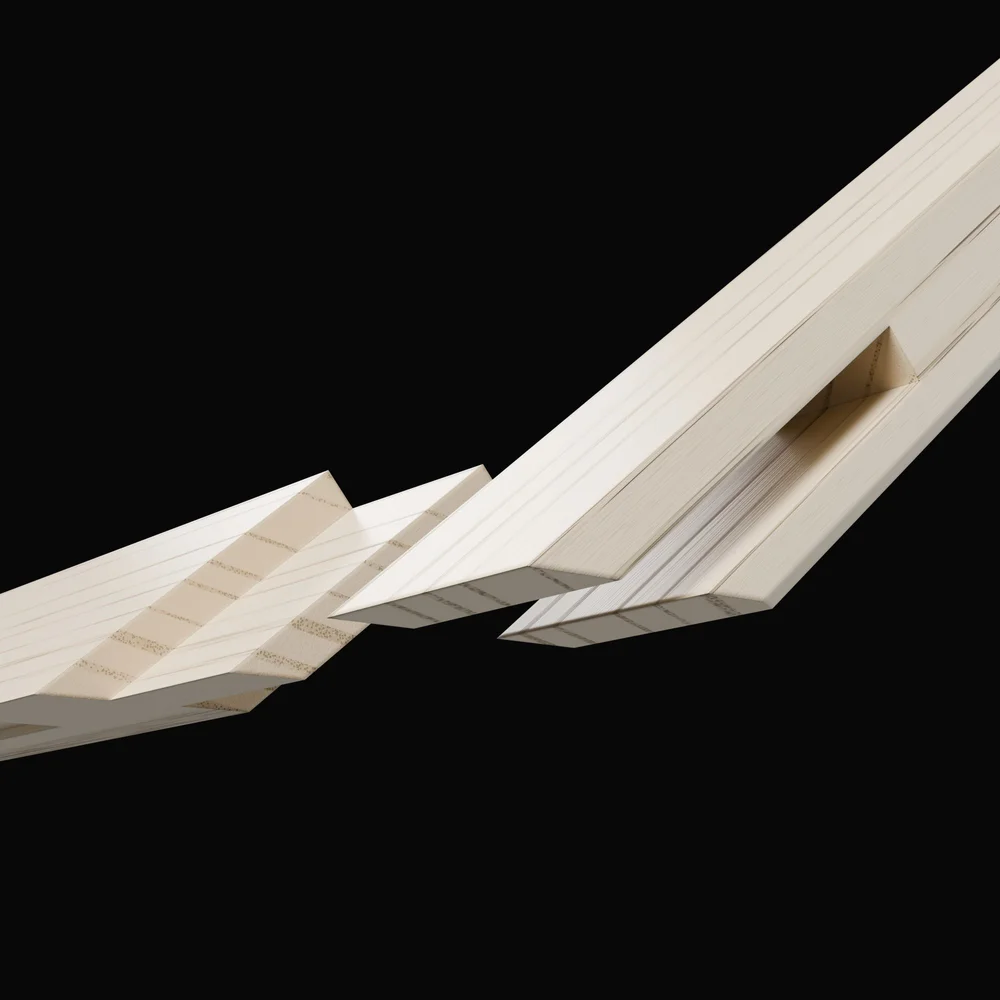
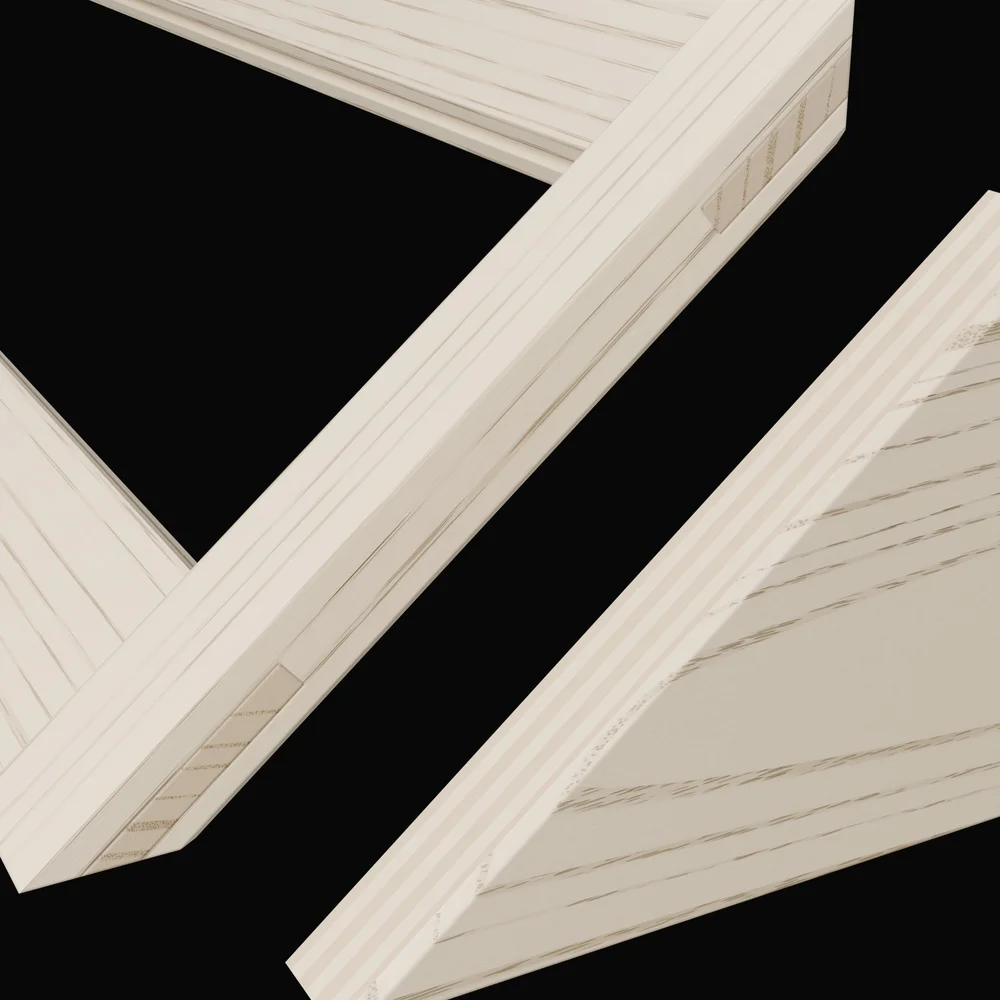
09Lid frame: corner bridle joints
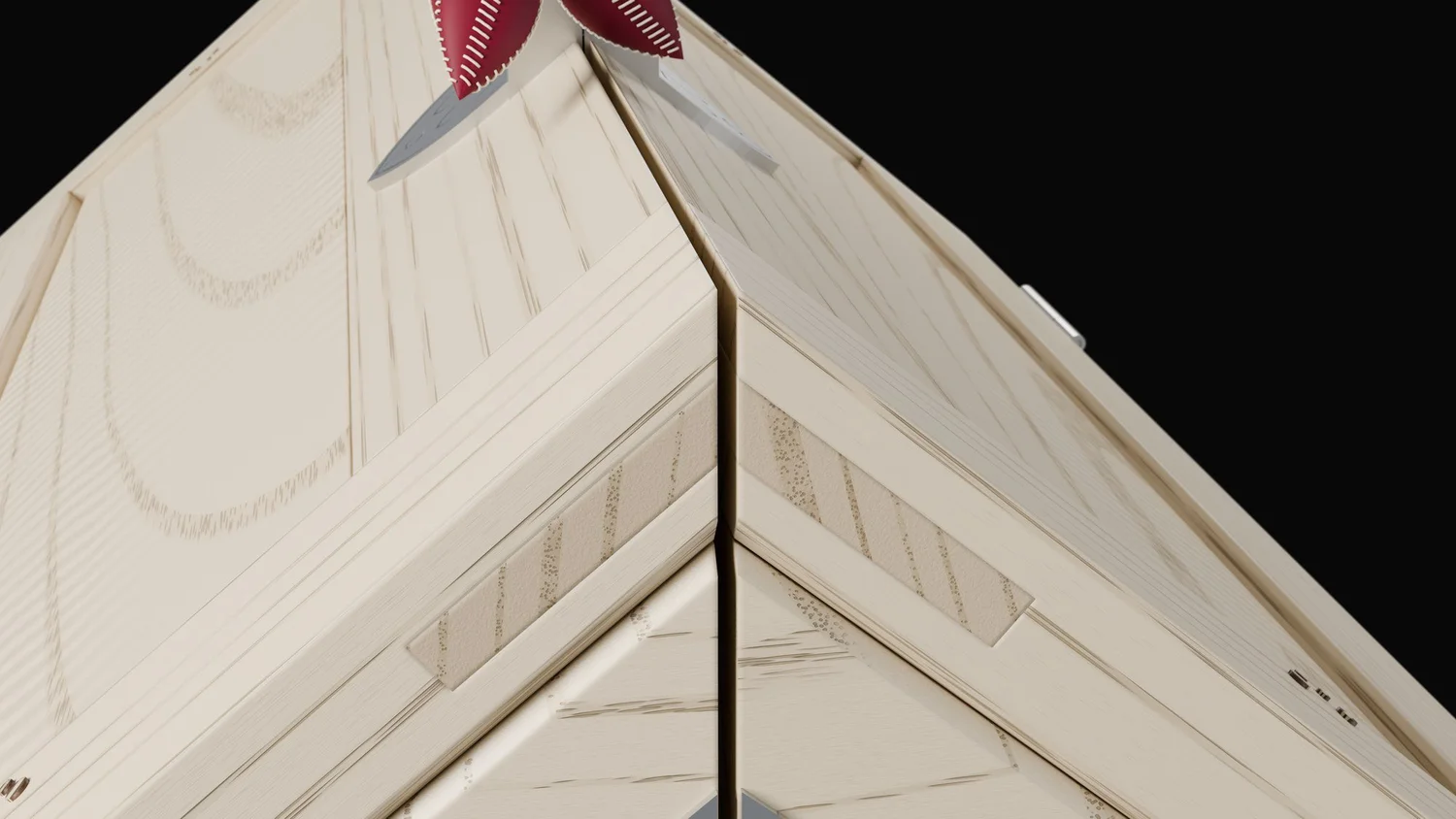
The gable-end rails run through to the eave and the ridge, each end slotted over a middle-third tenon on the stile.
10Gable: ash-veneered ply, V shadow groove
A plywood triangle veneered in ash, grain running level, glued under the lid frame. Ply because solid ash would leave short grain in the corners of the triangle that would break off. A 9/64 in V groove runs along the seam on both slopes.
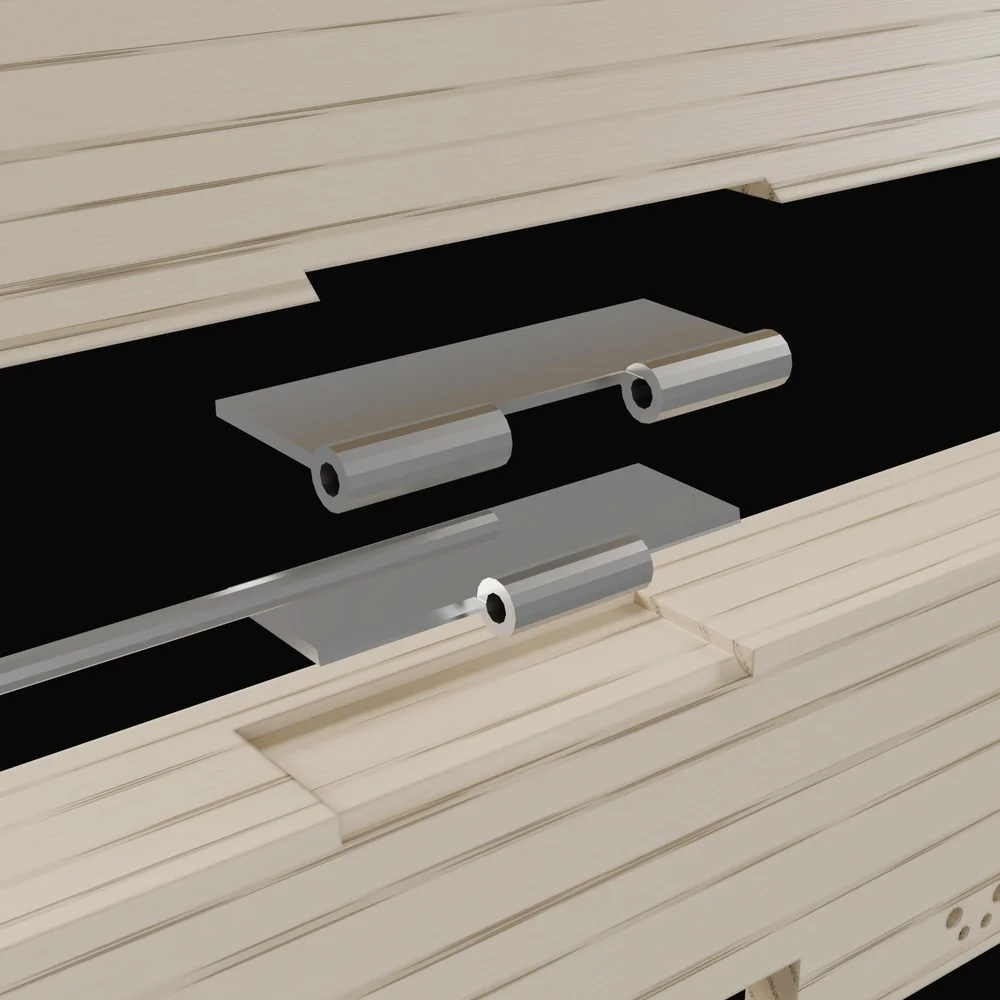
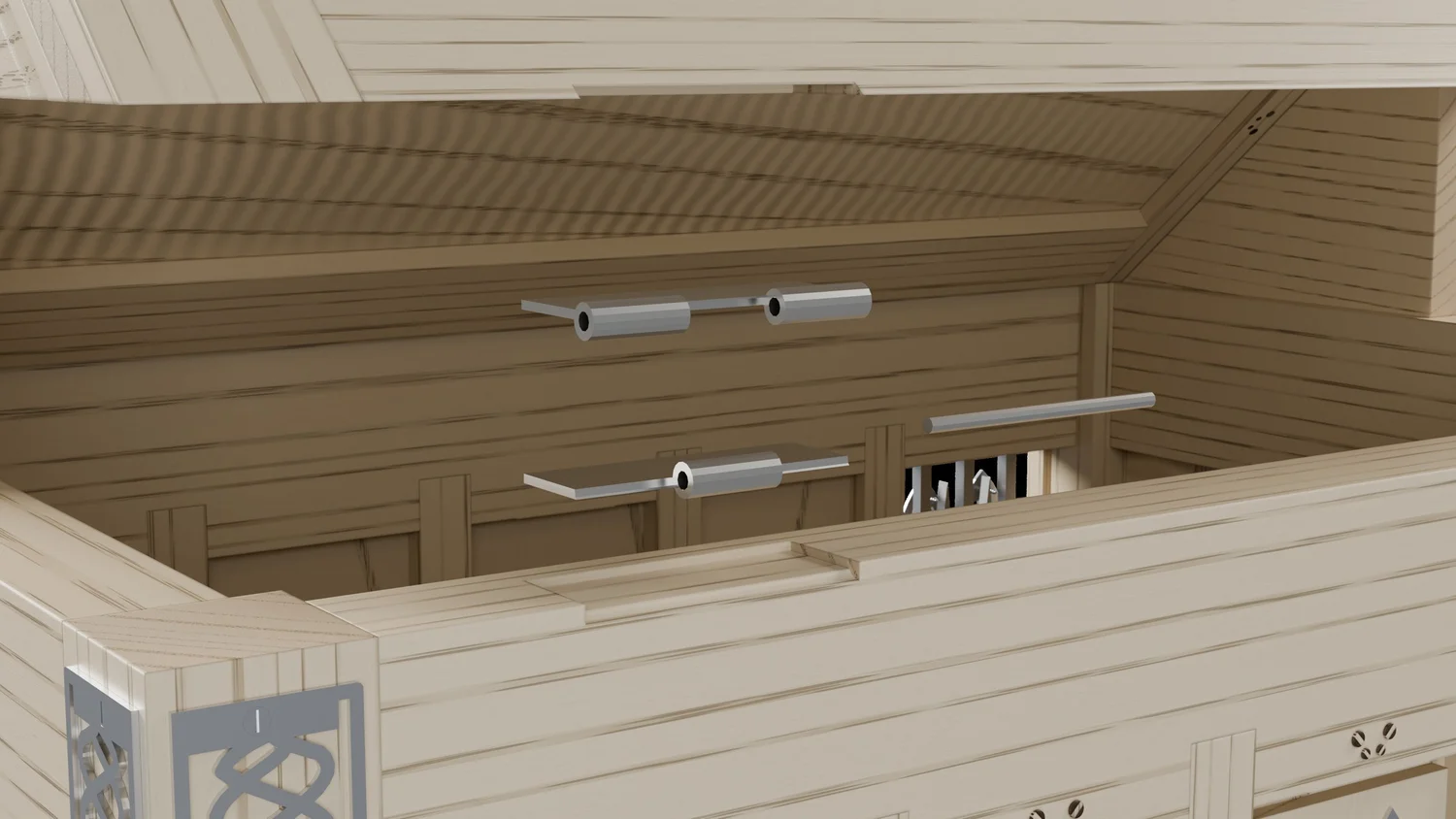
11Eave hinges
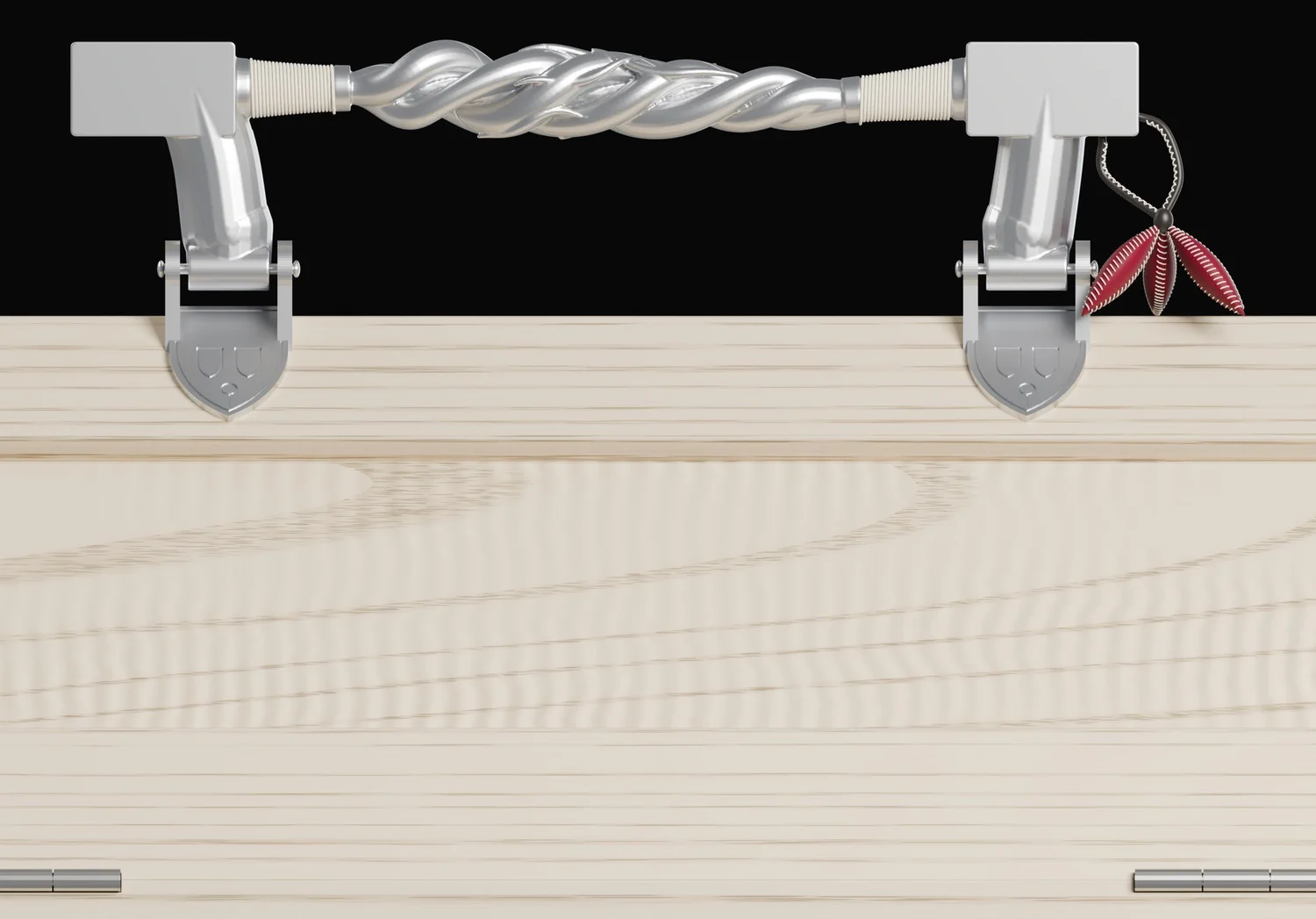
Stainless butt hinges, barrel on the eave corner, leaves mortised flush into lid rail and top rail. Two per wing.
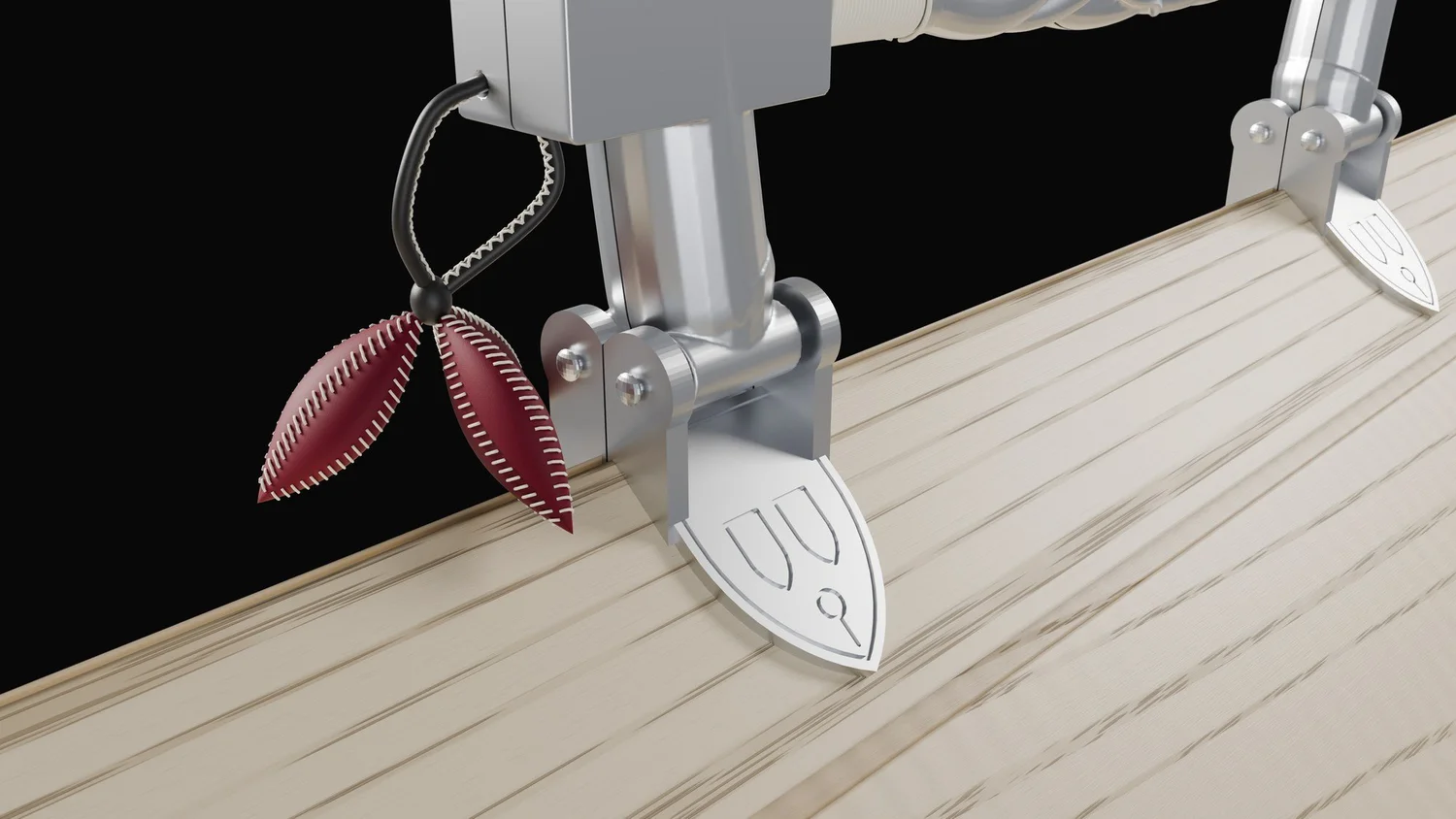
12Handle, split on the ridge
One half on each wing; the halves meet when the roof shuts. Bead-blasted 316L stainless, twisted grip, on loose vertical-grain tenons.
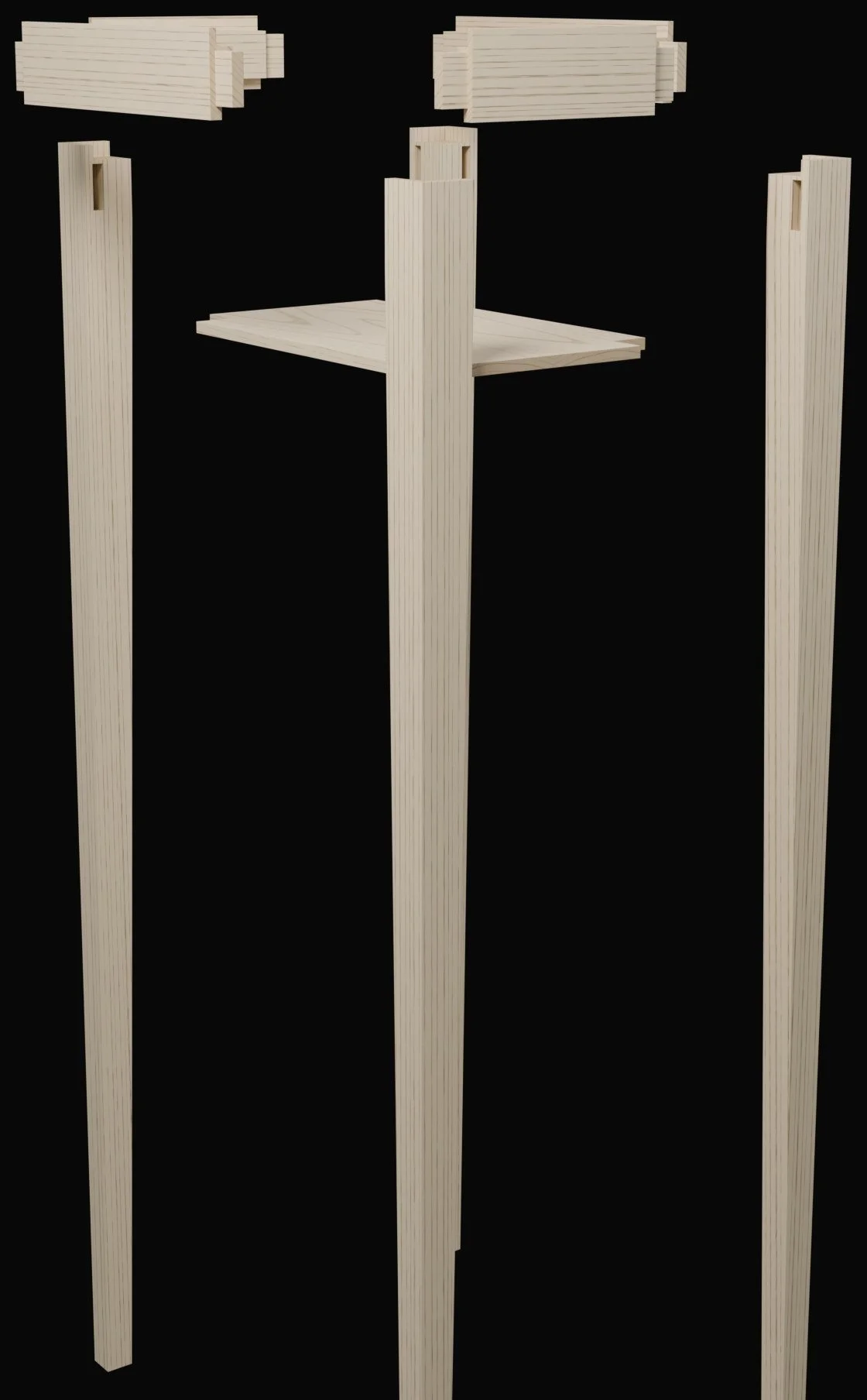
The stand, exploded
Four legs, tray aprons, keyed lid
01Legs: 1 3/4 in square, 44 1/4 in long
Solid ash, tapered on the two inside faces from the apron line down to 1 in square at the foot.
02Aprons: mortise and tenon
3/4 x 2 1/2 in aprons set back 1/8 in from the leg faces, 3/8 in tenons 7/8 in into the legs. The four aprons are the walls of the tray.
 1234
03Lid rabbet and leg pockets
A 1/2 in rabbet along the top inside edge of every apron, with matching pockets in the legs, so the lid sits flush with the apron tops.
04Tray bottom, rabbeted in
A 3/8 in board in a 3/8 x 3/8 in rabbet along the bottom of the aprons, notched round the legs. The hidden well under the case.
Tray lid: the floor under the case. A frame-and-panel board that closes the tray and carries the case. Lift it and the well is open. T-keys. Two raw ash T-keys slide through slots in the lid into the case’s bottom rails. Draw them and the case comes off the stand.
Joinery
Sixteen joints, pulled apart / every part named
How the jail works
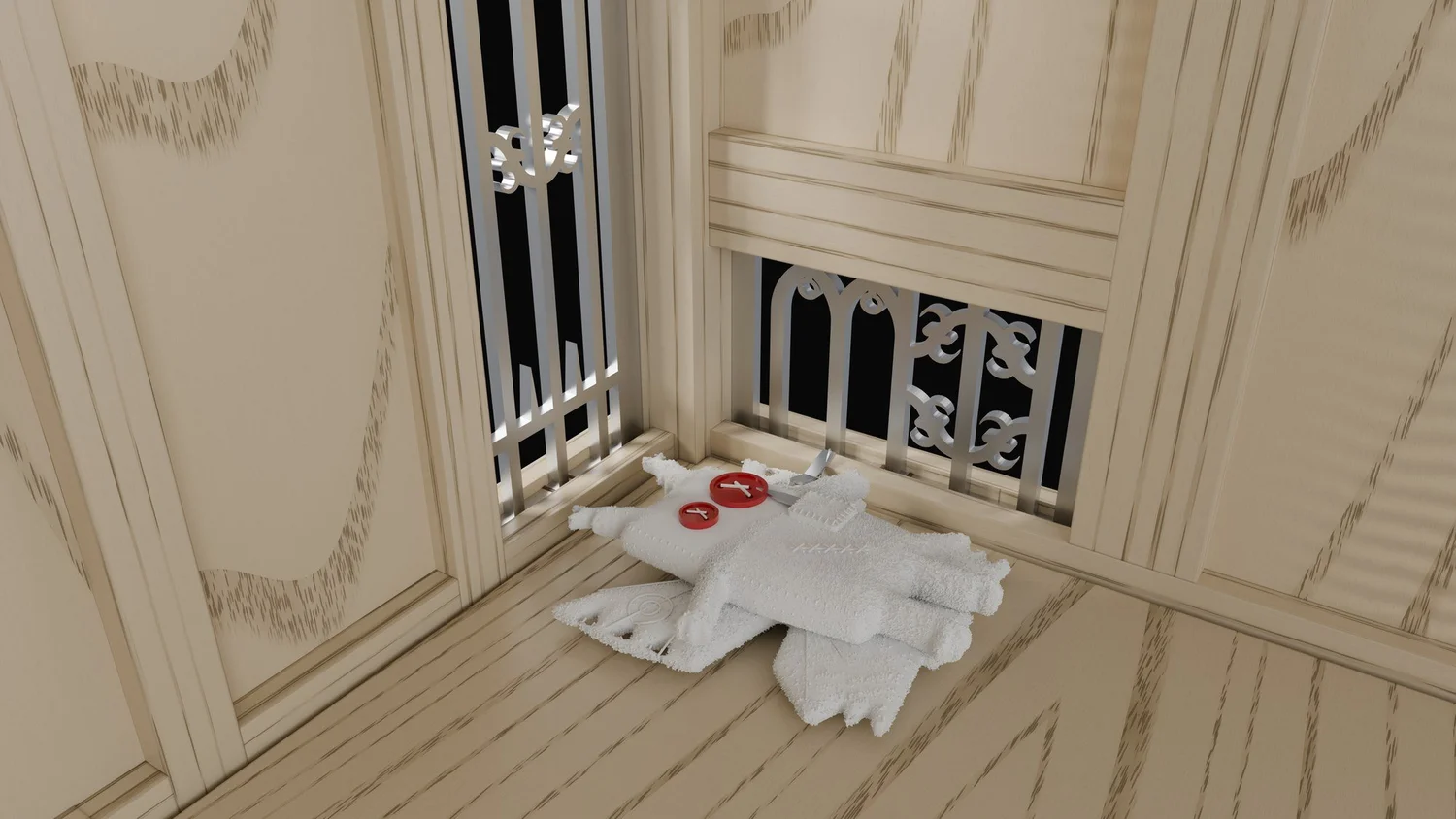
In the back-left corner, one bay of the flank and one bay of the back hold no panel. In their place sit two plates of 1/8 in laser-cut stainless: upright bars, two lancet arches and a scroll that wraps the bars. They meet at the corner post and sit in the same grooves as the panels, pinned through the rails with ash pins. Behind them, on the cell floor, the moth monster lies on its cushion.
The moth monster
The plush in the cell, element by element / from above, lying on his back on the cell floor / white felt, white thread, red buttons, stainless
- 1Feathered antennae A comb of teeth each side of the stem, longer outboard, with the tips forked.
- 2Mismatched button eyes Two red buttons, one big and one small, each with the moth’s four holes and white thread crossed through. They are the only colour on him.
- 3No neck One flat silhouette: a rounded crown straight into squared shoulders.
- 4Fur ruff Long fur round the thorax, short fuzz everywhere else.
- 5Pocket and lancet A felt patch on his chest, open at the top, with his stainless lancet tucked in.
- 6Three-fingered mitts Forked mitts on arms held straight out from the shoulders.
- 7Sutured belly An incision cross-stitched shut with five stitches. What came out of it, he ate.
- 8V-notched wings The trailing edges are forked with notches: his own body mods.
- 9Long straight legs Three-toed feet at the ends.
- 10Blanket stitch White thread on white felt all round every piece, plus stitched wing veins and eyespots.
- 11Stainless clothespin Clipped to the near forewing the way a specimen label hangs from its pin.
- Felt
- white wool felt, body and wings cut flat and stuffed thin
- Thread
- white, every stitch
- Eyes
- two red four-hole buttons, mismatched
- Steel
- stainless lancet and clothespin
- Size
- about 3 in long, 2 3/4 in across the wings
Pin moths
Giant peacock moth, wings open / four ash pins on a side rail / the same four marks
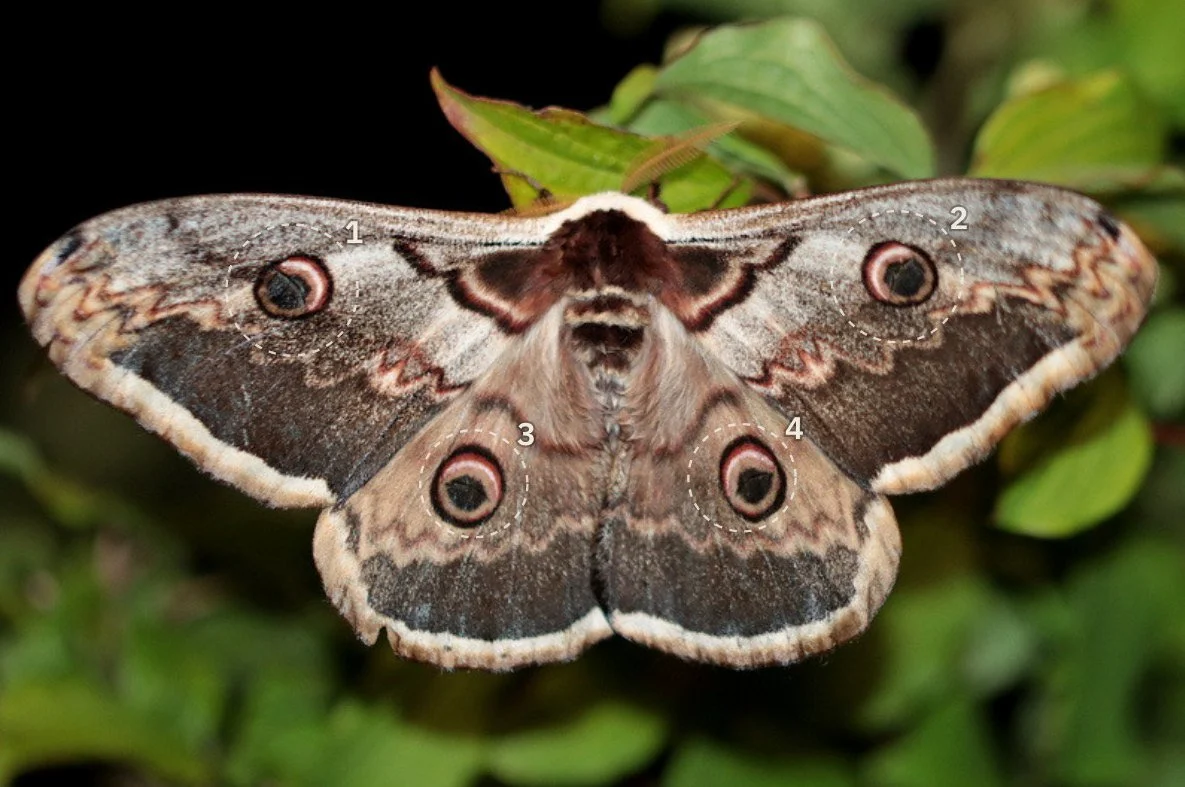
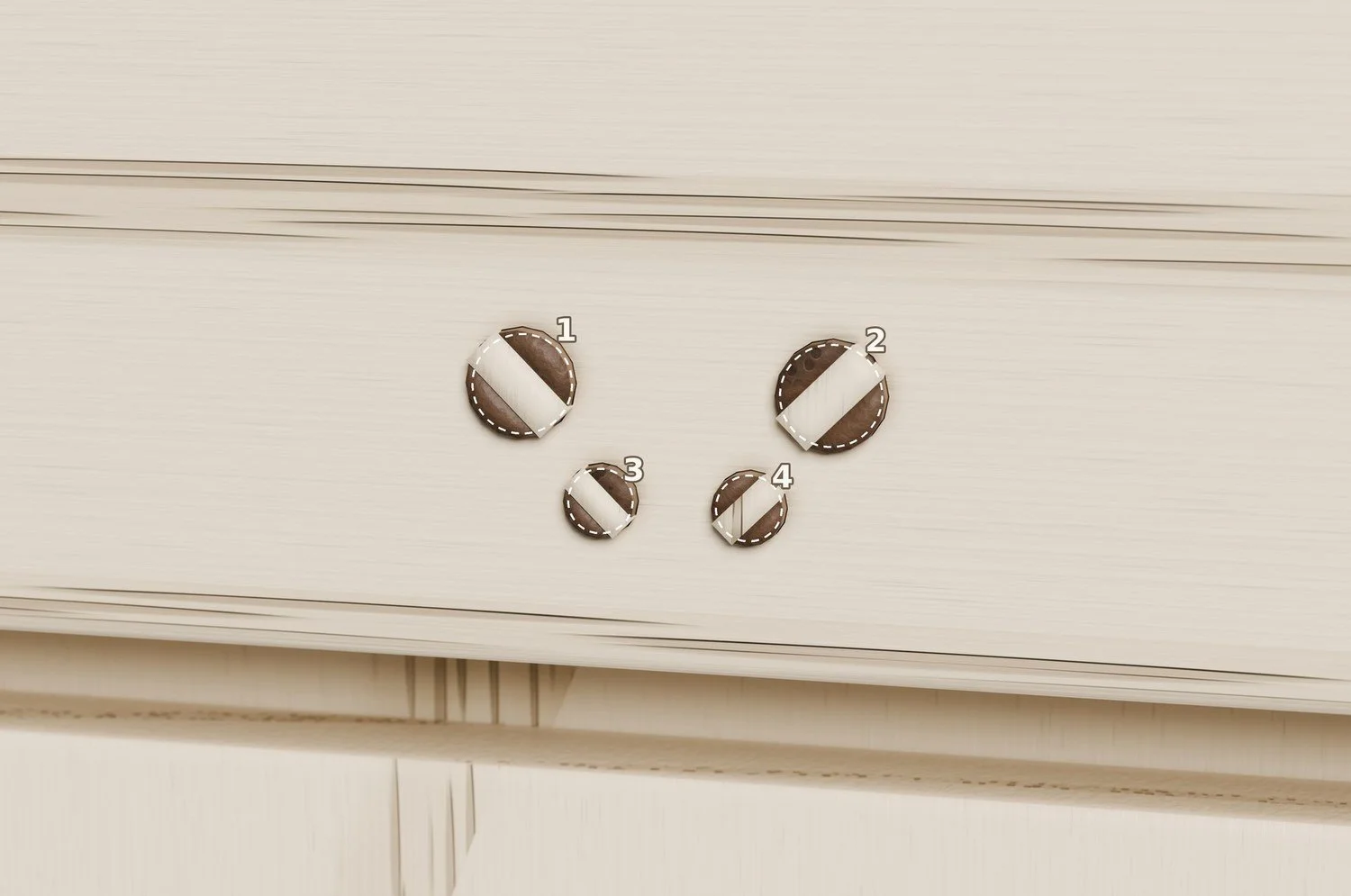
1 Left forewing eyespot: the big pin, top left.
2 Right forewing eyespot: the big pin, top right.
3 Left hindwing eyespot: the small pin, below and inboard.
4 Right hindwing eyespot: the small pin, below and inboard.
The moth is never drawn on the case. The pins are structural: they hold each floating panel centred in its groove, and they are set out as the moth’s four eyespots, so every pinned rail carries the same four marks. Up close it is joinery; from arm’s length it is a moth.
Four layouts, drawn full size
A Forewings
Wide pair above, narrow pair below: the guard’s outline.
B Swept back
Narrow pair above, wide pair below: a moth at rest, wings folded back.
C Two sizes
Forewings 3/32 in, hindwings 1/16 in. Reads as a moth from arm’s length.
D Diamond
Head, two wings and tail. The plainest; closest to an ordinary pin pattern.
Every layout stays inside the middle 3/8 in, so the pins never stop the panel moving, and inside the dashed band, the last 5/16 in of the rail where the tongue sits, so all four pins catch it.
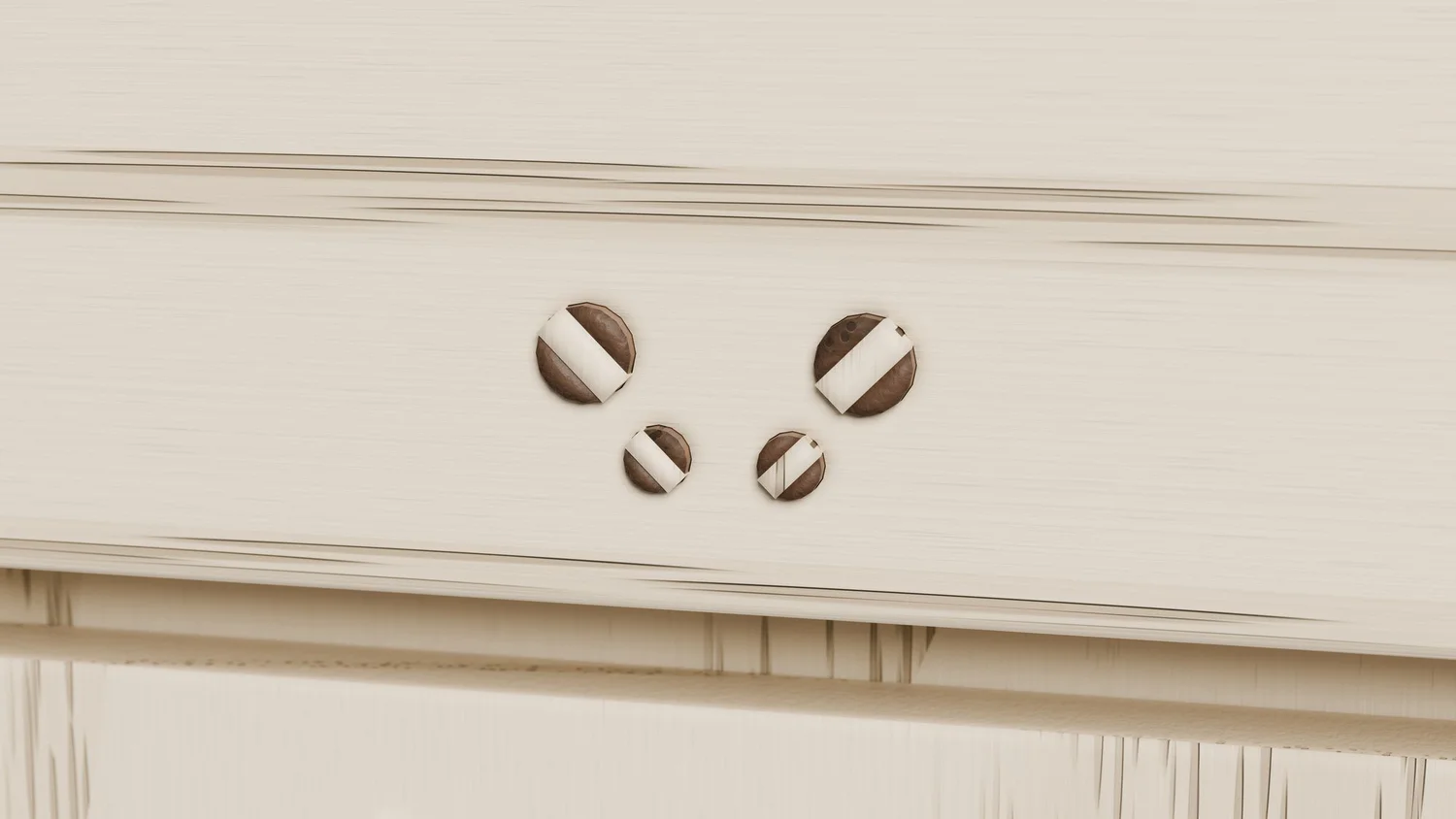
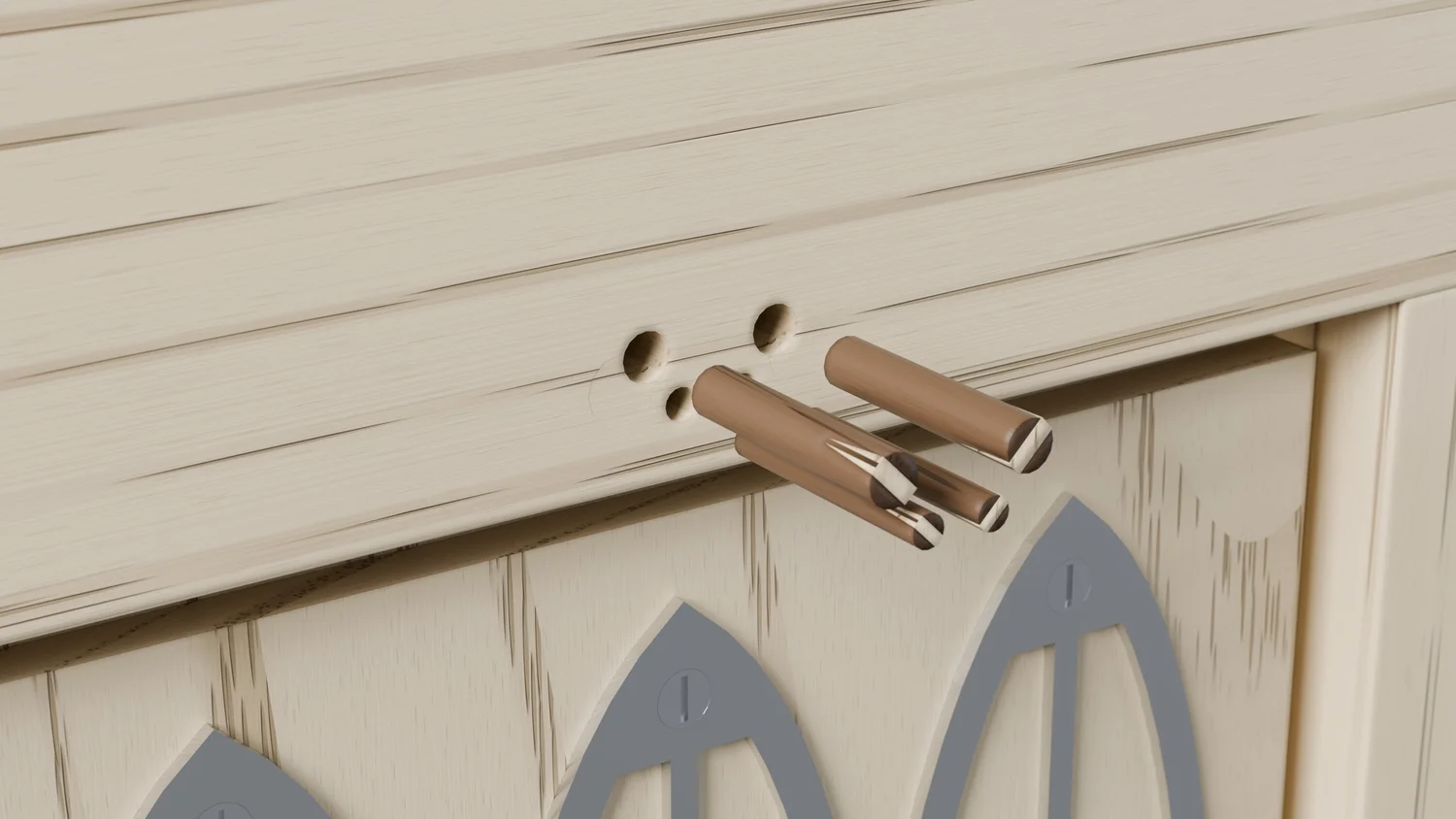
Design iteration
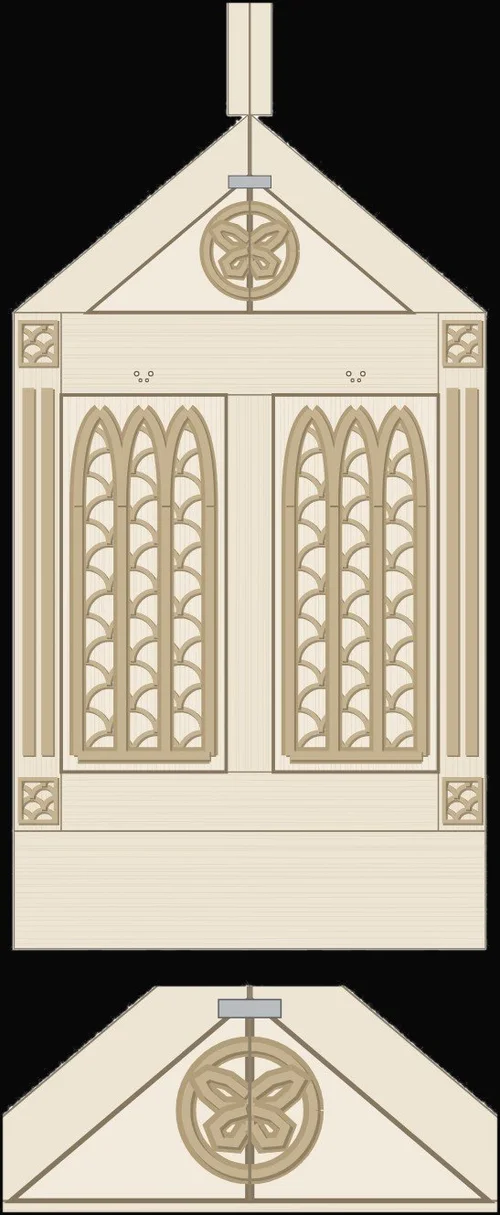
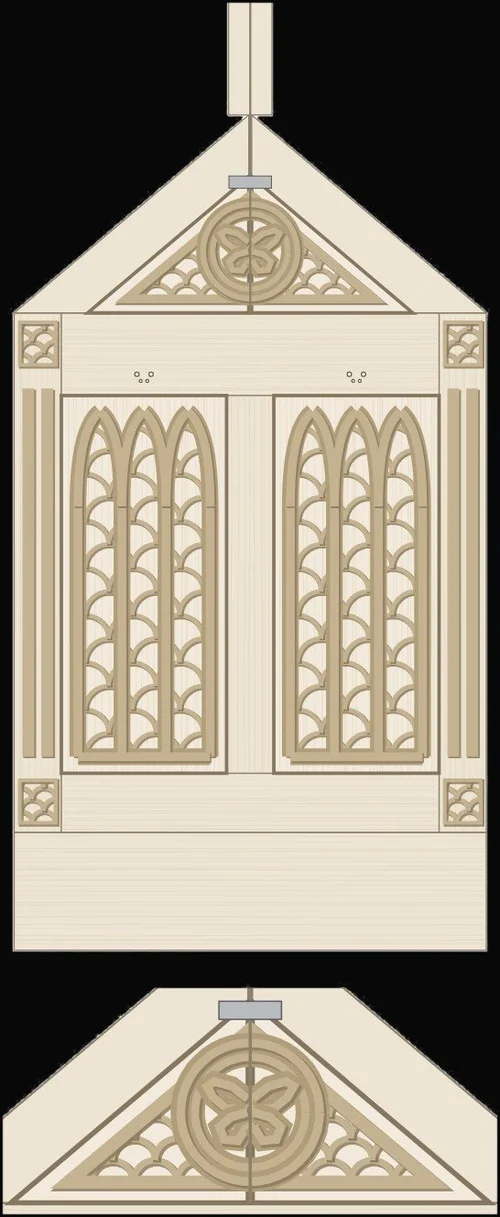
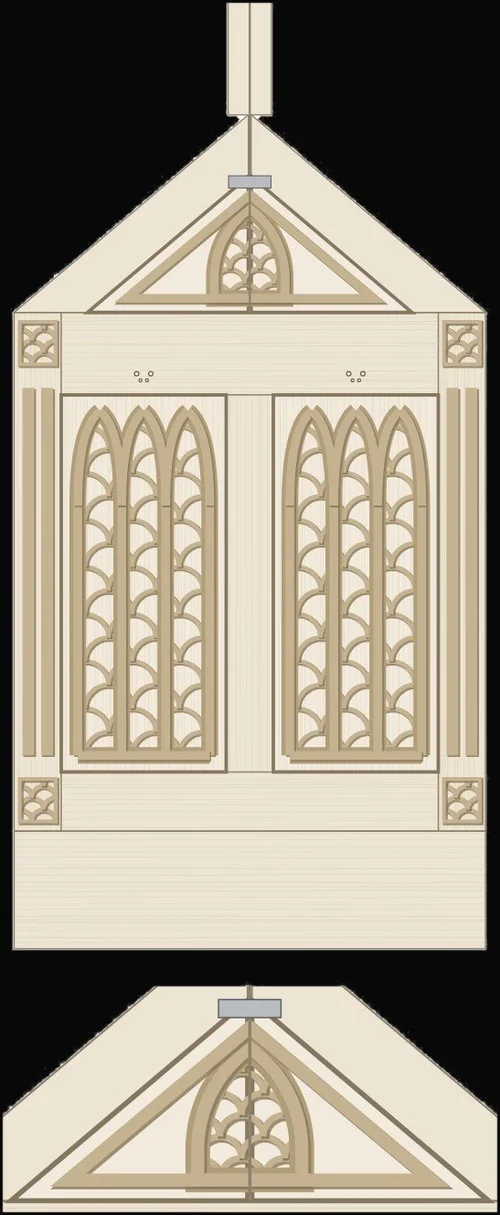
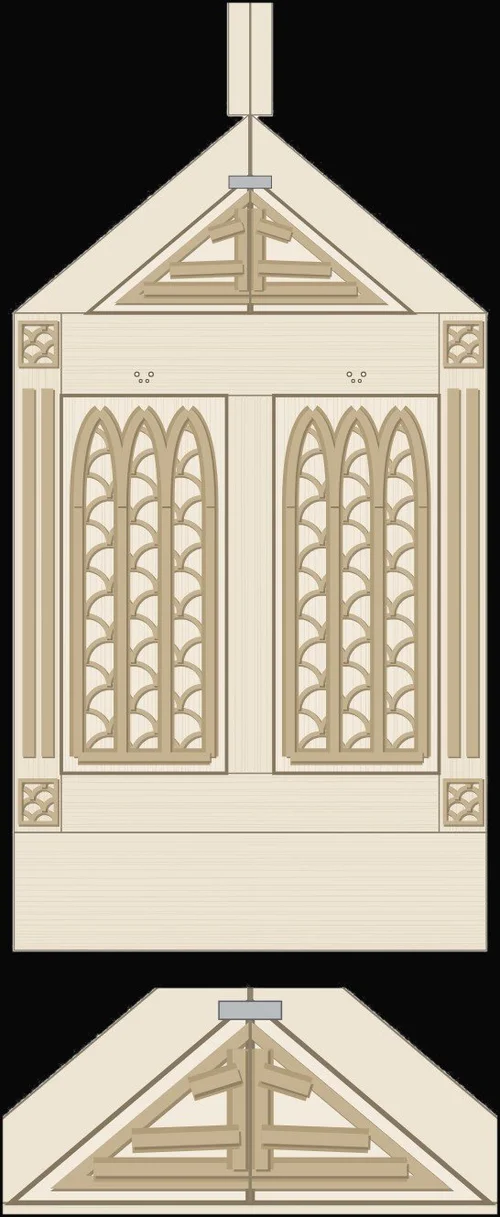
How the case got its face / flat elevations, to scale, drawn in raw ash
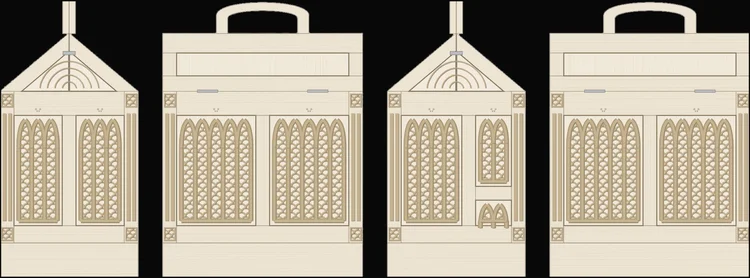
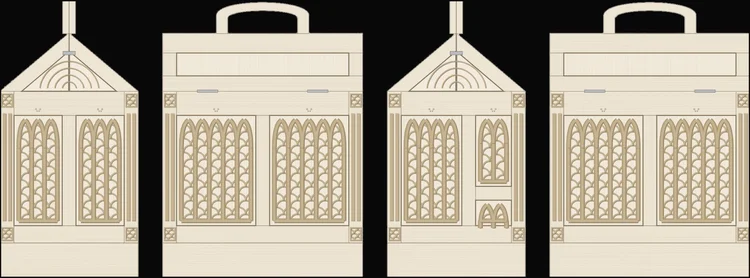
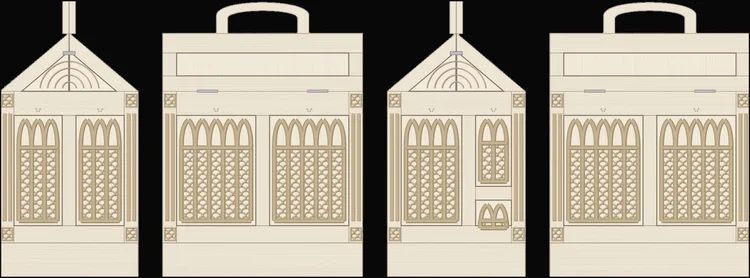
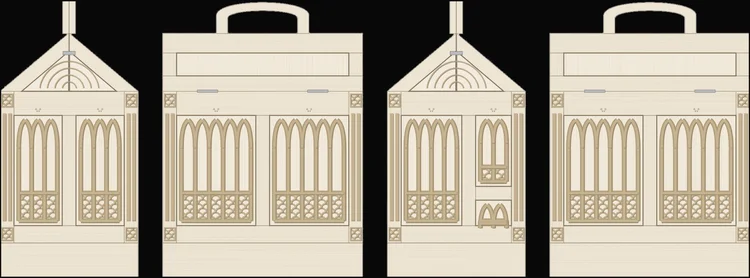
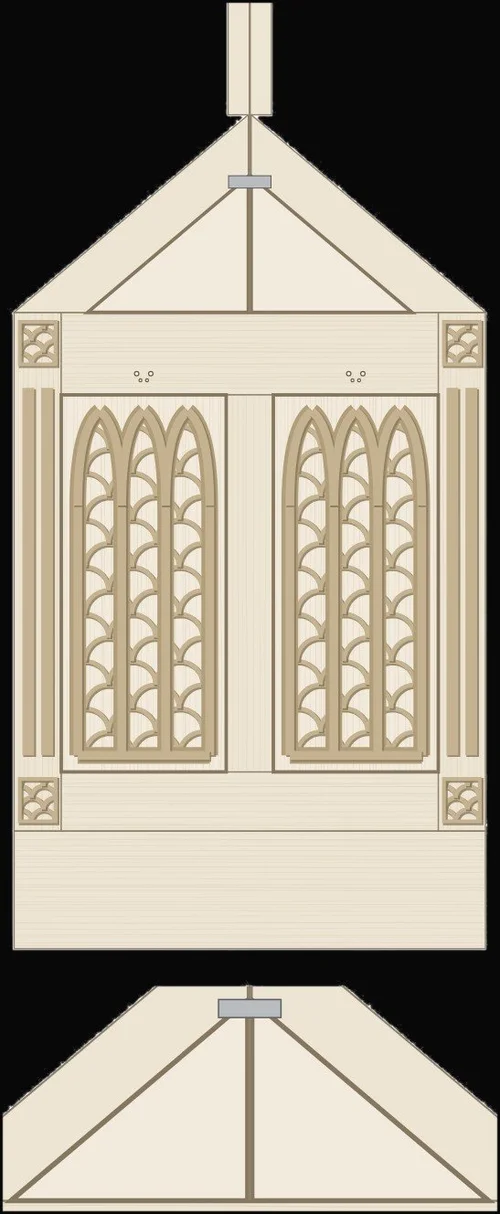
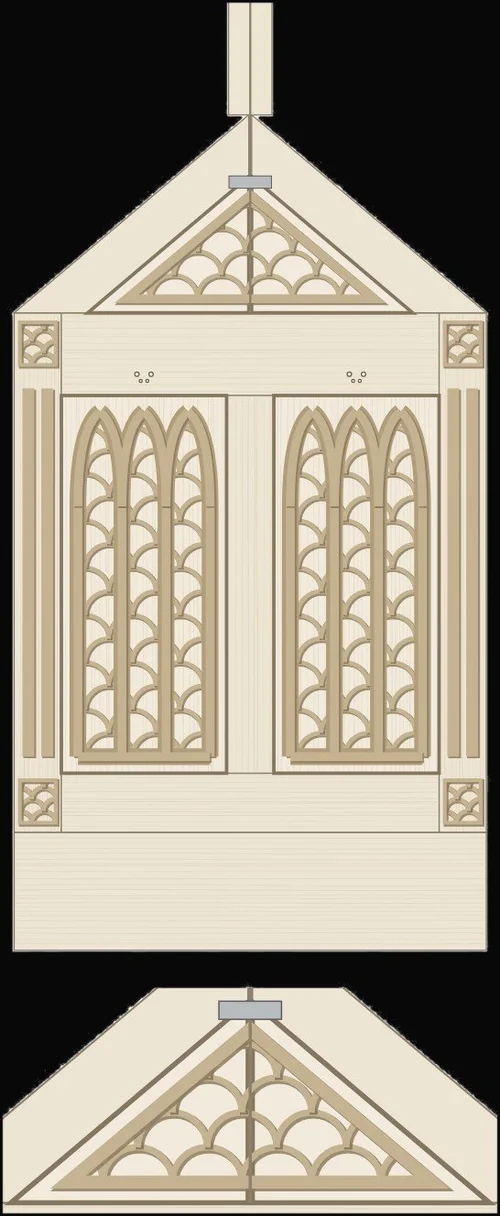
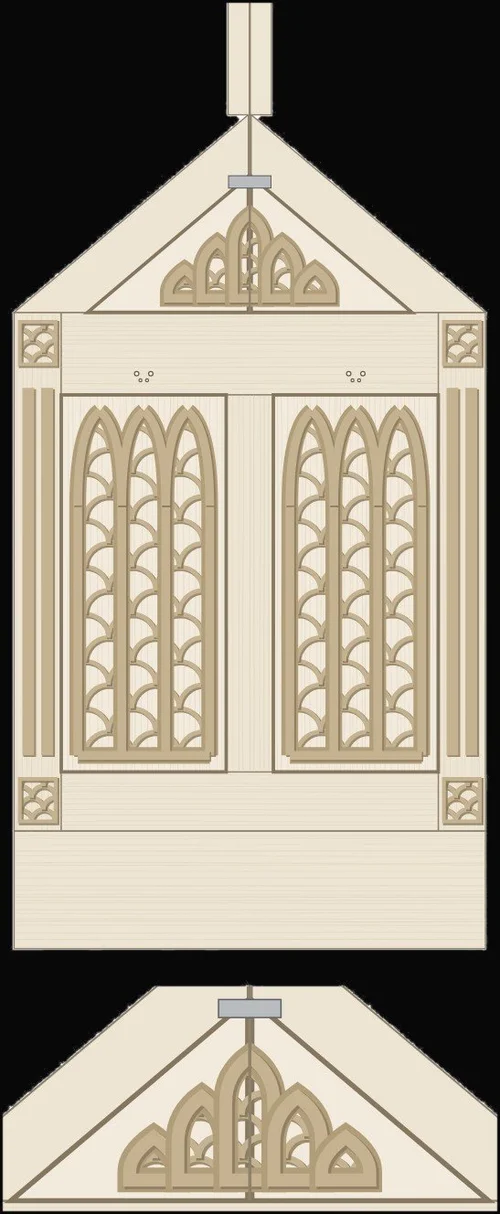
01 Carved first
Eight ways to set fish scales against the tracery, and eight gables, before the carving gave way to inlay.
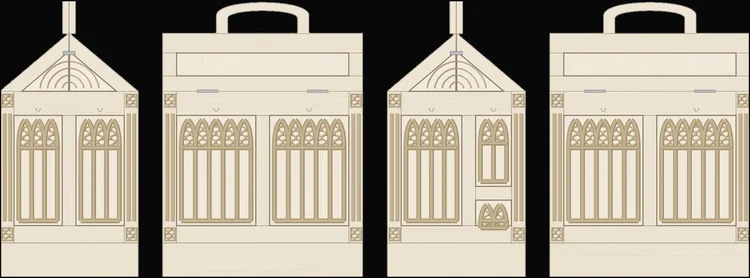
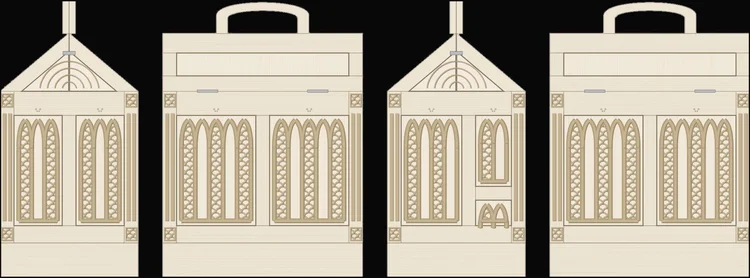
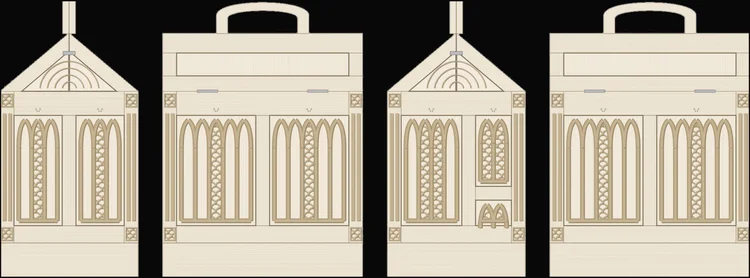
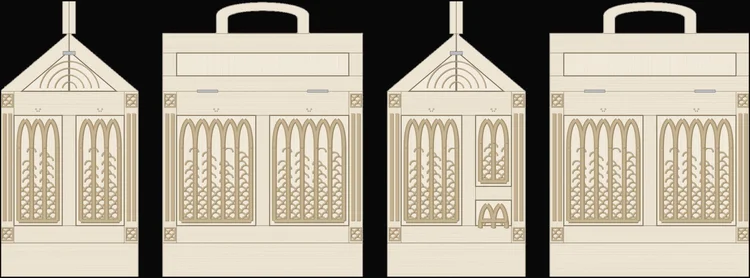
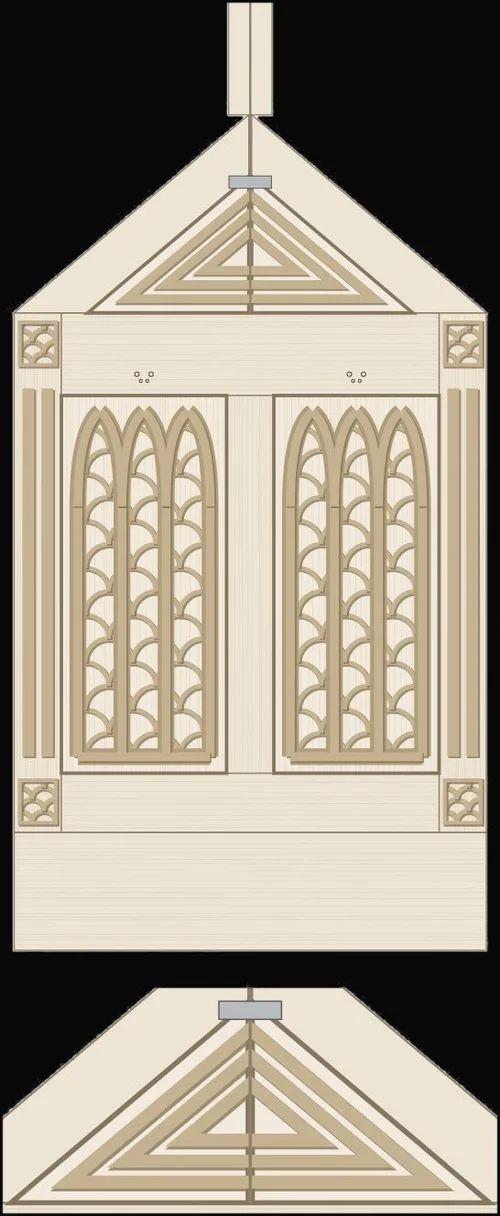
02 Inlay instead of carving
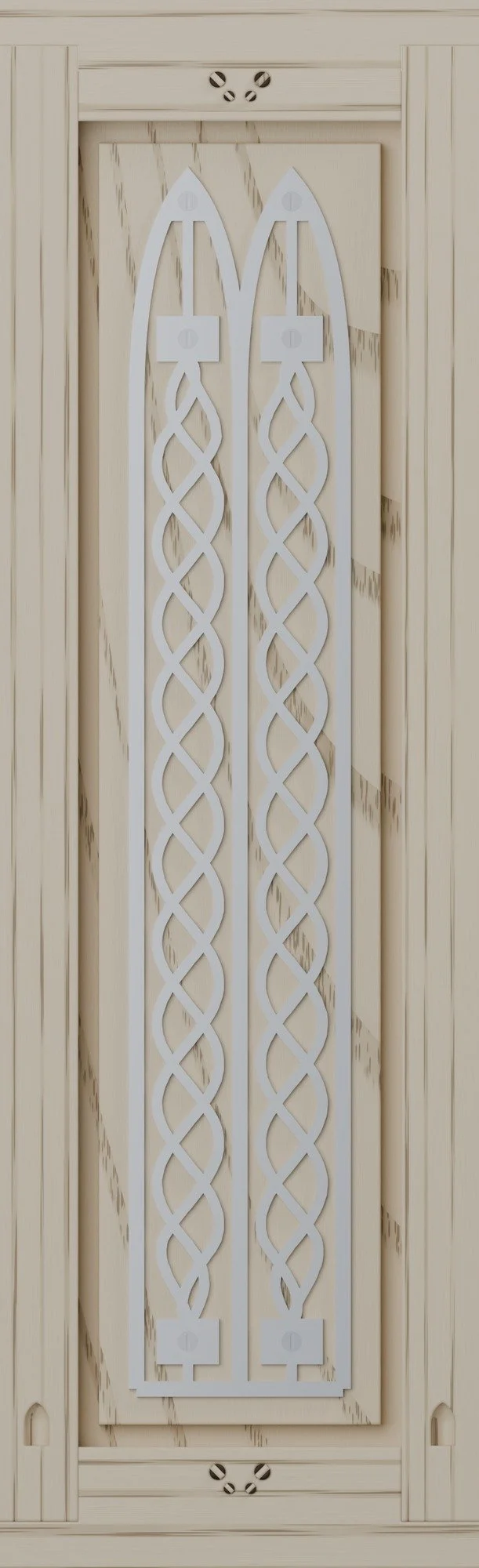
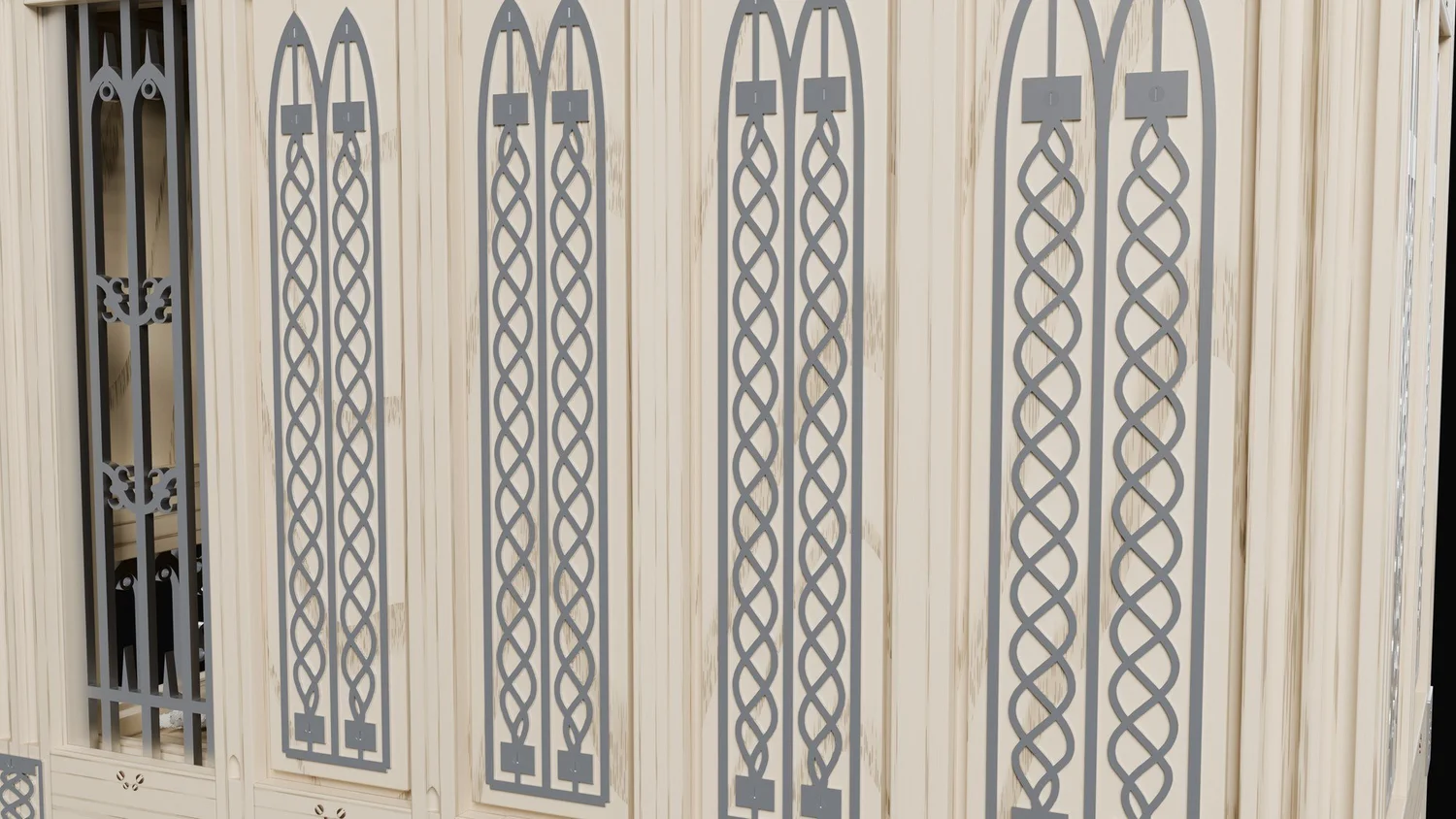
Then the routing went. Every line became a flush strip of laser-cut stainless set into raw white ash, and the scales gave way to three-strand braids drawn from the handle, gathering into square blocks at head and foot. This is the case as built.
Laser-cut mockup
The whole case at 1:1 / 1/8 in birch ply on the xTool
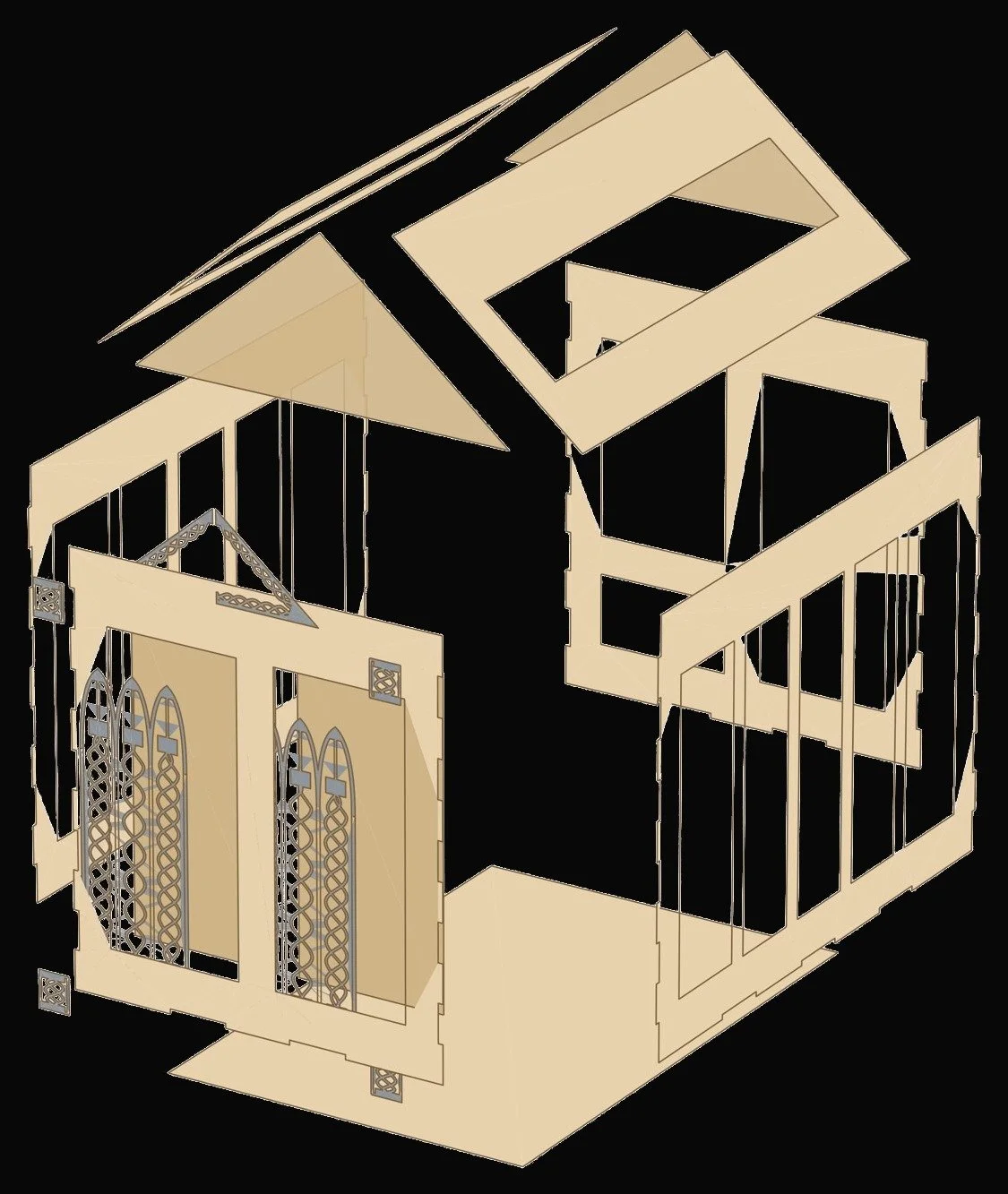
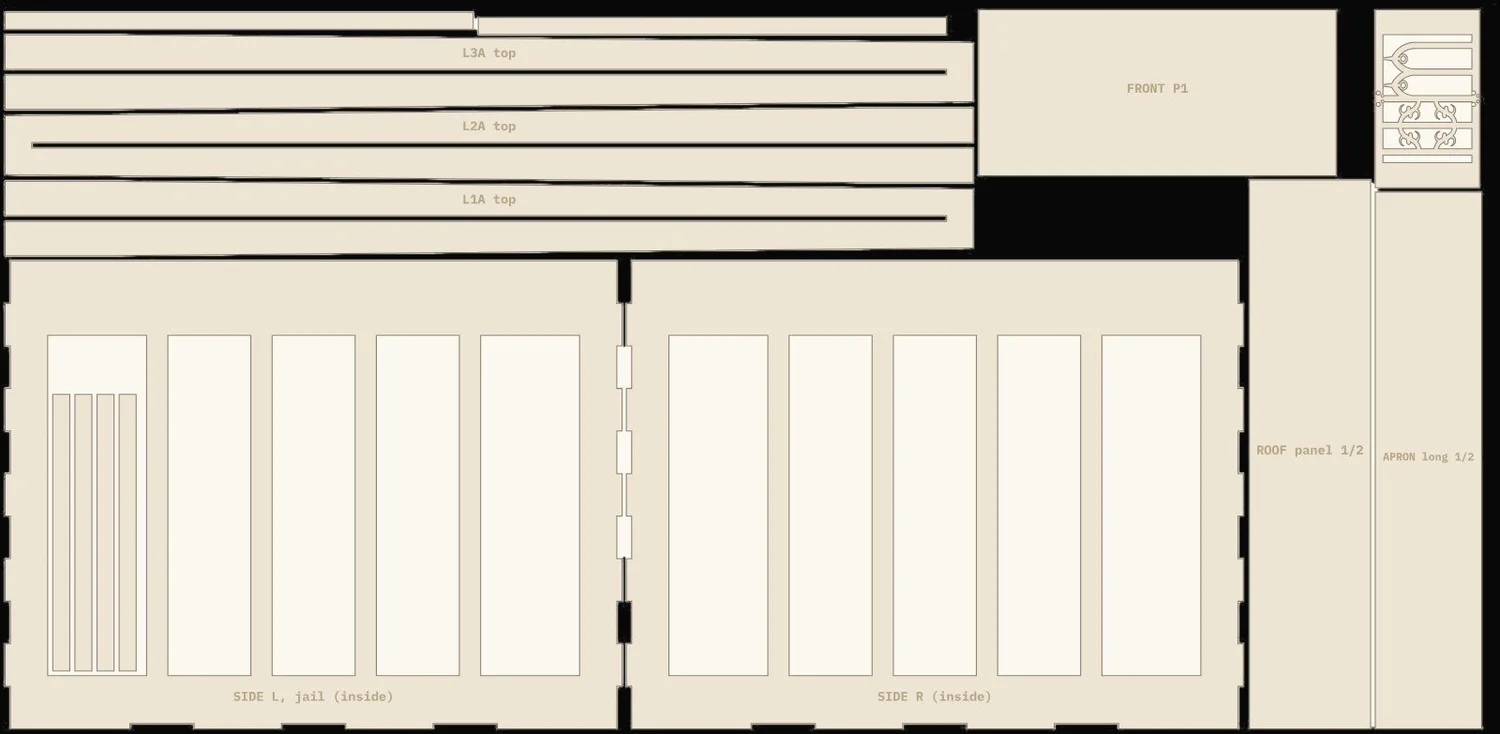
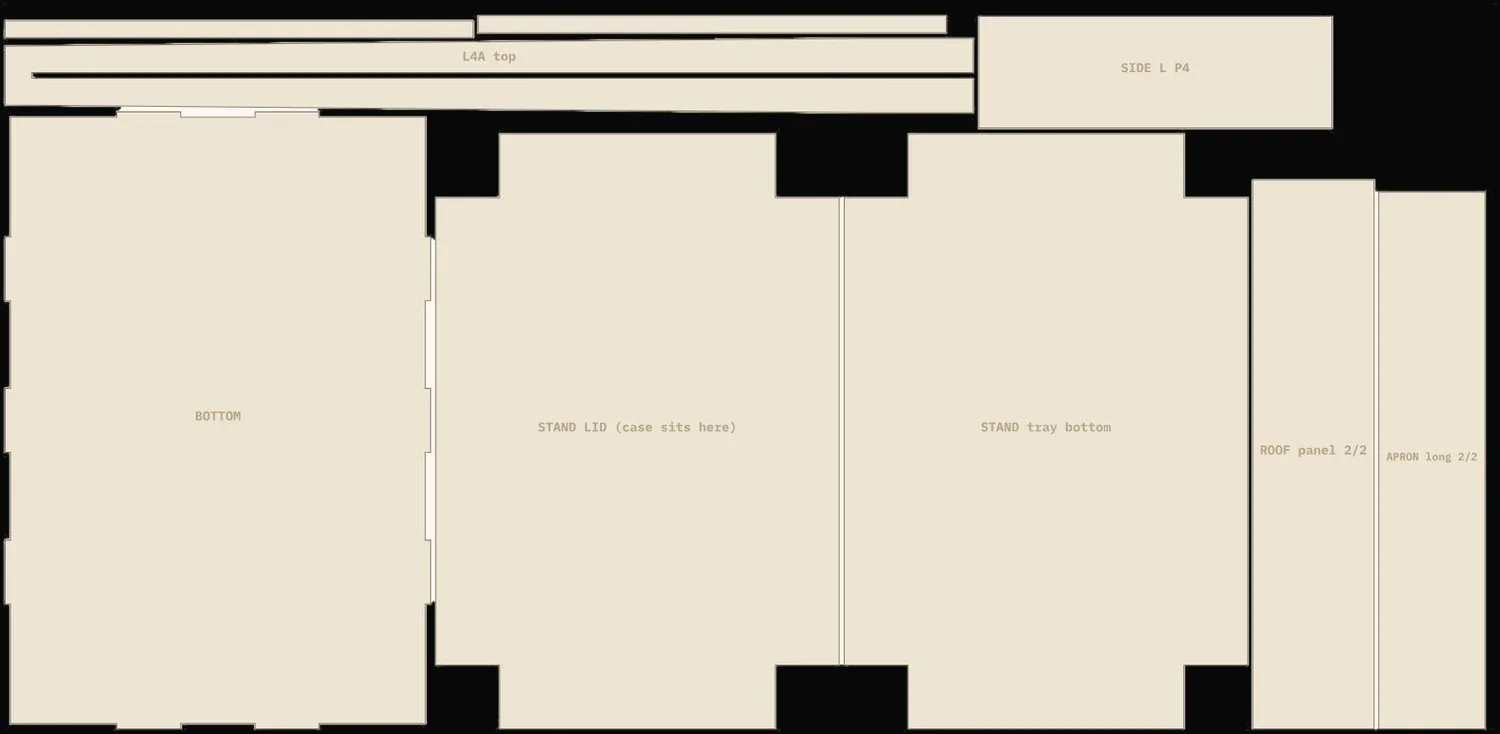
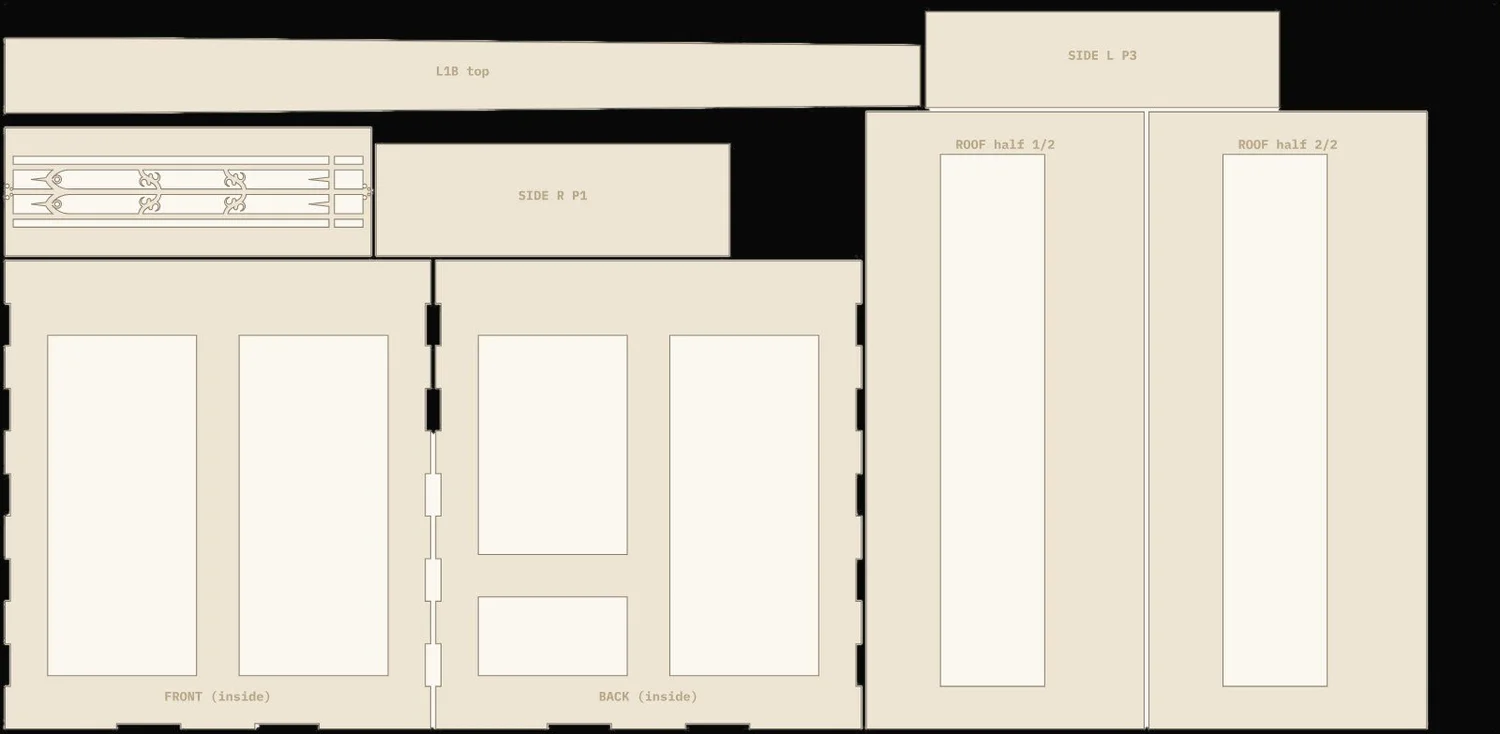
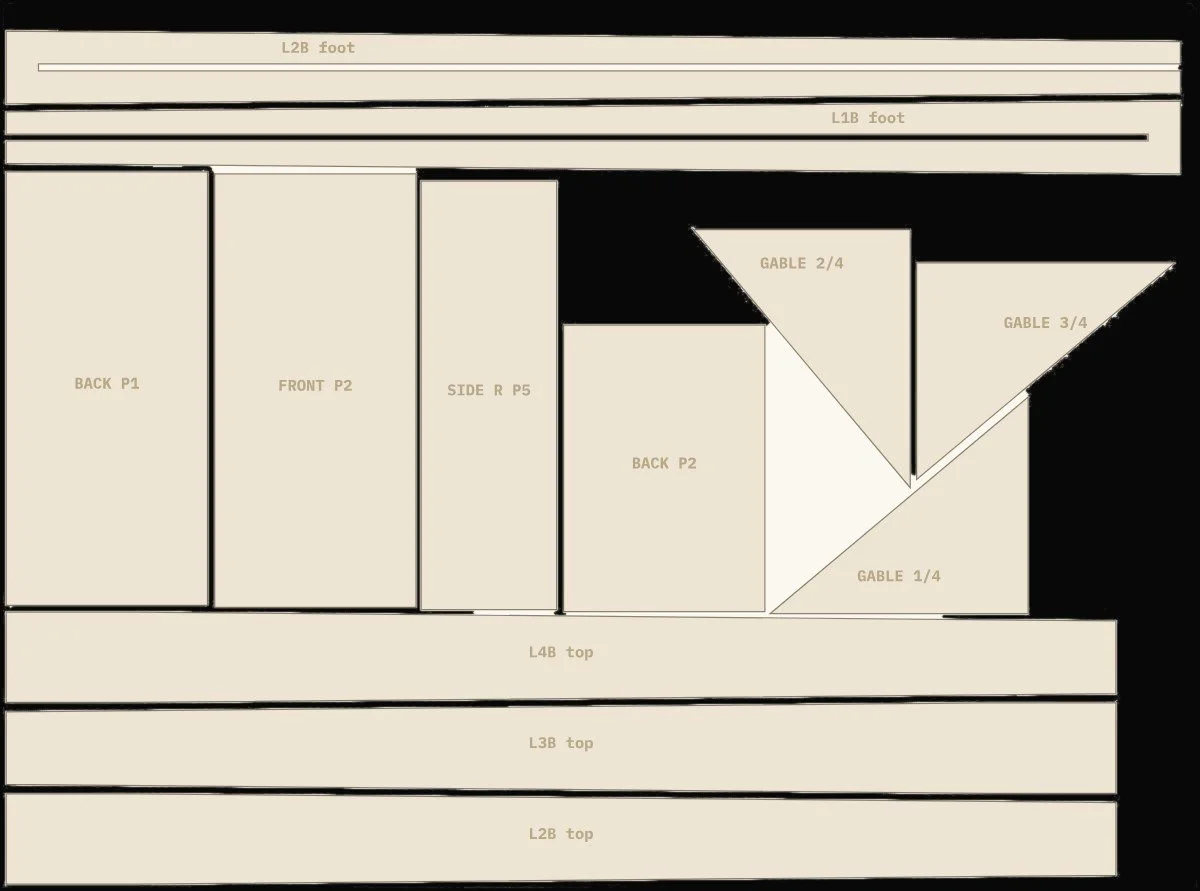
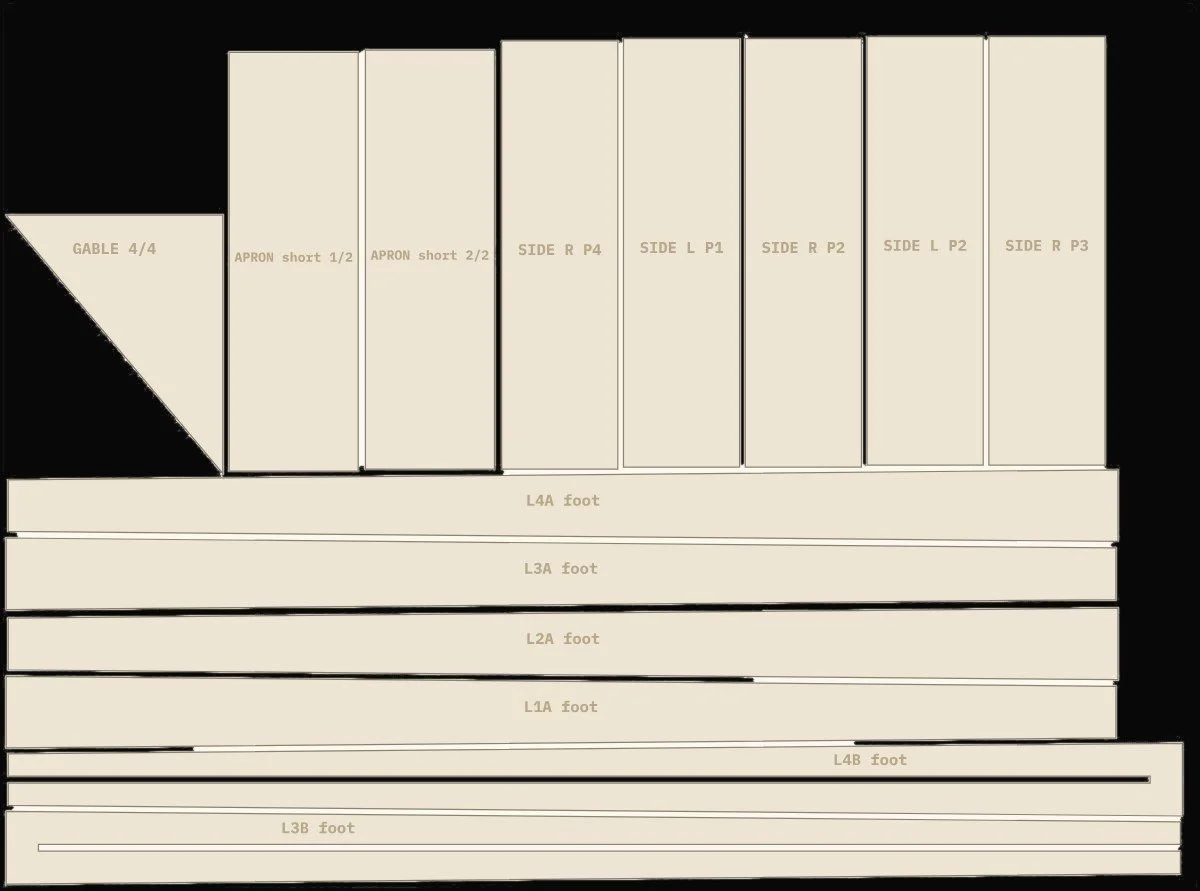
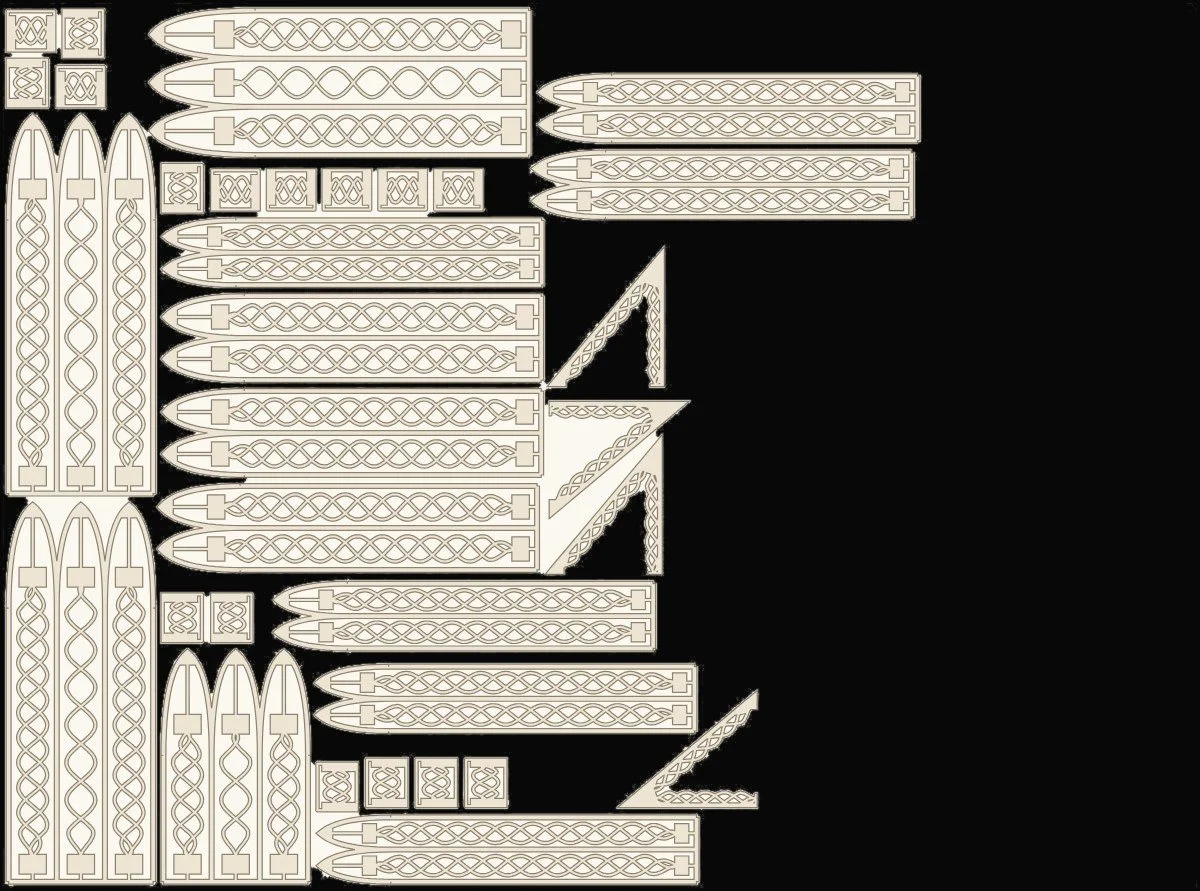
To check the proportions, the case was drawn for cutting full size from one 5 × 5 ft panel of 1/8 in Baltic birch and hot-glued together: box-jointed body, panels set one ply behind their windows, the split roof, the jail plates, and the cross-lap stand. The braids and lancets get their own sheet of 33 inlay pieces, so they can be cut from something thin and silver to stand in for the stainless.
Roof swoop options
Sixteen ways to swoop the gable / front view, red dashed: the left roof half opening 15° and 40° / red rings: where it goes wrong
C Gentle arc, 3/4 in
dip 3/4 in · rail 1 in at centre · seam V 1/16 in a side
- 1seam rubs 1/16 in
- Clear swoop, still calm
- Seam needs only ~1/16 in V relief
- Rail keeps 1 in at centre
- Seam bottom needs a small V bevel
- Top rail mortises sit closer to the curve
A Straight parting line
rail 1 3/4 in at centre
- No clearance problems
- No clearance problems at all
- Simplest joinery, rail stays full 1-3/4 in
- No swoop: reads stiff and boxy at the gable
B Gentle arc, 1/2 in
dip 1/2 in · rail 1 1/4 in at centre · seam V 0 in a side
- 1seam rubs 1/32 in
- Seam rub only ~1/32 in, a normal reveal covers it
- Rail keeps 1-1/4 in
- Easy to lay out with a bent batten
- Subtle: may read as a mistake from across the room
D Deep arc, 1-1/2 in
dip 1 1/2 in · rail 1/4 in at centre · seam V 1/4 in a side
- 1seam rubs 1/4 in
- 2rail only 0.25 in
- Dramatic, very visible from the front
- Rail drops to 1/4 in: must be remade taller
- Seam needs ~1/4 in V relief, visible
- Lid gable gets heavy and fragile at the tip
E Elliptical (fuller) arc, 3/4 in
dip 3/4 in · rail 1 in at centre · seam V 1/16 in a side
- 1seam rubs 1/16 in
- 2short grain
- Reads bolder than 03 at the same depth
- Same small seam relief as 03
- Turns steeply near the posts: short grain at the lid corners
- Harder to cut cleanly than a fair arc
F Flat shoulders + arc
dip 3/4 in · rail 1 in at centre · seam V 1/16 in a side
- 1seam rubs 1/16 in
- Hinge zone stays straight: hinges and posts untouched
- Crisp, architectural look
- Small kink where flat meets curve; needs careful fairing
- Same ~1/16 in seam relief as 03
G Pointed (Gothic) dip
dip 7/8 in · rail 7/8 in at centre · seam V 1/16 in a side
- 1seam rubs 1/16 in
- 2rail only 0.85 in
- 3fragile point
- Matches the Gothic jail and lancet details
- The point lands exactly on the seam, so it reads as one shape
- Point sits right on the seam: worst place for rub (~1/16 in+)
- Sharp tip on each lid half is short grain and chips
- Rail thin right at the point
H Ogee (S-curve)
dip 3/4 in · rail 1 in at centre · seam V 1/16 in a side
- 1seam rubs 1/16 in
- Most graceful, classic furniture curve
- Gentle at the posts, no short grain
- Needs a template; harder to make both sides match
- Same ~1/16 in seam relief as 03
I Swoop + bell drop
dip 1 1/8 in · rail 5/8 in at centre · seam V 1/8 in a side
- 1seam rubs 1/8 in
- 2rail only 0.60 in
- 3knockable drop
- Strong focal point under the ridge
- Bell can be a separate glued-on drop
- Bell is split by the seam: ~3/16 in relief or the bell must belong to one half
- Rail cut very thin under the bell
- Delicate: the drop tip will get knocked
J Double swoop (one per half)
dip 5/8 in · rail 1 1/8 in at centre
- No clearance problems
- No seam rub at all: the halves meet at the eave line
- Each lid half reads as its own wing
- Busy: two curves plus the ridge line
- Short rise at the centre is a weak little tooth on the rail
K Upward arch
rises 0.6 in · rail 2 3/8 in at centre
- No clearance problems
- No seam rub and no lid clearance issue
- Body rail gets taller and stronger
- Arch rises into the ply gable: smaller triangle
- Reads like a doorway, not a swoop
L Trefoil drop
dip 13/16 in · rail 15/16 in at centre · seam V 1/16 in a side
- 1seam rubs 1/16 in
- 2rail only 0.94 in
- 3fragile point
- Very Gothic, ties to the jail tracery
- Cusp points are short grain: fragile
- Centre cusp split by the seam needs ~1/16 in relief
- Lots of hand fitting
M Inset segmental arc
dip 3/4 in · rail 1 in at centre · seam V 1/16 in a side
- 1seam rubs 1/16 in
- Simple to lay out with a compass
- Posts and corner joints untouched
- Hard corners where the arc meets the straight
- Same ~1/16 in seam relief as 03
N Carved or inlaid line only
dip 3/4 in · rail 1 3/4 in at centre
- 1line breaks when open
- Zero clearance problems
- Can echo the stainless jail bars
- Easy to change later
- The swoop crosses the joint, so the line breaks when the lid opens
- Less sculptural than a cut edge
O Swoop on the body only
dip 3/4 in · rail 1 3/4 in at centre
- 1curved panel tops
- No lid or seam issues at all
- Swoop sits lower where the eye lands
- Panels need curved tops: more work
- Top rail must be cut from wider stock
P Bargeboard skirt
dip 7/8 in · rail 1 3/4 in at centre · seam V 1/16 in a side
- 1seam rubs 1/16 in
- 2covers panel tops
- Body rail stays full width
- Skirt sits in front of the body, so no body clearance issue
- Very fairy-tale cottage
- Skirt halves still meet at the ridge: ~1/16 in relief
- Adds thickness to the front
- Covers the top of the front panels
Details
Hardware
Counts for the whole piece
| Part | Material | Count |
|---|---|---|
| Front and back inlay sheets | 0.03 in 304 stainless, 2B, laser cut | 2 |
| Side inlay sheets | the jail side leaves off the strip over the bars | 2 |
| Gable inlay sheets | 0.03 in 304 stainless | 4 |
| Jail bar plates | 1/8 in 304 stainless, laser cut, flank and back | 2 |
| Handle halves | 316L stainless, bead blasted, linen whipping | 2 |
| T-keys | raw ash | 2 |
| Handle fob | black leather cord, three red leather pods | 1 |
| Handle loose tenons | raw ash, vertical grain | 4 |
| Eave hinges | stainless butt hinge, 1 1/2 in | 4 |
| Moth pins, 3/32 in | walnut, raw ash wedge | 62 |
| Moth pins, 1/16 in | walnut, raw ash wedge | 62 |
| Jail pins | raw ash pin and wedge | 12 |
| Flat-head screws | 316 stainless, 82° head, slotted, 32 tpi | 130 |
| Clothespin | stainless | 1 |
| Lancet | stainless | 1 |
Ten caskets, ten tools
Each casket door carries the mark of the tool inside
Ten families of instruments for the Moth Doctor, three of each. Every family has a mark. It is cut through the casket door as a pull standing 1/8 in proud, and inlaid in the door’s upper panel.
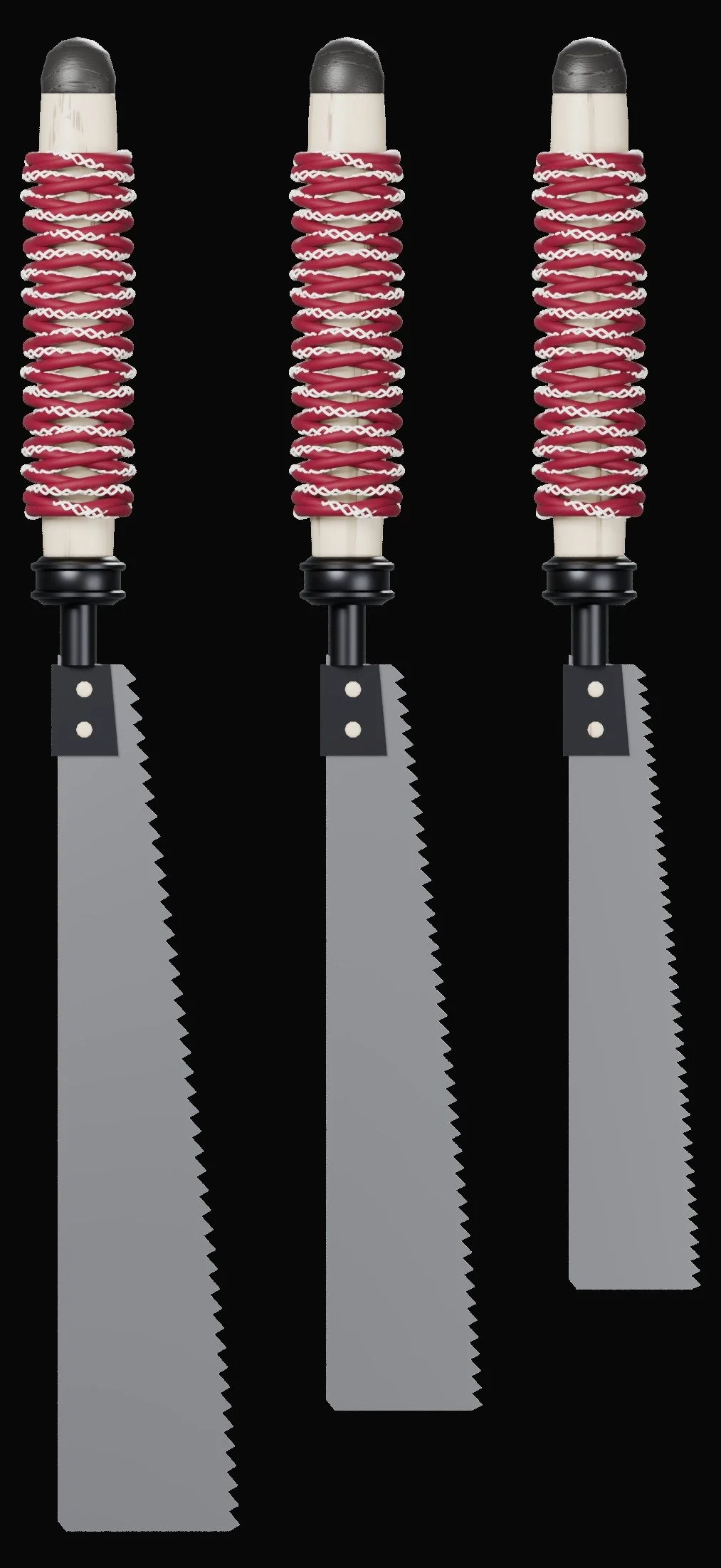
Case 01
Marrow saws
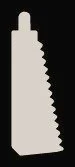
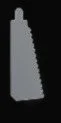
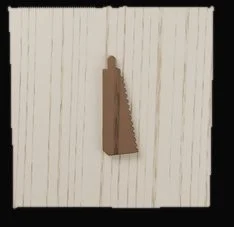
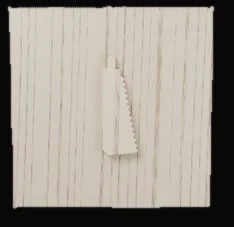
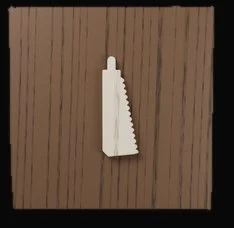
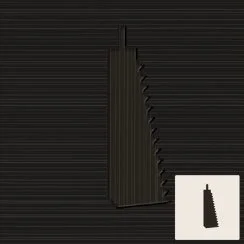
The tapered plate with its teeth and the two ash pins at the neck.
Case 02
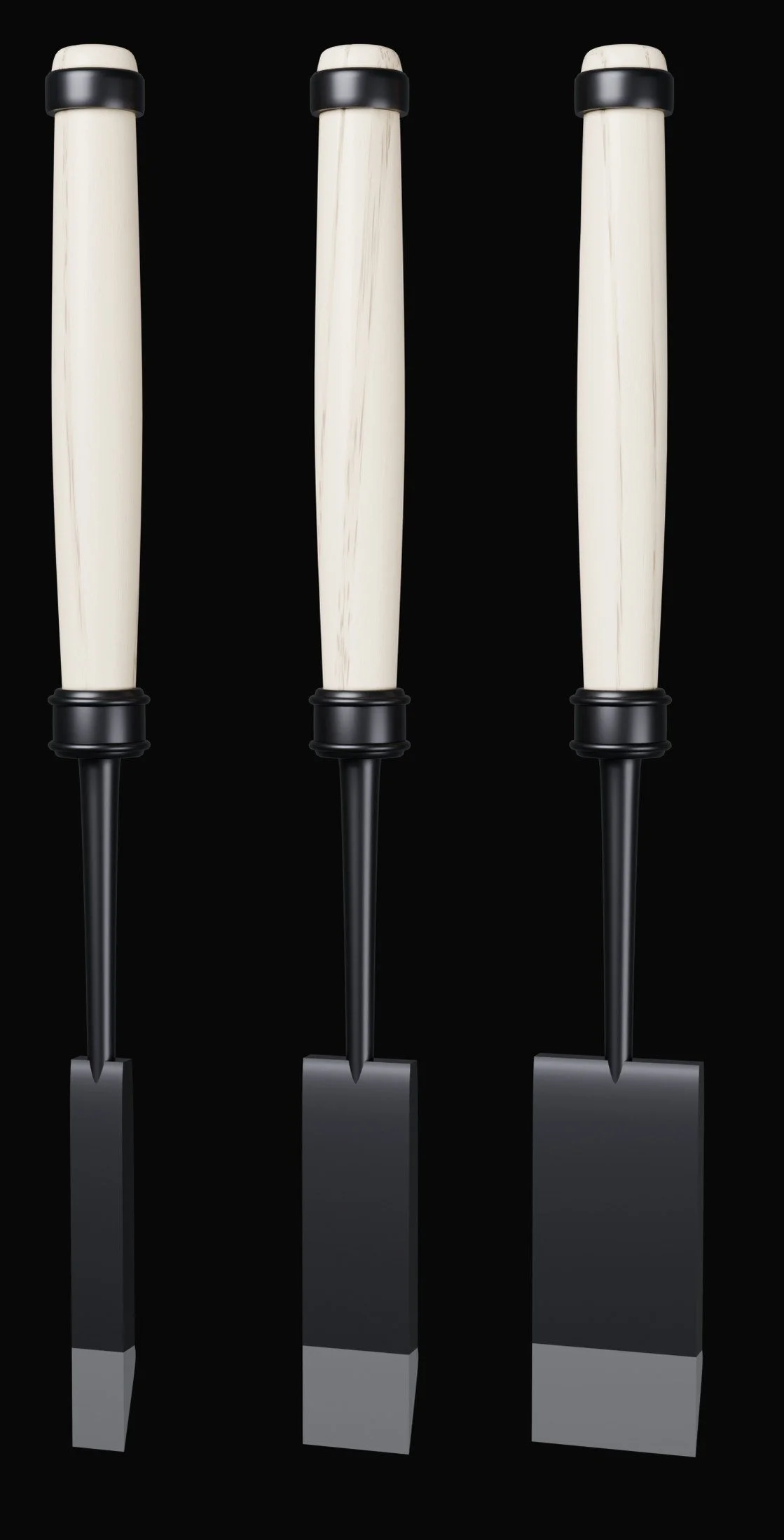
Oath chisels


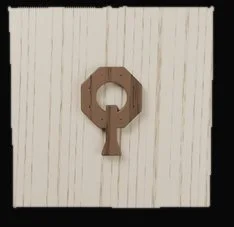
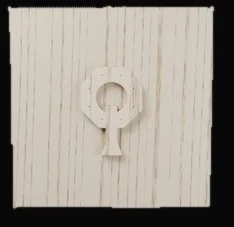
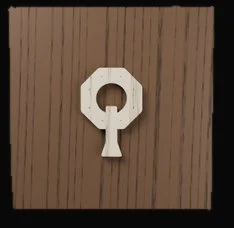
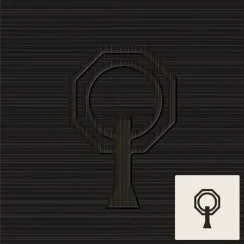
The octagonal grip seen end-on inside its hoop, the blade dropping through.
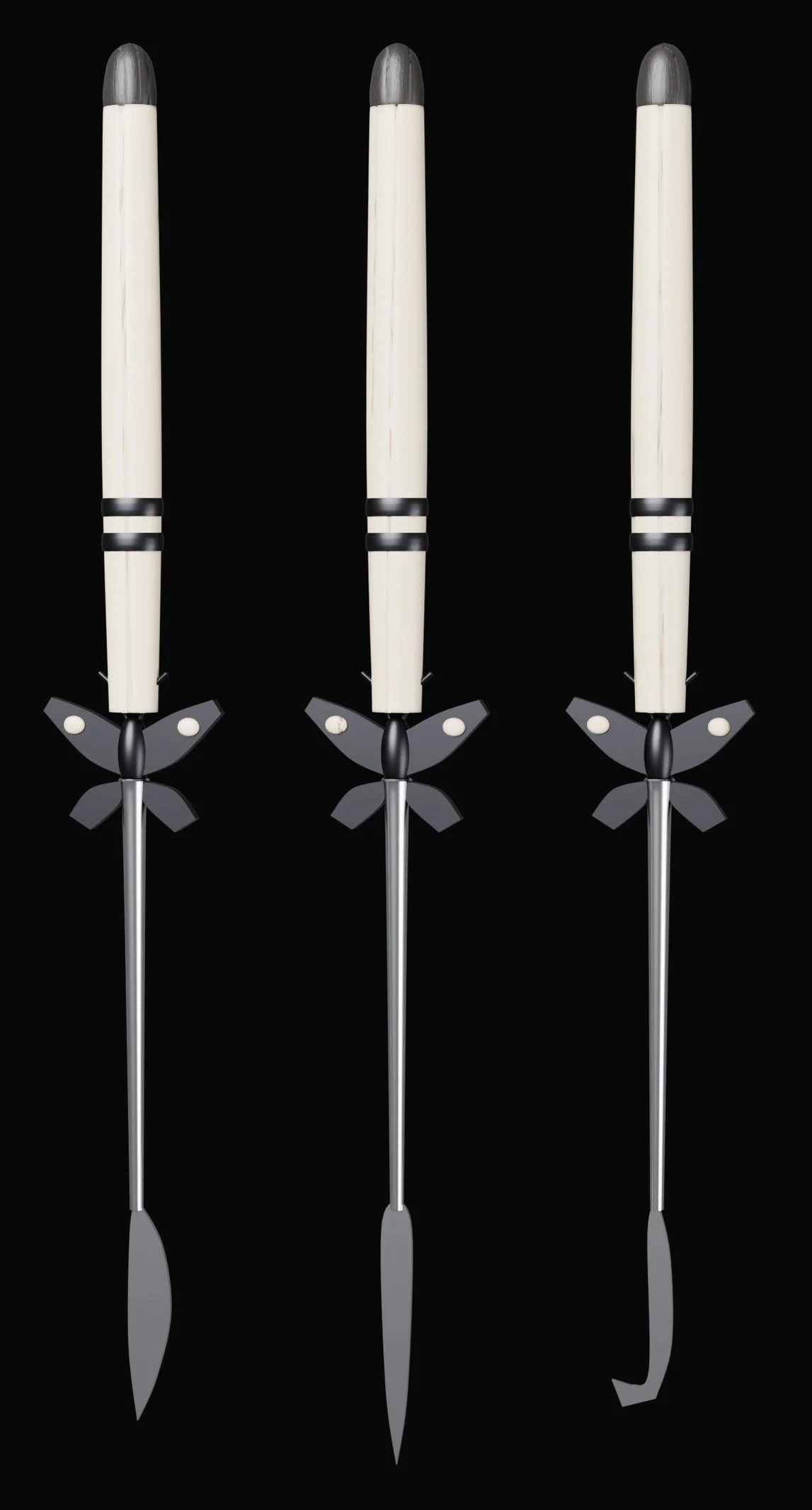
Case 03
Moth scalpels


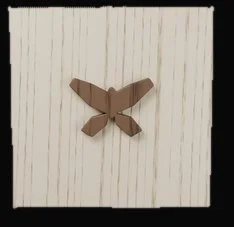


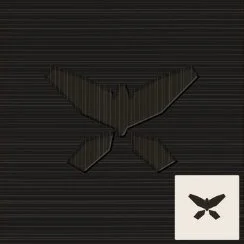
The guard itself.
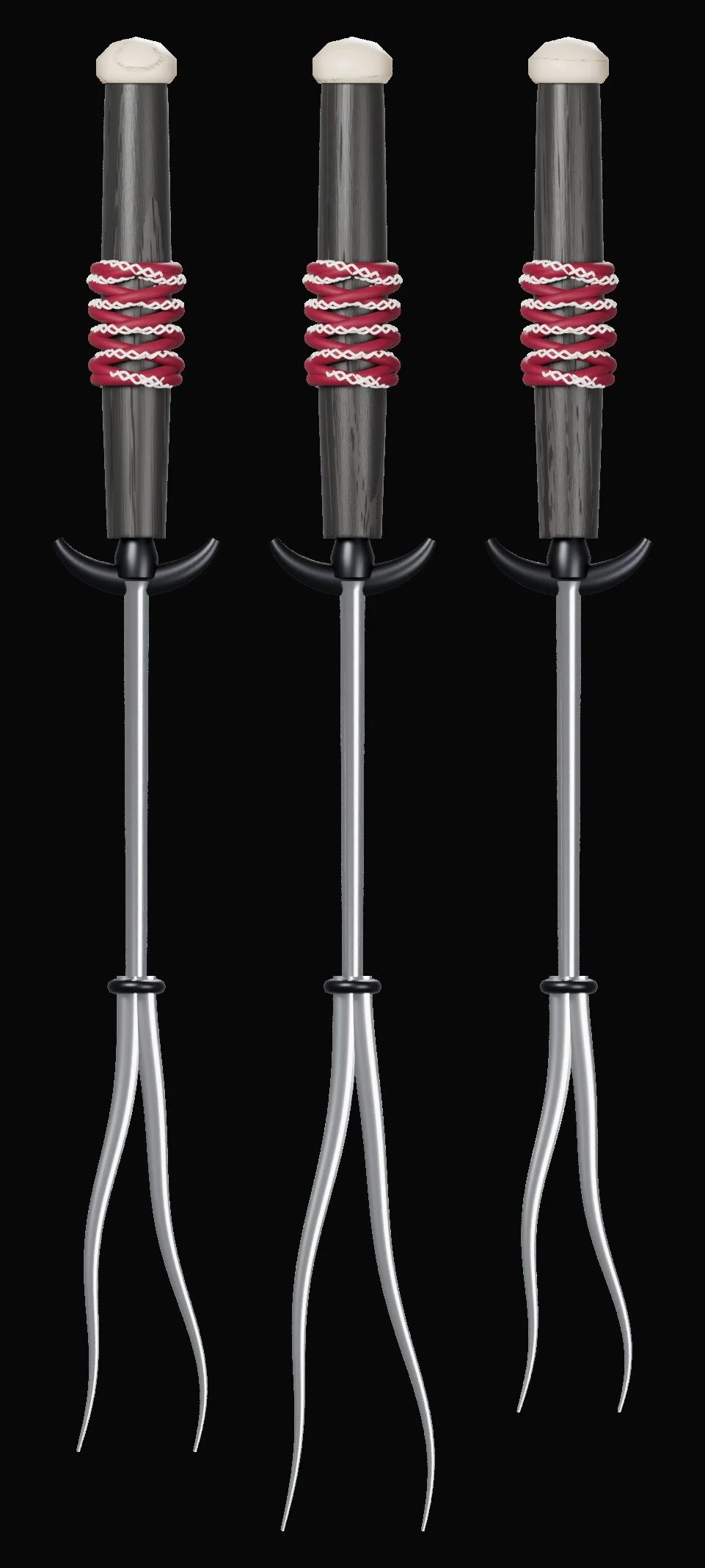
Case 04
Serpent forks


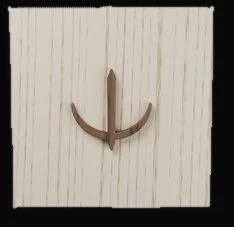
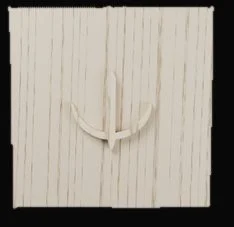
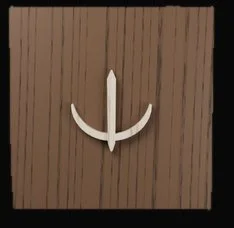
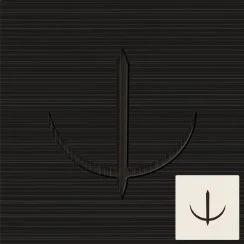
The crescent guard on its shaft.
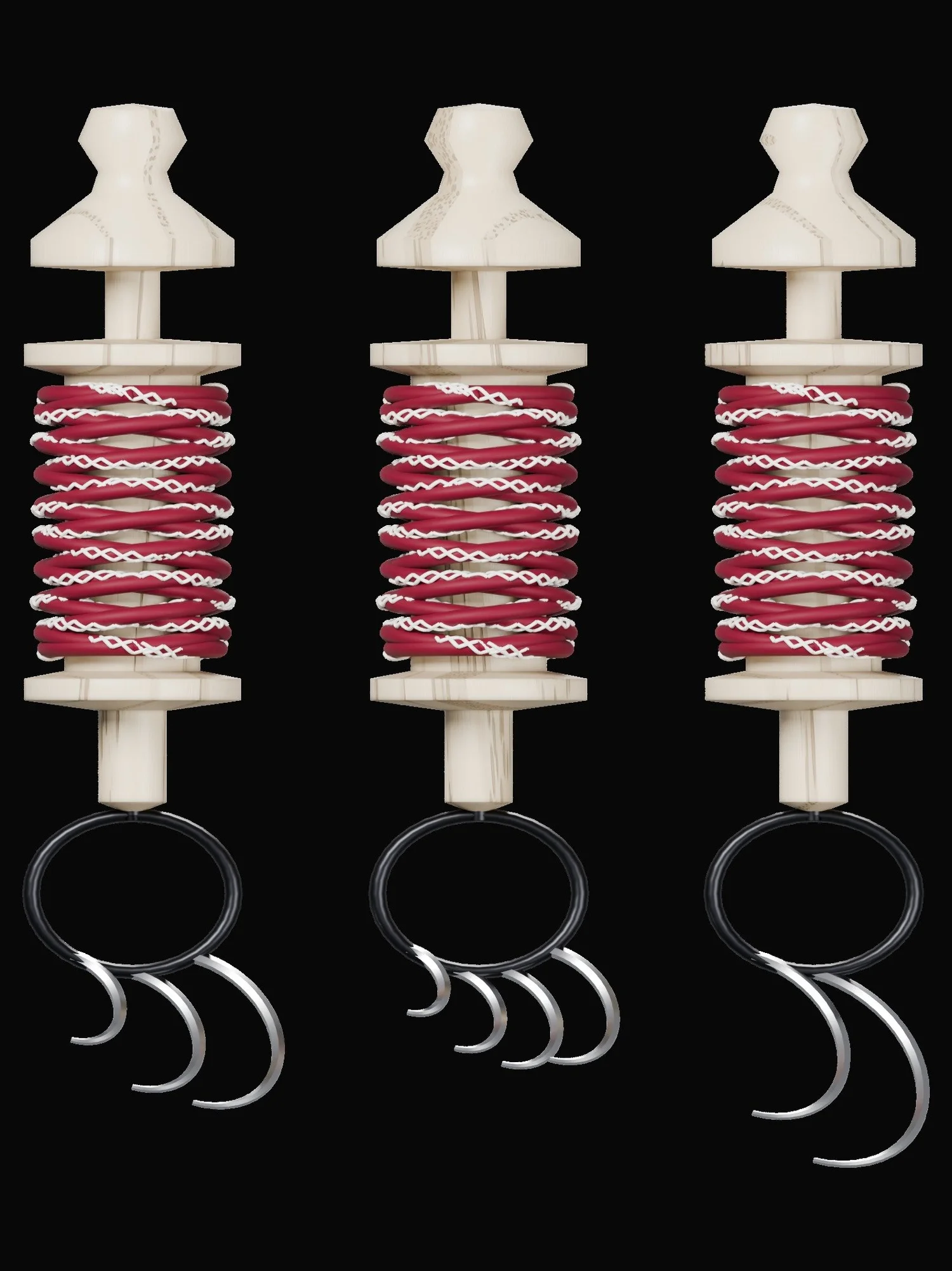
Case 05
Suture spindles


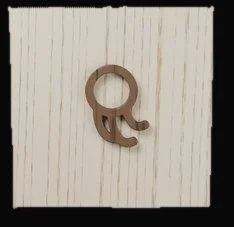
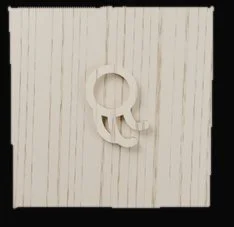
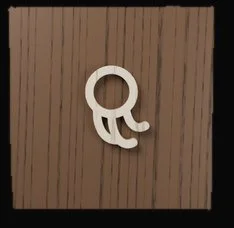
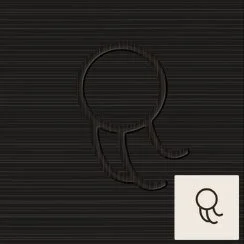
The ring with three curved needles.
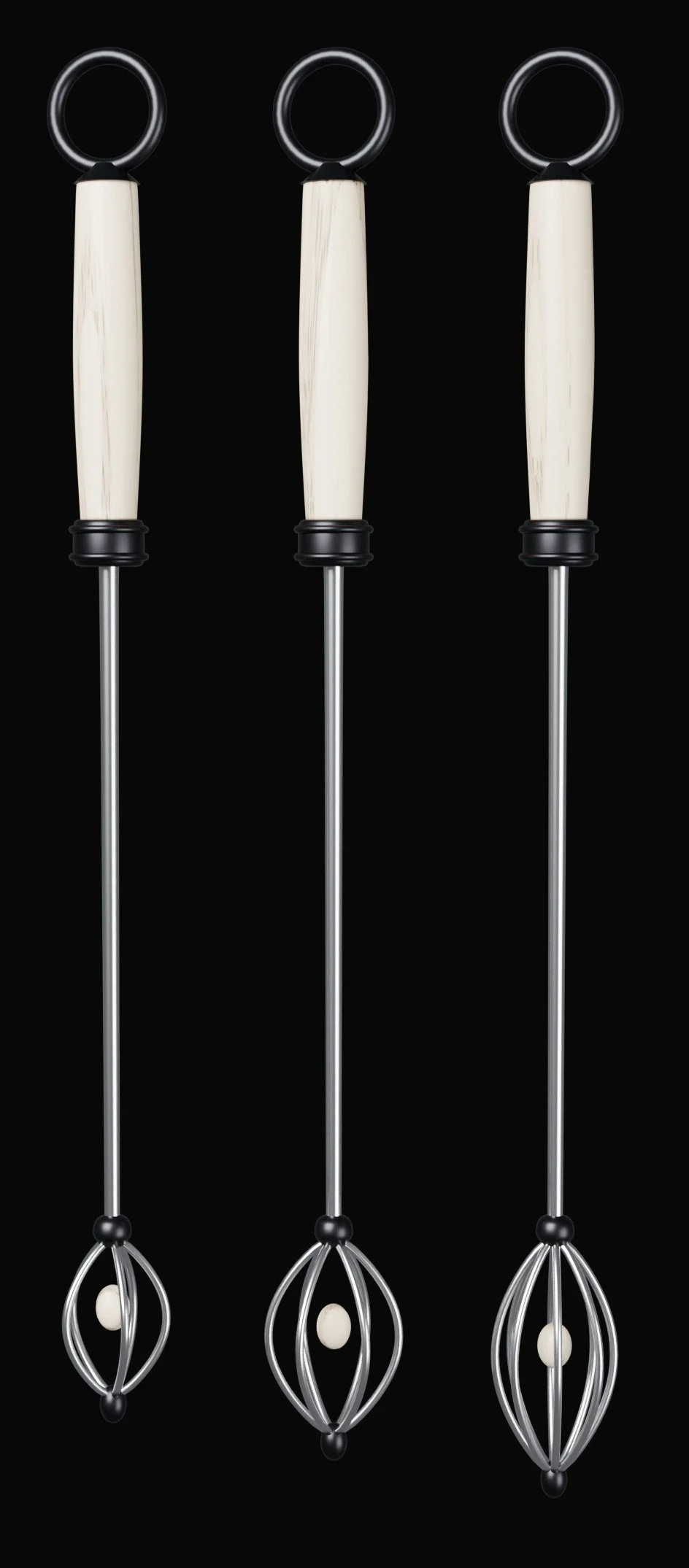
Case 06
Lantern spreaders

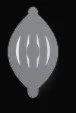
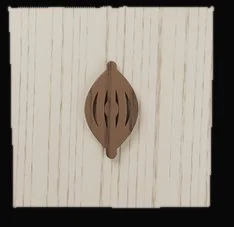
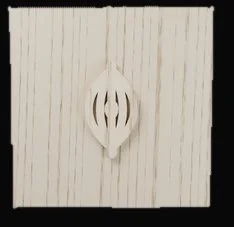
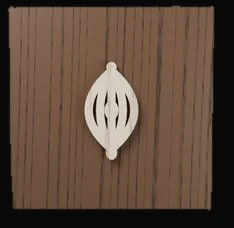

The cage as a cocoon.
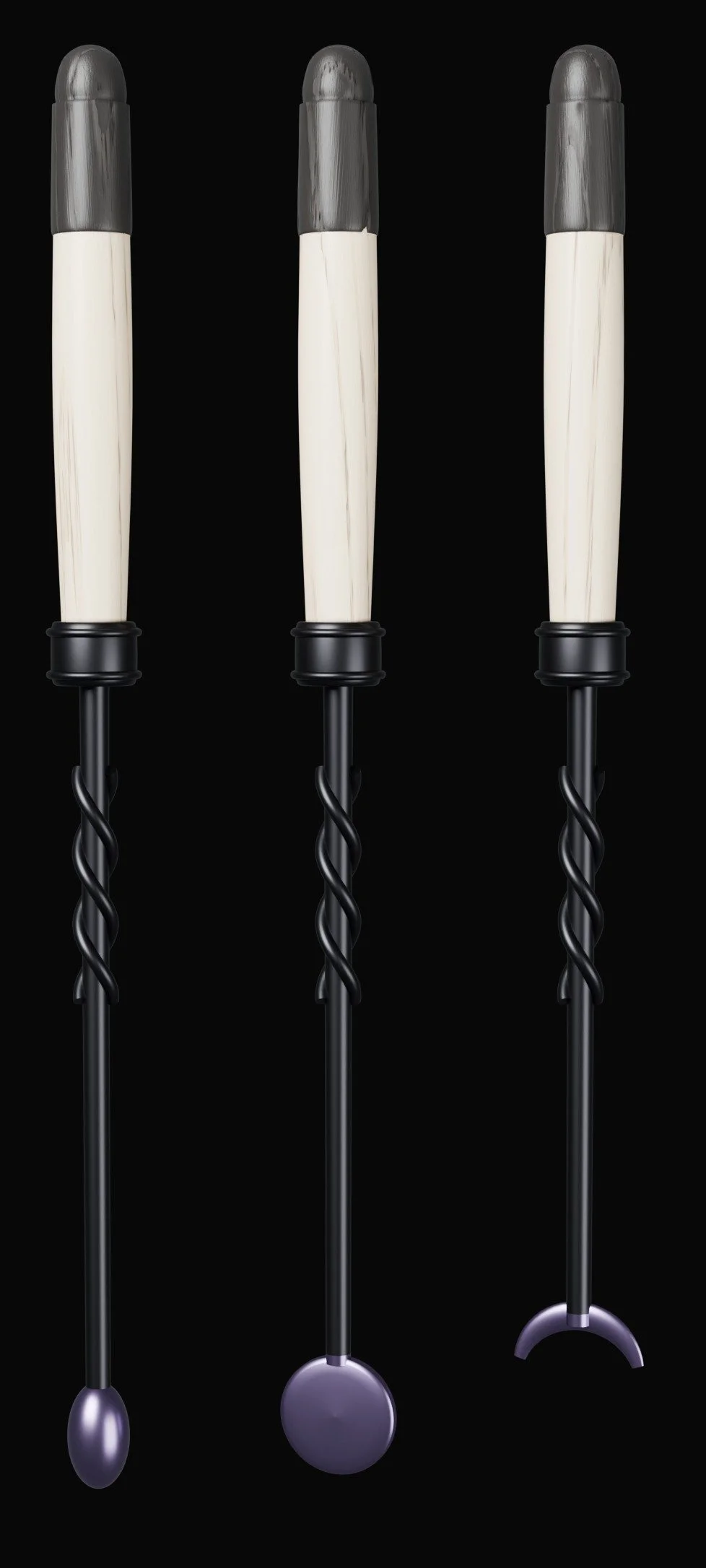
Case 07
Ember irons


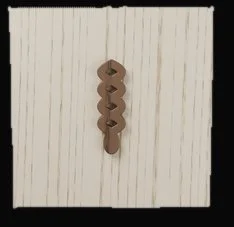
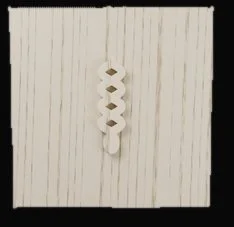
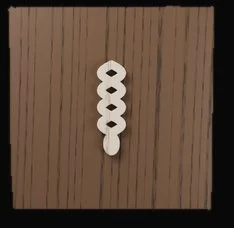
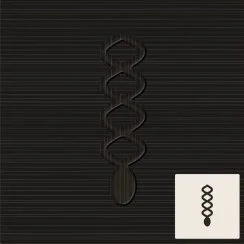
The twisted heat break and olive.
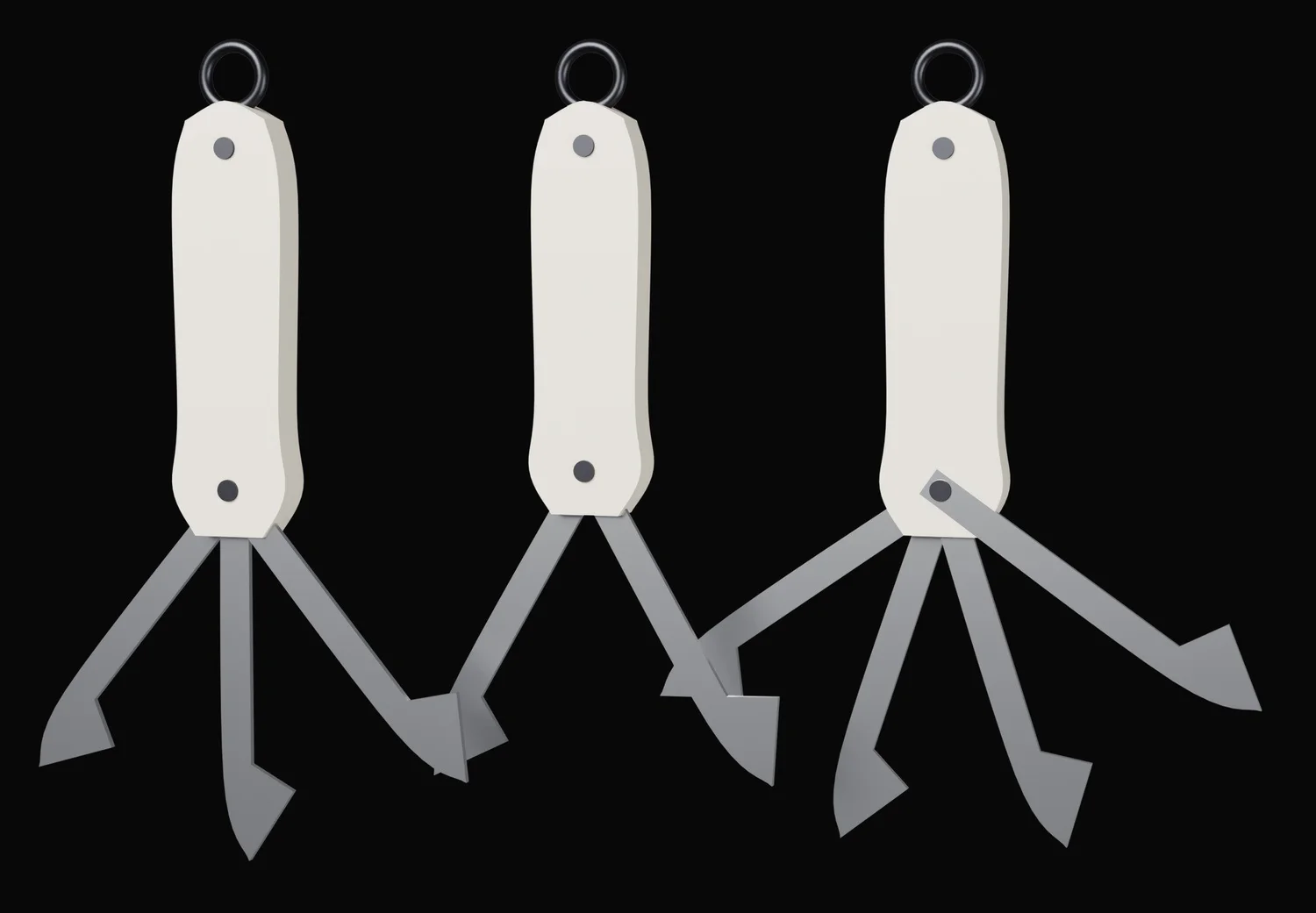
Case 08
Fleams


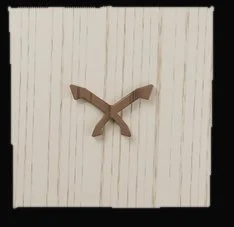
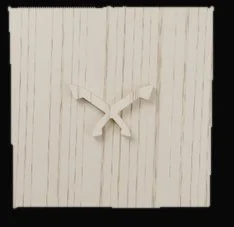
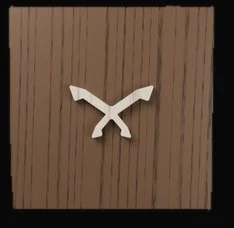
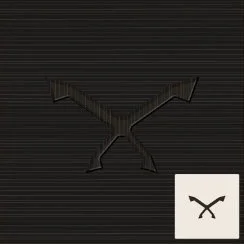
Thorn blades round the pivot.
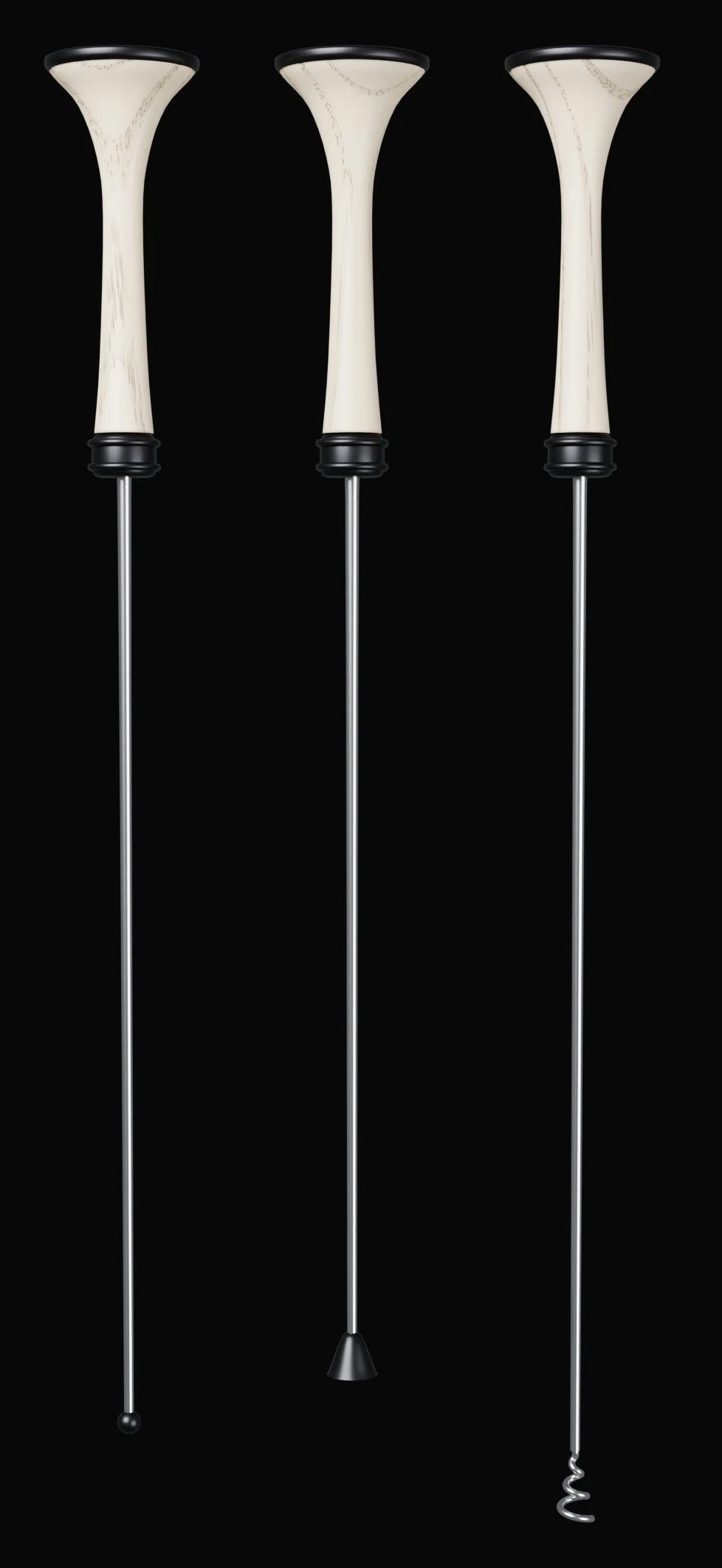
Case 09
Listening probes


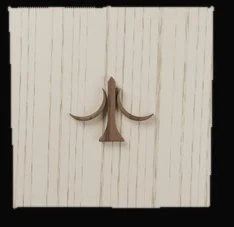
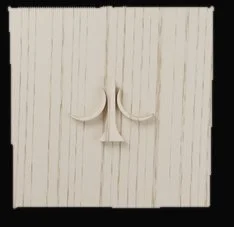
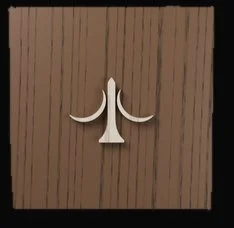
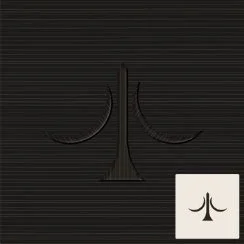
Crescent wings, ball body.
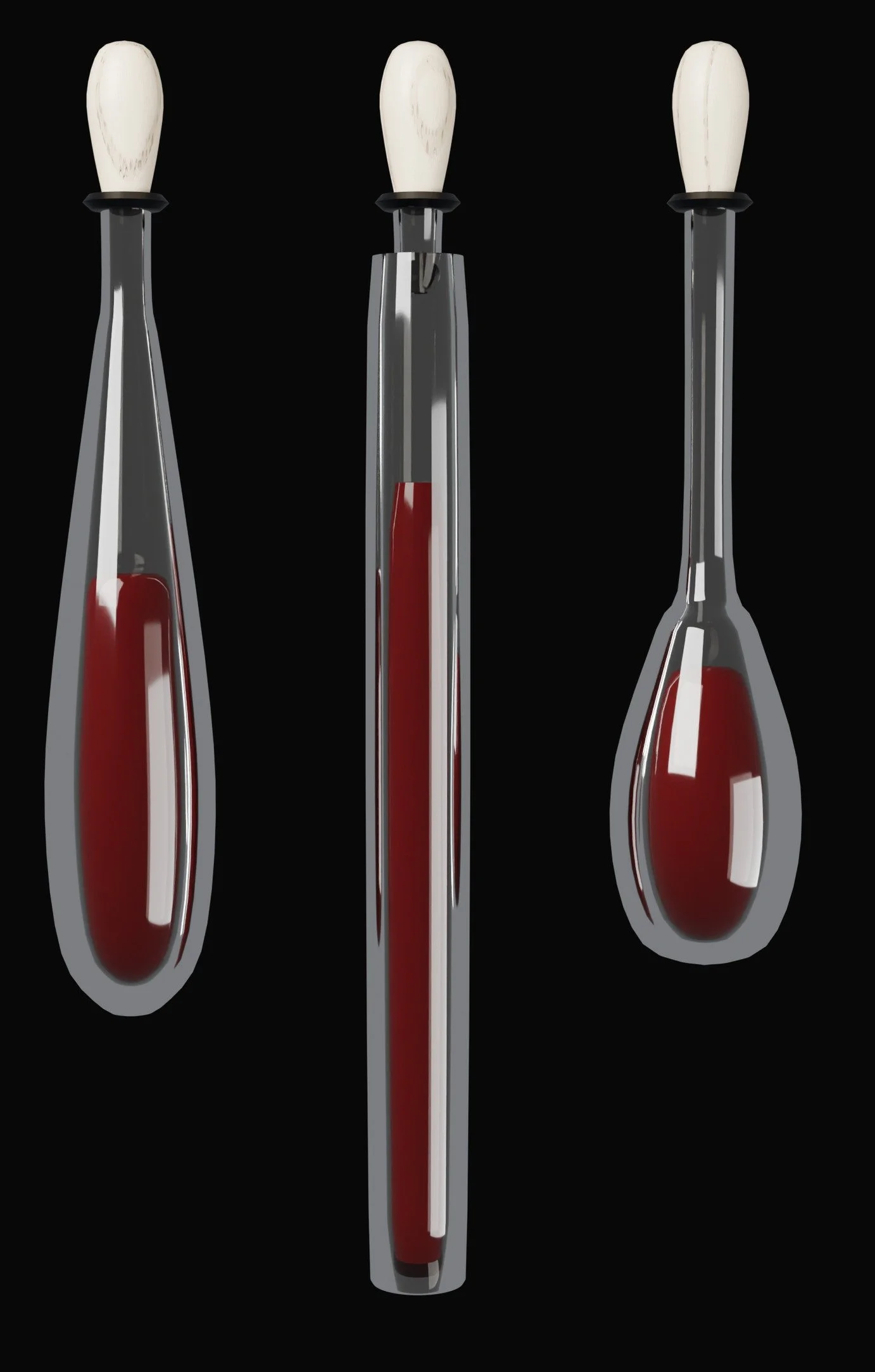
Case 10
Tincture phials


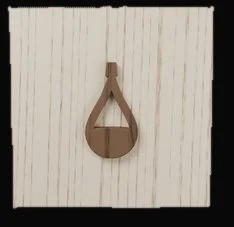
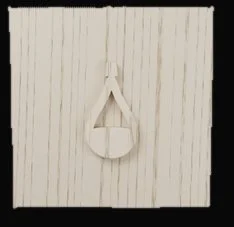
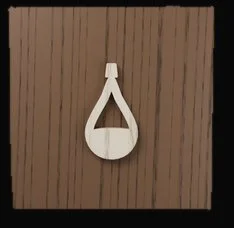
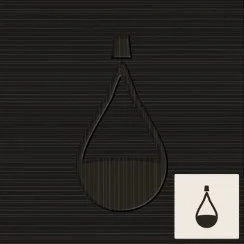
The teardrop flask, its stopper, and the tincture as the solid part.