Studio Shrine Bench
Studio Shrine Bench is a bench for two people who want to face each other. One walnut plank, two feet wide and twelve feet long, is a seat at each end and turns on its side in the middle, so between the seats it is a screen. A drum under each seat holds it up, and a half drum with a bouclé cushion is the back. Each seat turns a full circle on its drum, as Morrison's do. The seats are 23 inches off the floor.
The starting point is Jasper Morrison's bench on the terrace of the Kamado Shrine in Dazaifu, part of the shrine's juyosho by Masamichi Katayama of Wonderwall: long benches on a viewing deck, with seats that turn to face the view. I wanted that long, quiet line in walnut, with the two seats turned to face each other instead of the view.
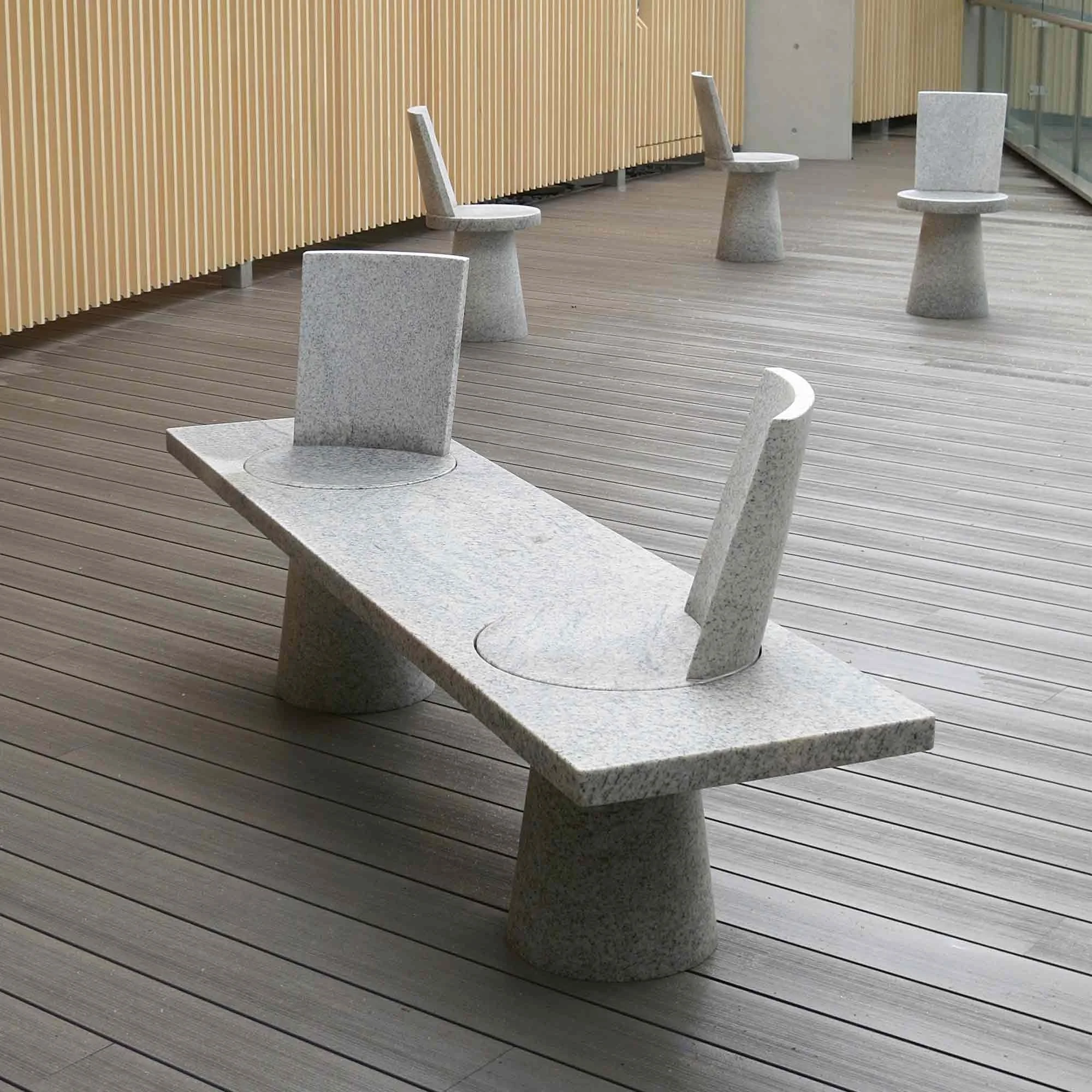
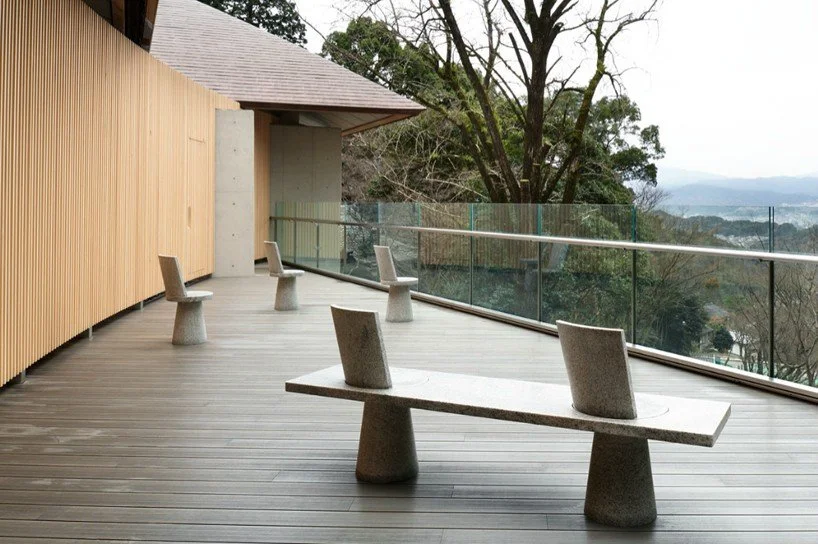
The reference. Left: Jasper Morrison, Kamado Shrine Bench, 2012. Photo: Jasper Morrison Studio. Right: the viewing deck of the Hōmangū Kamado Shrine juyosho, Dazaifu, by Masamichi Katayama / Wonderwall with Jasper Morrison, 2012. Photo: Nacása & Partners, via designboom.
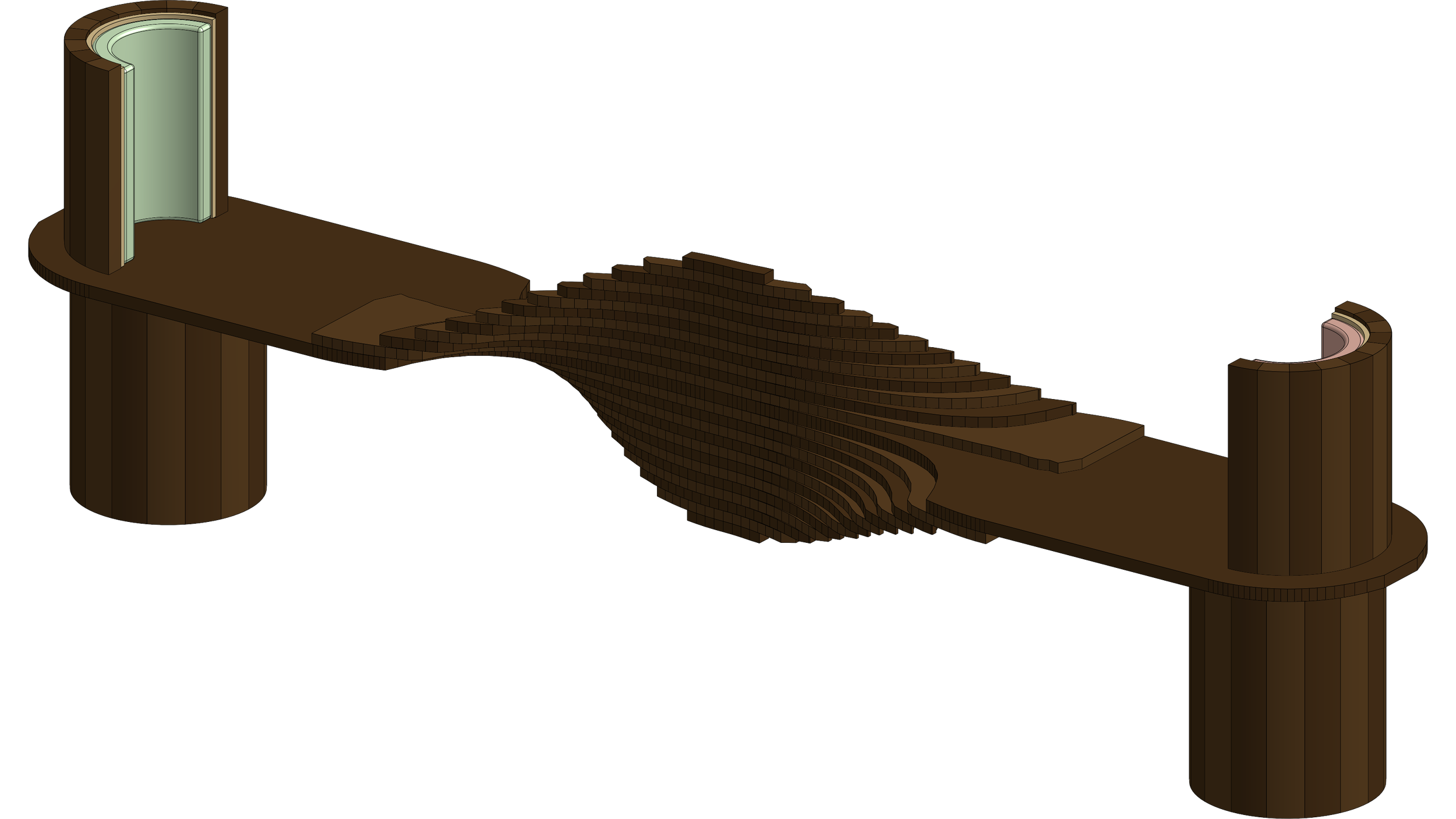
The plank
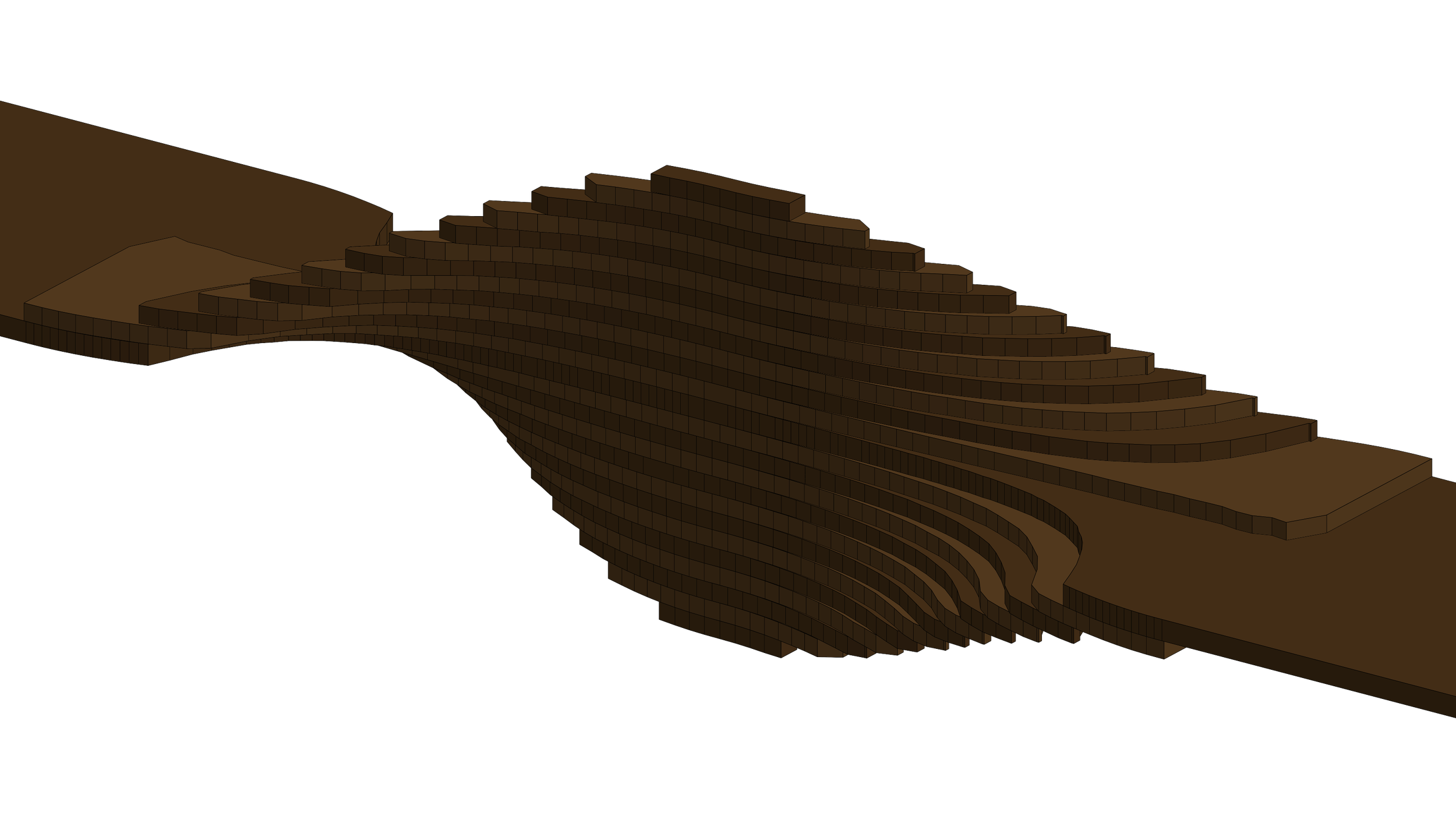
Built, not bent. The plank can't be bent. A 24-inch walnut board over an inch thick will not twist a quarter turn in three feet. So it is built up instead: boards glued in a stack, then carved. The stack is 25 horizontal layers with the grain running the length of the bench. A 6/4 board in the middle is the whole seat plank, and 12 layers of 1-inch boards sit above it and 12 below it through the twist. Each layer is cut to the shadow of the twisted plank at that height, so after the glue-up the twist is already there in steps, and power carving takes the steps off. Every glue line is face grain to face grain.
Counting up from the seat, the layers are 72 inches long by 12 wide, then 59 by 6, 53 by 4¼, 48 by 3¼, 43 by 2½, 39 by 2, 35 by 1¾, 30 by 1½, 26 by 1½, 21 by 1⅜, 16 by 1¼ and 8 by 1¼, and the same again going down. About 76 board feet rough: 37 of 6/4 and 39 of 5/4, before waste.
The drums
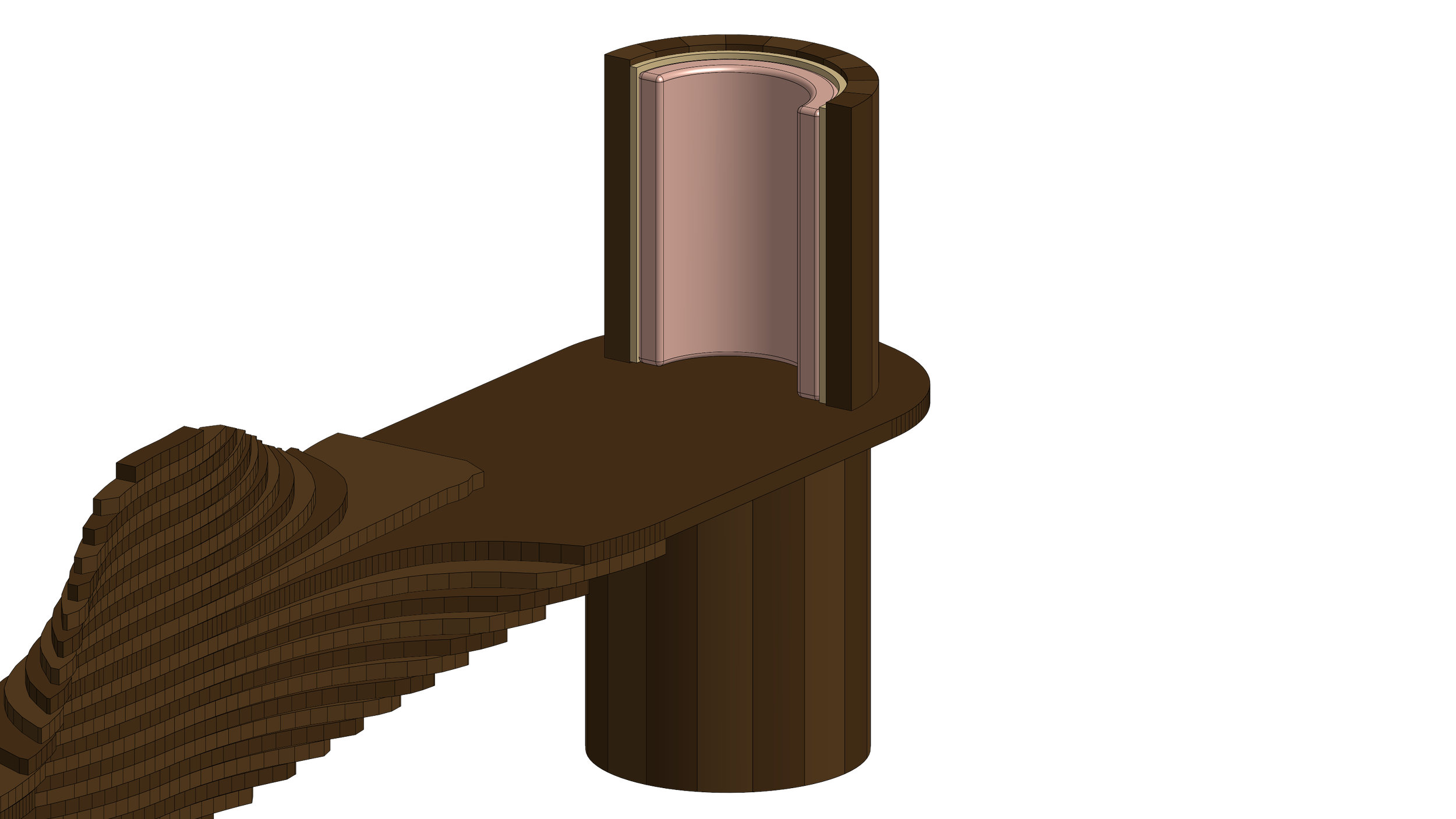
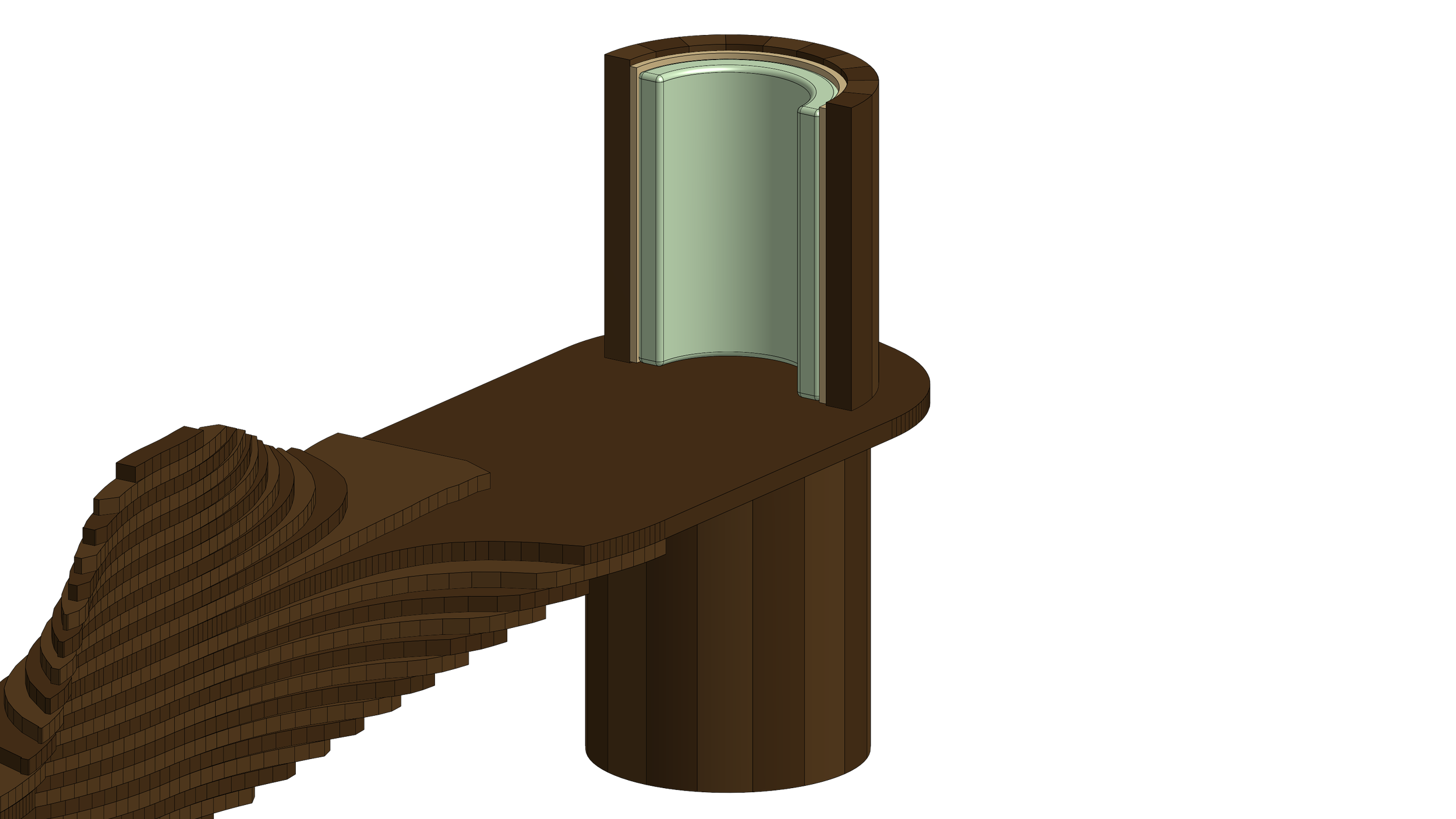
The drums. They are staved, so their grain runs up and down, against the plank. Each post is 16 staves of 8/4 walnut, each back 10, glued into a ring and carved round, with a 1¾-inch wall. Inside each post are three ¾-inch plywood buttons, one at the floor, one in the middle and one under the seat, with a cross of plywood beams under the top button and over the bottom one. The inside of each back is lined with a bent plywood panel, and the cushion sits on that panel, so nothing crosses the seat.
One joint through three parts, and a seat that turns. The joinery is mortise and tenon. Each seat is a round walnut disc, 18 inches across and 1.2 thick, let into a round hole in the plank. Every back stave ends in a ⅜-inch tenon that goes down into that disc, and the cushion is fixed to the inside of the back, so back, cushion and seat are one piece, and that piece turns a full circle on the post below it, on a ring bearing let into the post's top button. The post staves on the inside half carry ⅜ by ¾-inch tenons up into the underside of the plank. About 9 board feet of 8/4 for a back and 18 for a post, and one sheet of plywood for all four drums.
Cushions. The pink and mint pieces are the cushions: foam on the inside of each half drum, over the plywood ribs, upholstered in bouclé and fixed to the walnut back, so they turn with it.
The seat
Is the seat too flimsy? The soft spot is the flat 1.2-inch seat between the post and the start of the twist, about 15 inches of plank. Treated as a beam in black walnut, 300 pounds perched at its inner edge bends it a sixteenth of an inch at 780 psi, nine times under breaking even if you drop into it. A shove on the top of the screen twists each seat about a degree. At 1 inch it is still fine; at three quarters it starts to feel springy. The check in the shop: clamp a 24-inch offcut with 15 inches overhanging the bench and stand 200 pounds on the end. It should dip about a sixteenth.
Tools
Every piece needs its own tools. These are the ones this bench asks for, made as part of the process. Each gets its drawing and its photos here as it is made.
Micro-adjusting stop for the table saw. A stop block that creeps up on the cut line a turn of a bolt at a time, so a cut lands on a pencil line instead of near it. The first one was a maple block, a threaded rod and two brass nuts. The next one is drawn for laser-cut steel from SendCutSend. In design.
Circle-cutting jig for the table saw. The seats are 18-inch discs and the layers end in arcs. A sled with a pivot pin on a sliding carriage holds the blank and turns it past the blade, taking the circle in passes. In design.
Glue-up jig for the stack. A cradle that holds 25 layers in line while the glue sets, with the twist's outline on it so every layer lands where the model says. Laser-cut parts from SendCutSend on a plywood base. In design.
Layer templates. The outline of each of the 25 layers, printed from the model at full size and stuck to the boards for the bandsaw. From the model.
Bridge City UG-1 universal gauge. Not made here, but the measuring tool the whole build is set up from: every angle and every thickness on the jointer, the planer and the saw is read off it.
Design process
01The reference. Jasper Morrison's bench for the Kamado Shrine terrace: a long seat on a deck with a view, and seats that turn. The first model is one plank with a drum at each end and a half drum for a back.
02The twist. The plank turns a quarter turn in the middle, so it is a seat at both ends and a screen between them. In the first model it was drawn as bent wood.
03Not bent, built. A plank this wide and thick will not take that twist. The model was rebuilt as a stack lamination, carved after glue-up. The bent version stays in the file as the shape to carve to.
04The stack, by the numbers. 25 layers, grain along the bench. Each layer's outline is taken from the twisted plank itself: everything the plank passes through at that height, plus an eighth of an inch. The outlines come straight from the model, so they can be printed as templates.
05Staved drums. The first drums were bricklaid rings, with the lines running around. They are now staves, with the lines running up, so the grain stands against the plank's. Plywood buttons and beams inside keep them round and carry the seat.
06The seat turns. The first joinery locked the backs to the plank. Morrison's seats turn, and so do these: the back staves' tenons go into a round seat disc, and the disc turns on the post, and the cushion is fixed to the back, so seat, back and cushion spin a full circle as one unit. The post's inner staves still tenon up into the plank.
07Cushions. The coloured parts of the model are upholstery: foam shaped to the inside of the half drums, covered in bouclé.
08Is the seat too flimsy? Checked as a beam: a sixteenth of an inch under 300 pounds in the worst spot, nine times under breaking. Keep the plank at 1.2 inches; never under 1.
09Clean views. The first pictures were screen grabs. These are rendered straight from the model, and the reference photographs sit at the top with their credits.
10The inside of the back. The first model had two plywood shelves across the back and cushions left over from the bent-wood version, which pushed through the staves and sat in the way of anyone sitting down. The shelves are gone. The back is lined with a bent plywood panel against the staves, the cushion is built on that panel, and both ends are generated from the same rule, so the two cushions face the same way.
11Next. Animate the seat turning its full circle. Draw the tools above, then render the bench in the room.